


When Your Hotel Stay Goes Wrong: What Are Your Rights?
Your room isn't what you reserved. The shuttle isn't running. The hotel is oversold. Or you walk through the lobby and immediately wonder what you've gotten yourself into. Here's what to do before a hotel problem takes over your trip.
A confirmed hotel reservation feels pretty straightforward.
You picked the property. You selected the room. You entered your credit card. You received a confirmation.
What could go wrong?
Quite a bit, actually.
The room you reserved may not be available. An advertised amenity may be closed. The hotel may be oversold. Your “upgrade” may actually make the room less useful. Or you may arrive and discover that the property simply isn't what you expected from the listing and reviews.
Unlike airline travel, there isn't one neat federal rulebook telling every U.S. hotel exactly what it owes you whenever something goes wrong.
Some protections come from consumer law. Others may come from state law, your reservation terms or hotel and brand policies. And sometimes what you're asking for isn't really a legal “right” at all. It's a reasonable customer-service solution.
That distinction matters.
Because when something goes wrong at a hotel, the goal isn't necessarily to win an argument.
The goal is to fix your stay.
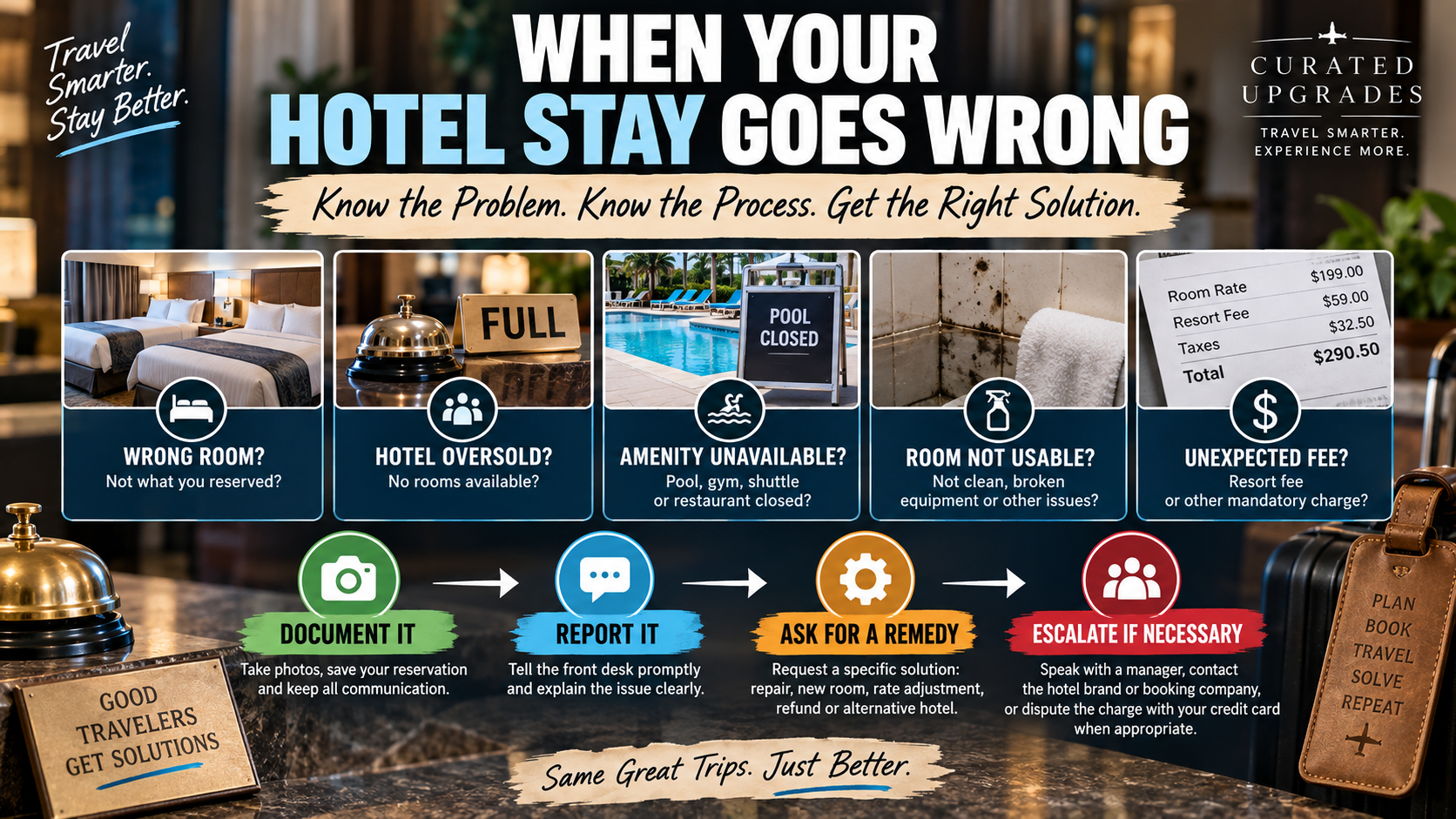
First: What Did You Actually Reserve?
Before heading to the front desk, pull up your reservation confirmation.
What room category did you book? What bed configuration? Did you pay for a particular view? Was breakfast included? Was parking included? Did the property specifically advertise an amenity that influenced your decision?
There's an important difference between:
“I hoped my room would have a bathtub.”
and:
“My reservation says I booked a room with a bathtub.”
The same goes for requests. Asking for a room near the elevator doesn't necessarily guarantee you'll receive one.
But if you reserved two queen beds and receive one king, or paid for a suite and receive a standard room, that's a different conversation.
Before asking the hotel to fix something, know exactly what you purchased.
An “Upgrade” Isn't Always an Upgrade
Hotels occasionally move guests between room categories.
Sometimes they'll solve a room-availability problem by moving you into something the hotel considers better.
Bigger room. Higher category. More expensive rate.
Sounds great.
Except an upgrade isn't much of an upgrade if it doesn't work for the people staying in it.
FROM OUR TRAVELS: PLEASE DON'T MAKE ME SLEEP WITH MY SISTER
I once booked a hotel room in Florida with two queen beds. My mother was dying, and one of my sisters was flying in to join the family. We planned to share the room, so the two beds weren't merely a preference. They were the reason I booked that room type.
I checked in that afternoon, picked up the keys and then left to get my sister from the airport. From there, we went straight to the hospital.
My mother died later that evening, with our family together in the ICU.
By the time my sister and I finally made it back to the hotel, it was after midnight.
We opened the door and found...
one king bed.
I went back to the front desk and explained that I had reserved two queens. The employee told me we'd been “upgraded” to a king room.
It had already been a very long and emotional night. I explained that the woman with me was my sister, our mother had just died, and then added:
“Please don't make me sleep with my sister.”
Somehow, we still had a sense of humor.
The employee immediately understood the problem. He apologized and moved us into a suite for the next few days at the price I had already paid.
THE LESSON: AN UPGRADE HAS TO WORK FOR THE GUEST
A hotel may consider a larger or more expensive room an upgrade.
That doesn't necessarily make it one.
If you reserved two beds because you need two beds, replacing them with one king materially changes what you booked.
But the other lesson from that night may be even more important.
We gave the hotel an opportunity to make it right.
We didn't begin by demanding a refund, compensation or loyalty points. We explained what we'd reserved and why the replacement didn't work.
The employee listened and solved the problem.
That's good hotel service.

When the Hotel Doesn't Have Your Room
Sometimes the problem isn't an upgrade. The hotel simply doesn't have what you reserved.
And sometimes it doesn't have any room at all.
Hotels commonly refer to relocating an arriving guest to another property because the hotel is oversold as “walking” the guest.
This is one place where travelers should be careful with statements such as:
“The hotel HAS to...”
There isn't one universal federal compensation rule covering every U.S. hotel and every oversold reservation. The reservation terms, applicable state law and the hotel's or brand's own policies may all matter.
That doesn't mean you should simply accept:
Sorry, we're full. Good luck.
Ask specific questions.
Can you accommodate us in another room here?
If not, are you arranging another hotel?
Who is paying any difference in the room rate?
Will you cover transportation to the replacement hotel?
If the hotel promises reimbursement, compensation or a refund, get the details in writing before you leave if possible.
When the Room Is Dirty, Broken or Unusable
Not every hotel problem requires changing properties.
Maybe the room hasn't been properly cleaned. The toilet doesn't work. The air conditioning has failed. There's no heat. Or another significant problem makes the room unsuitable.
Report it promptly.
Take photographs or video when appropriate, particularly if the condition might later be disputed.
Then give the hotel an opportunity to:
Fix the problem.
Move you to another room.
Provide another reasonable solution.
If the hotel can't correct a significant problem, the conversation about a rate adjustment, refund, relocation or escalation becomes much stronger.
What you don't want to do is quietly tolerate a fixable problem for three nights and introduce it for the first time while checking out.
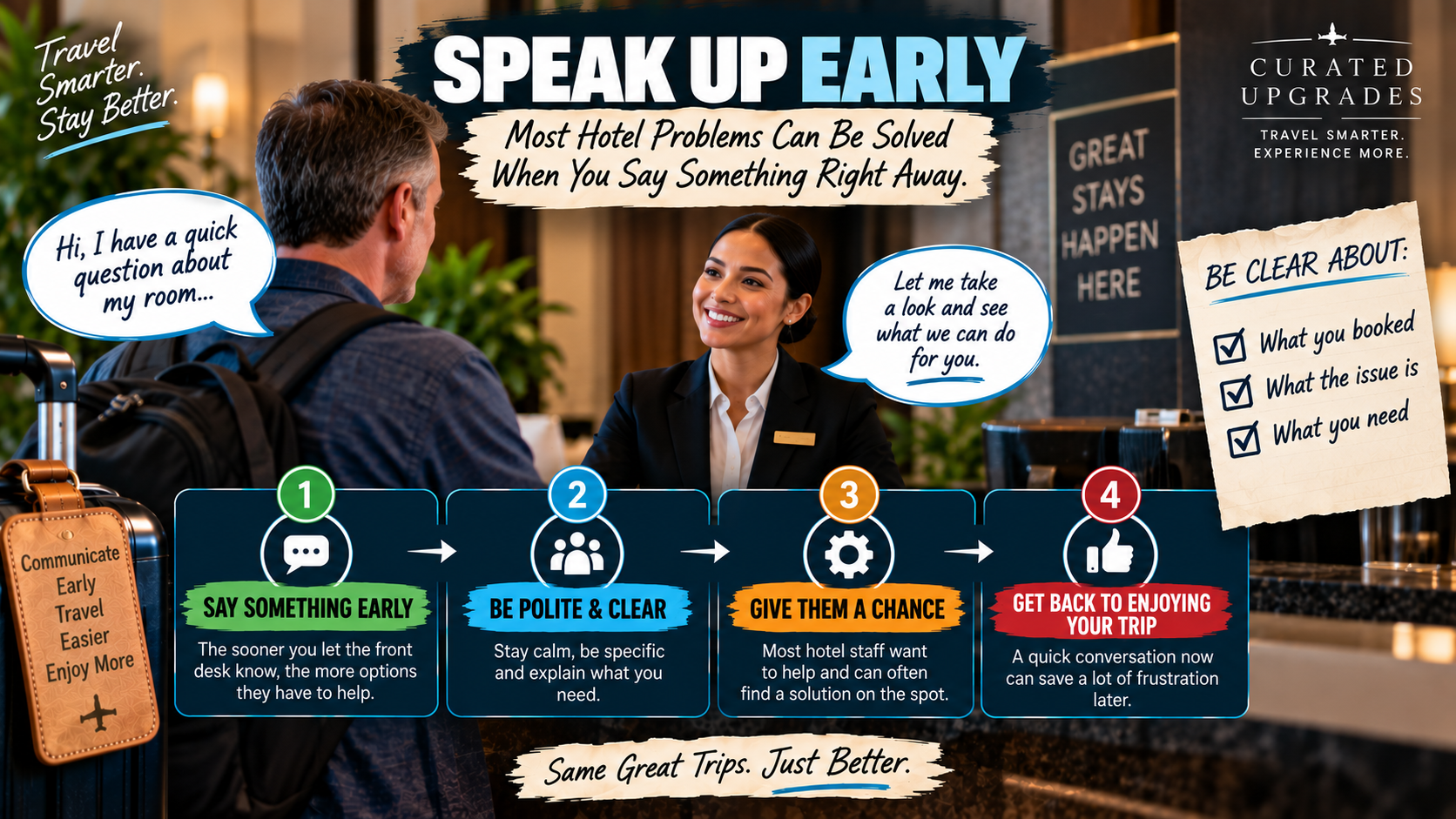
Give the Hotel a Chance to Fix It
This may be the simplest lesson in the entire article.
Say something.
And do it while the hotel can still help.
Be polite, but be specific.
Instead of:
“This room is terrible.”
Try:
“Our reservation is for two queen beds, but this room has one king. We need two beds. Can you move us to the room type we reserved?”
You're giving the employee a problem that can actually be solved.
A simple formula works surprisingly well:
What I booked → What went wrong → What I need
If the front desk can't resolve it, ask for a manager.
If the property can't resolve it, the next step may be the hotel brand or the company through which you booked.
And if someone promises to waive a charge, refund money or provide compensation, ask for written confirmation.
What If an Advertised Amenity Isn't Available?
This gets more complicated because not every amenity matters equally to every traveler.
The pool is closed.
Breakfast isn't being served.
The airport shuttle isn't running.
The EV charger doesn't work.
The restaurant is closed.
The first question I'd ask is:
How important was that amenity to your decision to book this particular hotel?
If you never intended to use the pool, its closure probably didn't materially affect your trip.
But what if you specifically chose an airport hotel because it advertised a shuttle?
That's different.
When an amenity materially influences a booking, save the listing or confirmation showing it. And if that service isn't available when you arrive, ask the hotel for a remedy that fits the actual inconvenience.
FROM OUR TRAVELS: WHEN ONE NIGHT WAS ENOUGH
On a trip to Las Vegas, we booked a hotel about a block off the Strip and within what looked like easy walking distance of Caesars Palace, where we were going to a show.
The reviews seemed decent. The location worked. And the hotel advertised an airport shuttle.
On paper, it checked the boxes.
Reality wasn't nearly as appealing.
When we arrived, the lobby was smoky, poorly lit and less than sparkling clean. It simply wasn't somewhere we wanted to spend the rest of our stay.
But it was very late.
Instead of scrambling to find another hotel in the middle of the night, we stayed.
The next morning, we checked out.
There was also a more specific problem. The hotel had advertised an airport shuttle, but when we arrived at the airport, it wasn't available. We had to take an Uber instead.
The hotel was also charging a resort fee.
When I checked out, I didn't demand that they refund the night we'd actually used. Instead, I asked the manager to waive the resort fee. We hadn't used the resort amenities, and one of the advertised services we'd expected to use hadn't been available.
The manager waived it.
Then we fixed the bigger problem ourselves.
We moved to Caesars Palace for our second night and upgraded the rest of our stay.
THE LESSON: ASK FOR A REMEDY THAT FITS THE PROBLEM
We had occupied the first hotel's room overnight.
Simply deciding that we didn't like the property didn't mean we were automatically entitled to stay for free.
But the unavailable advertised shuttle gave us a specific issue to raise with management.
We asked for a reasonable adjustment.
The hotel agreed.
And rather than spend more of our trip arguing about a hotel we no longer wanted to stay in, we moved.
Sometimes the best resolution isn't winning an argument with the hotel. It's fixing the rest of your trip.
Resort Fees: The Rules Have Changed
This is one area where travelers now have a clearer federal rule.
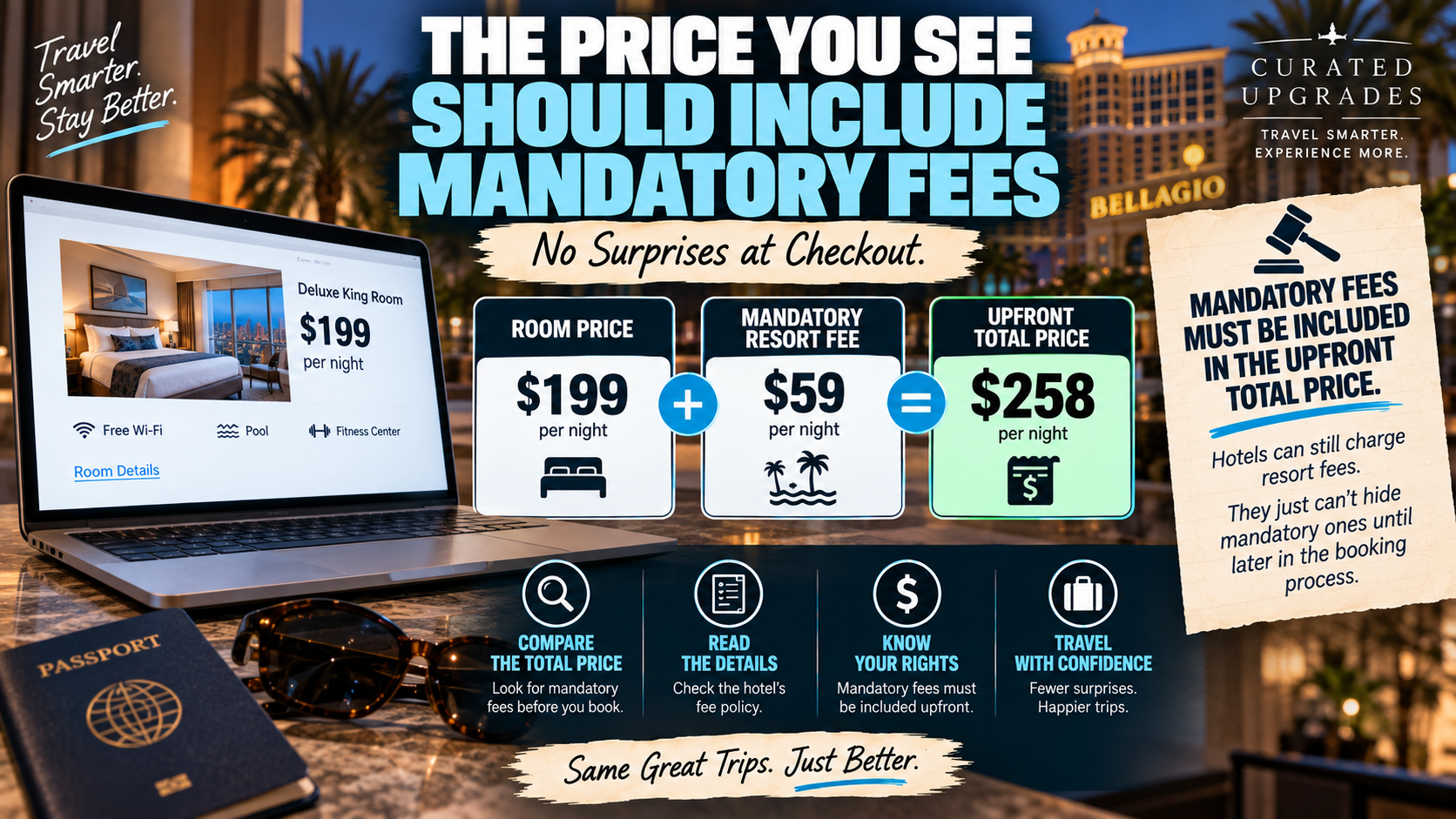
The Federal Trade Commission's Rule on Unfair or Deceptive Fees has been in effect since May 12, 2025 and covers short-term lodging, including hotels. When a business advertises a price, the most prominent price must include mandatory fees the business knows and can calculate upfront.
That means a hotel can still charge a mandatory resort or destination fee.
It just can't use that mandatory fee to make the room initially appear cheaper than the price you're actually required to pay.
For example, if a room costs $199 and carries a mandatory $59 resort fee, the upfront total price should reflect $258, rather than presenting $199 as the prominent price and revealing the required $59 later. The FTC specifically uses mandatory hotel resort fees as an example of charges that must be included in the displayed total price.
Government taxes and genuinely optional add-ons can be excluded from that initial total under the rule, although applicable excluded charges must still be disclosed before payment.
For the current details, read the FTC's Rule on Unfair or Deceptive Fees FAQ.
Booking Direct vs. Booking Through a Third Party
We're not going to tell you to always book direct.
We don't.
Sometimes an online travel agency, credit-card travel portal or other booking channel offers enough savings or rewards to make it the better value.
The important thing is understanding what else you're choosing along with the price.
You're also choosing who you may have to call when something goes wrong.
When you book directly, the hotel generally controls the reservation and you're dealing directly with the property. Depending on the rate and brand, loyalty benefits may also apply and changes can have a simpler path.
When you book through a third party, another company may control the reservation or payment. A change, cancellation or refund can sometimes require dealing with that company rather than having the hotel handle everything itself.
That isn't necessarily a reason not to book third party.
It's a reason to include the troubleshooting path in the value calculation.
The FTC gives similar advice to travelers using comparison websites and travel apps: know whether you're buying from the app company or the actual hotel because that can affect refunds, travel points and change or cancellation costs.
Price isn't the only difference. Know who you'll have to call if something goes wrong.

Ask for Something Specific
“I want compensation” doesn't give the hotel much direction.
Instead, identify what would actually solve the problem.
Wrong room?
Ask for the room category you reserved or an equivalent solution.
Broken air conditioning?
Ask for repair or another room.
Advertised shuttle unavailable?
Ask whether the hotel can provide alternative transportation or an appropriate adjustment.
Hotel oversold?
Ask whether it will arrange comparable lodging elsewhere and what costs it will cover.
Paid for something you didn't receive?
Ask for an appropriate rate adjustment or refund.
The remedy should fit the problem.
Your Credit Card Isn't Step One
A credit-card dispute can be useful when you've legitimately paid for something that wasn't provided and the merchant won't resolve the issue.
But it shouldn't normally be the opening move.
A better progression is:
Hotel staff → Manager → Hotel brand or booking company → Credit-card dispute when appropriate
Keep your reservation confirmation, photographs, correspondence and receipts.
If the dispute eventually reaches your card issuer, documentation gives you something much stronger than a recollection of what happened.
🟢 CURATED VERDICT: GIVE THE HOTEL A CHANCE TO FIX IT
Most hotel problems don't need to become battles.
Explain what happened. Show what you reserved. Ask for a specific solution.
A good hotel may surprise you with how well it handles the problem.
Our unexpected one-king “upgrade” eventually became a suite because the front-desk employee was given the opportunity to fix it.
🟡 CURATED VERDICT: KNOW WHAT YOU ACTUALLY BOUGHT
A disappointing hotel isn't automatically a refundable hotel.
Separate subjective disappointment from something the property actually promised and failed to provide.
Save your confirmation and the details of amenities that matter to you.
That gives you something concrete to point to when there's a problem.
🔴 CURATED VERDICT: DON'T SPEND YOUR VACATION FIGHTING A HOTEL
Escalate when necessary.
Document significant problems.
Ask for a reasonable adjustment when it's justified.
But remember what you're actually trying to protect:
Your trip.
Sometimes fixing tomorrow is more valuable than spending today fighting about yesterday.
The Bottom Line
Hotel problems range from mildly annoying to trip-altering.
Your best protection begins before you ever reach the front desk.
Know what you reserved. Save the confirmation. Pay attention to the amenities that matter to you. Document significant problems. Report them promptly.
Then give the hotel a reasonable opportunity to make things right.
You may have legal protections in some situations. In others, your strongest remedy may come from reservation terms, hotel policy or simply good customer service.
Knowing the difference helps you ask for the right solution instead of just the biggest one.
And when the solution isn't good enough?
Sometimes the best upgrade is checking out.
Consumer rules, hotel policies and booking terms can change. This article reflects information available as of September 2026 and is intended as general travel information, not legal advice.
COMPANION ARTICLE
Booked a vacation rental instead?