

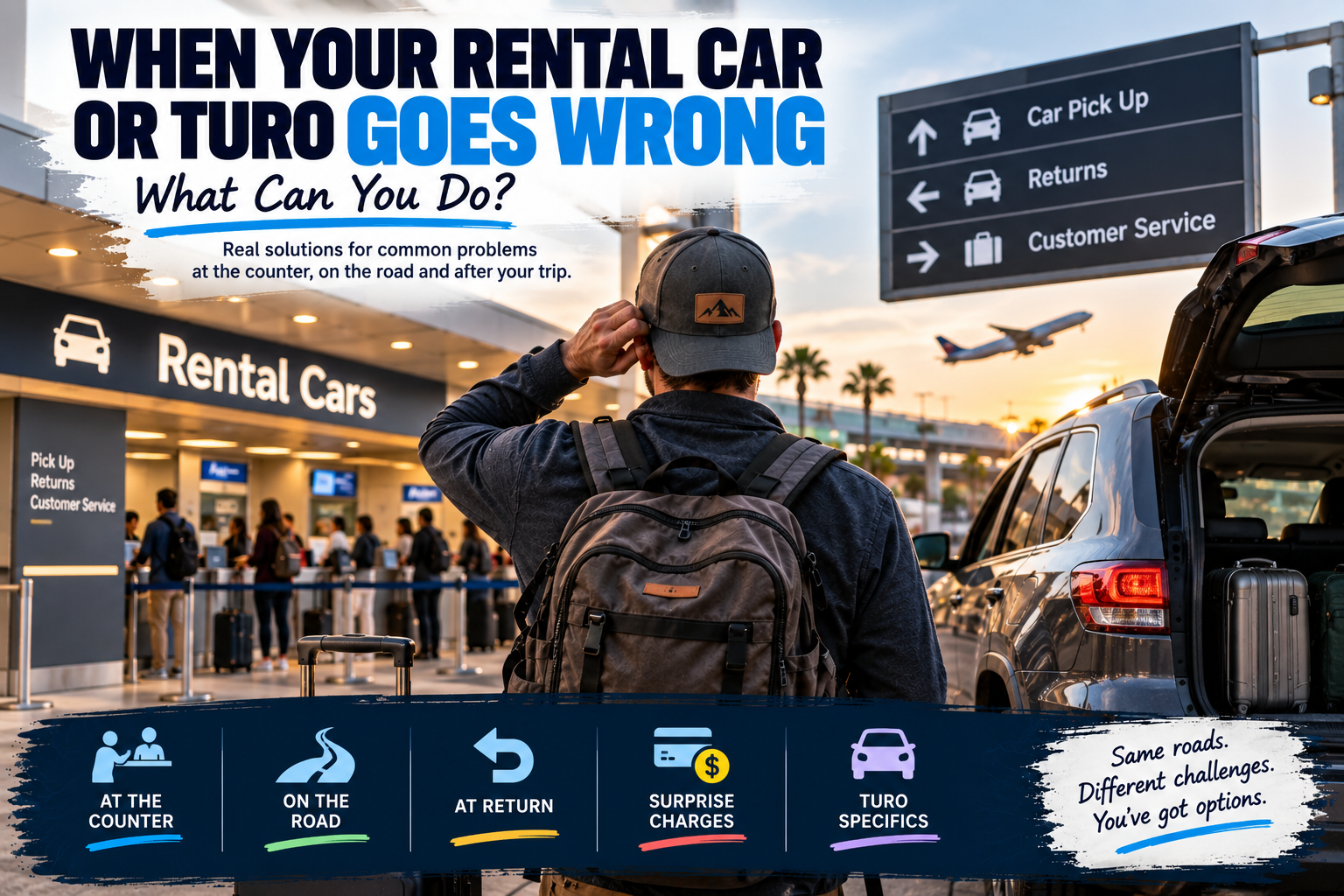
When Your Rental Car or Turo Goes Wrong: What Can You Do?
The car you reserved isn't there. Your flight is late. A warning light comes on. Or you're already home when an unexpected charge appears. Here's what to do next.
Rental cars are supposed to be the easy part.
You reserve a car, pick it up, drive it and return it.
Until the car you reserved isn't available.
Or your flight is delayed and the rental counter may close before you arrive.
Or a warning light comes on halfway through your trip.
Or you return the car without a problem and three days later there's a charge on your credit card you don't recognize.
Then what?
Unlike airline passengers, rental-car customers in the United States don't have one neat federal Rental Car Bill of Rights that tells you exactly what compensation you're owed when something goes wrong.
Your protections can come from several different places: the rental agreement, company policies, state consumer-protection laws, your insurance, credit-card benefits and, with Turo, the platform's own terms and protection plans.
That makes one distinction particularly important:
Know the difference between a right, a contract term, a company policy and good customer service.
They're not the same thing.
And when something goes wrong, the first goal usually isn't to figure out how much compensation you can demand.
It's to solve the problem without letting it wreck the rest of your trip.
Your Reserved Car Isn't There
You arrive at the rental counter and the vehicle class you reserved isn't available.
First, don't assume that automatically entitles you to a complimentary upgrade. There isn't a general federal rule requiring a rental company to give you a more expensive vehicle for free whenever your reserved class is unavailable.
But that doesn't mean you have to silently accept whatever they offer, either.
Ask what they can provide that meets the needs of the vehicle you reserved and what, if anything, it will do to your rate.
The important word there is needs.
I once reserved a 4WD Jeep in Arizona. At the counter, they offered to “upgrade” me to a minivan.
The minivan may have been considered an upgrade by the rental company's classification system.
It wasn't an upgrade for my trip.
I declined and was told I'd need to wait. When I walked into the garage, I could see plenty of Jeeps, but they belonged to another company within the same corporate family. I asked whether one of those vehicles might be an option.
About 15 minutes later, I was driving away in a Jeep.
No counter confrontation. No demands. Just:
Is there another way to solve this?
We've had the opposite experience, too. In Utah, our reserved convertible wasn't ready and we waited about 20 minutes. The agent was apologetic from the start. This was during the post-COVID staffing crunch, so we didn't make a federal case out of a short delay.
When the car arrived, he told us to return it empty.
The gas was on him.
Nice gesture. But the important part?
He put it in writing on our rental agreement.
If an employee changes your rate, fuel requirement, return instructions or anything else outside the normal terms, ask them to document it.
Being pleasant doesn't mean surrendering your rights. Sometimes reasonable people simply find reasonable solutions.

The Substitute Doesn't Work for Your Trip
There is a difference between preference and capability.
If you reserved “midsize sedan or similar,” getting a different make of midsize sedan usually isn't the same problem as reserving a vehicle because you genuinely need AWD, passenger capacity, luggage space or another capability.
We've rented 4WD vehicles in places including Curaçao, Costa Rica, Arizona and Oregon. We didn't always end up needing the four-wheel drive itself, but the added capability and ground clearance were part of why we selected the vehicle.
So if the substitute offered at the counter doesn't do what you reasonably expected from the class you reserved, explain why it doesn't work.
Don't get hung up on the badge on the grille.
Focus on what the vehicle needs to do.
Something Is Wrong With the Car
You're already on the road when a tire loses pressure, a warning light comes on, the car begins making an alarming noise or something simply doesn't feel safe.
Now the priority changes.
Safety comes first.
Get somewhere safe if you can do so safely. If you believe the vehicle is unsafe to drive, don't keep driving simply because returning it would be inconvenient.
Then contact the rental company and follow its roadside-assistance or vehicle-replacement instructions.
Don't authorize significant repairs yourself unless the company tells you to.
We've been fortunate. The closest we've come was a low tire. I stopped at a tire shop, added air and reported the problem to the rental company.
Not every problem needs a tow truck and a replacement car.
But every significant problem should be reported.
With Turo, the process is different because you're dealing with an individual host and the platform rather than a traditional rental fleet. Turo instructs guests experiencing a breakdown to contact the host and use its roadside/support process when appropriate. If the vehicle can't be made operational, Turo's support process may include towing and assistance finding another vehicle.
That doesn't make Turo inherently better or worse.
It makes the recovery system different.

Your Flight Is Delayed
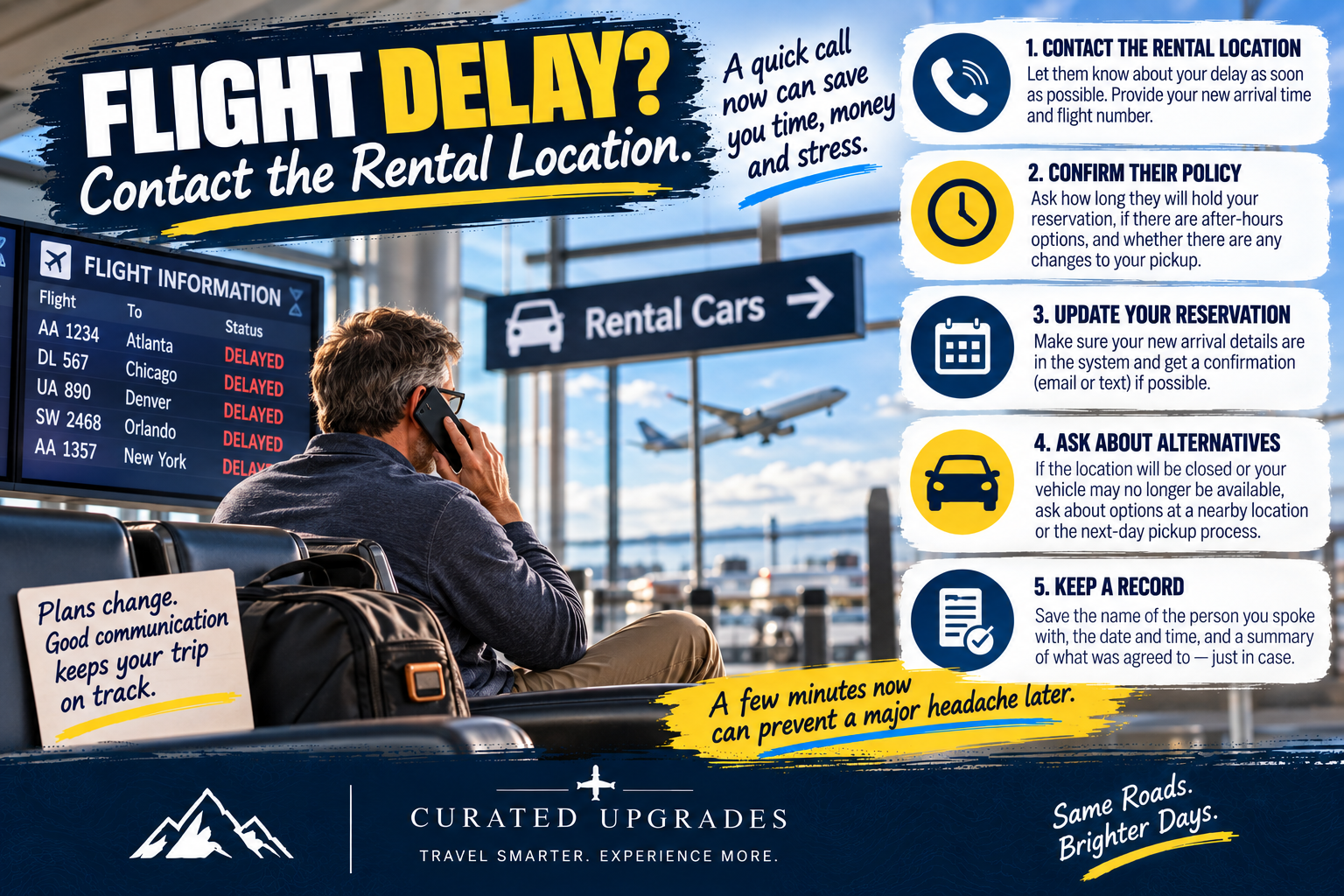
This is one of those situations where a small action can prevent a much larger problem.
Add your flight number to your rental reservation.
I routinely do this whenever I'm flying to my rental-car pickup.
But don't assume the flight number guarantees that someone will wait indefinitely for you.
If you're going to arrive substantially later than planned, contact the rental location.
On a trip to Ireland, we ended up arriving a full day later than scheduled. I called the rental company while we were still in Toronto, explained what had happened and told them when we expected to arrive.
They accommodated us.
The lesson isn't that every company will hold every car for every delayed traveler.
It's simpler:
Don't let a flight delay quietly turn you into a no-show.
Tell them what's happening.
Ask how long they'll hold the reservation, whether the location will still be open and what your options are if you arrive after hours.
And if someone makes a special arrangement for you, get confirmation when possible.
The Counter Is Selling You Something You Weren't Expecting
Insurance.
Loss Damage Waiver.
Supplemental liability.
Roadside assistance.
Prepaid fuel.
Toll package.
An upgrade.
The answer isn't automatically yes.
But it isn't automatically no, either.
The FTC specifically advises renters to understand the total cost and what their own auto insurance, credit card or other coverage may already provide. A CDW or LDW generally addresses damage to the rental vehicle. That isn't the same thing as liability protection for injuries or damage to somebody else's property.
So when an unexpected product appears at the counter:
Ask what it covers.
Ask whether it's optional.
Ask what it costs for the entire rental.
And know what protection you already have before you arrive.
The same applies to prepaid fuel.
I've heard the pitch that you should prepay because you never know whether you'll find an open gas station before returning to the airport.
Perhaps that was more compelling when Calvin Coolidge was president.
In 2026, I'm generally comfortable finding gasoline near a major airport. 😆
But prepaid fuel can still have value if you're deliberately buying convenience.
That's the question:
Are you buying something useful, or paying to solve a problem you probably don't have?
The FTC likewise notes that prepaid fuel may be convenient but can cost more than filling the tank yourself.
Before You Leave the Lot
This article is about what to do after something goes wrong.
But there's one preventive habit that's too important to leave out because it can determine what happens later.
Document the car.
I walk around it with the employee when possible.
If I see damage, I point it out and make sure it's recorded.
Then I take my own pictures.
I photograph the fuel gauge.
If mileage isn't unlimited, I photograph the odometer.
And I keep the rental paperwork until the car has been returned and the final charges have posted.
With Turo, documentation is even more central to the platform's process. Turo tells guests to take and upload pre-trip and post-trip photos documenting the vehicle's condition, including existing damage. Those photographs can be relevant to payment disputes and damage claims.
Think of those pictures as cheap insurance for your memory.
Three weeks later, you don't want to be arguing:
“I'm pretty sure that scratch was already there.”
You want a picture showing that it was.
Turo Is Similar, But It Isn't a Rental Counter
We've compared Turo against traditional rental cars several times.
So far, we've never actually booked one.
Why?
For the trips we've priced, Turo hasn't beaten the traditional rental once we've compared the complete trip cost.
But price isn't my only concern.
With a traditional rental company, you're generally dealing with a business that operates a fleet. If something happens to one car, there may be another vehicle somewhere within that company's network.
With Turo, you're booking a particular vehicle from a particular host, backed by Turo's platform rules and support.
That's a different recovery model.
Turo does require hosts to make booked vehicles available as expected and maintain them in safe, roadworthy condition. Its current rules also penalize certain host conduct, including some improper cancellations and illegitimate damage claims.
If a Turo host cancels, Turo currently allows the guest to use the canceled-trip funds to rebook a similar vehicle. If the guest doesn't rebook within 24 hours, Turo says it will issue a full refund. Last-minute cancellations can also be taken to Turo support for rebooking assistance.
And there's an important Airbnb-like rule here:
If the Turo host tells you to cancel because they can't provide the car, don't cancel for them.
Turo specifically tells guests that the host must cancel. If you cancel instead, you could incur a guest cancellation fee.
That's exactly the sort of fine-print distinction worth knowing before the problem happens.
You're Returning the Car. Don't Walk Away Yet.
The return deserves the same attention as pickup.
Before leaving, take another look around the vehicle.
Photograph it from multiple angles.
Photograph the fuel gauge.
Photograph the odometer.
If possible, get a receipt or confirmation showing that the vehicle has been returned.
This becomes particularly important with an after-hours drop.
If nobody is standing there to inspect the car with you, your photographs may be the best record of what you actually returned and when.
For Turo, follow the host's approved return instructions and complete the platform's checkout process. Turo's current policy requires the vehicle to be returned at the scheduled time and correct location, unless a change or extension has been properly arranged.

They Say You Damaged the Car
This is where your pickup and return photographs earn their keep.
Don't immediately assume the claim is fraudulent.
But don't simply accept it either.
Start with:
What damage are you claiming?
Ask for the documentation supporting the claim and compare it with your own:
Pickup photographs
Existing-damage report
Return photographs
Rental agreement
Return receipt
Messages or emails
If the damage was visible in your pickup photographs, you've got considerably more than your recollection.
Turo's system also relies heavily on photographic evidence. Its current host rules can impose a violation fee when a host submits certain damage claims without valid time-stamped pre-trip and post-trip photos, and another fee can apply to frivolous damage claims.
Documentation works both ways.
A Surprise Charge Appears After the Trip
Don't immediately hit the credit-card dispute button.
First figure out what the charge is.
I learned this one in France.
After the trip, a toll-related charge appeared that I wasn't expecting. Once I looked into it, I realized I'd driven through something I hadn't understood was a toll.
That part was my fault.
But the little toll brought friends.
There was the toll, the rental company's administration charge and other transaction-related costs.
The Fee Fi Fo Fum Fee family had arrived. 💳
Ever since then, I pay much closer attention to toll systems when driving overseas.
The FTC warns that rental-car toll programs vary significantly. Depending on the program, you might pay a daily service fee, a one-time rental-period fee or an additional service fee whenever you incur a toll.
So when a charge appears:
IDENTIFY → VERIFY → COMPARE → CHALLENGE IF NECESSARY
Find out what it is.
Compare it with your rental agreement.
If it's legitimate, pay it.
If it's wrong, contact the rental company and provide your documentation.
If you can't resolve a consumer problem with the rental company, the FTC directs consumers to their state attorney general or the FTC's fraud-reporting system as potential escalation paths.
A credit-card dispute can still be an option when appropriate, but it shouldn't substitute for first understanding what you're disputing.

The Curated Verdict
🟢 GREEN: DOCUMENT THE CAR AT BOTH ENDS
Photos at pickup and return take a few minutes and can become your strongest evidence if there's a disagreement later.
🟡 YELLOW: AN “UPGRADE” ONLY WORKS IF IT WORKS FOR YOUR TRIP
Don't obsess over whether the replacement vehicle has a higher sticker price. Ask whether it still provides the capability, space and function you booked.
🔴 RED: DON'T DRIVE AWAY WITH AN UNDOCUMENTED PROBLEM
Existing damage, incorrect fuel level, warning lights, missing equipment or an agreement that doesn't match what you were told should be addressed before you leave whenever possible.
When Something Goes Wrong, Solve the Problem in Front of You
Not every rental-car problem requires a manager.
Not every delay deserves compensation.
Not every unexpected charge is illegitimate.
And not every “upgrade” is actually an upgrade.
The best response usually starts with four things:
What went wrong?
What do I need to fix it?
What can I document?
Who needs to know?
Our experience in Utah ended with a free tank of gas because an apologetic employee and two reasonable travelers found an easy solution.
Arizona ended with the 4WD vehicle we'd actually reserved because we asked whether there was another option.
Ireland worked because we communicated before our late arrival became somebody else's no-show problem.
And France taught me that one innocent-looking toll can sprout an impressive collection of administrative offspring.
None required pounding the counter.
They required knowing what mattered, asking questions and keeping records.
Because when a rental car goes wrong, the goal isn't to win the argument at the counter.
It's to get your trip moving again.
Policies, fees, protection plans and rental agreements change. This article reflects information reviewed in September 2026. Always check the terms for your specific rental company, location, rate or Turo reservation.