


Cruise Gratuities: What Are You Already Paying, and When Should You Tip More?
Daily gratuities, prepaid tips, beverage and dining service charges, and when additional tipping makes sense.
You've booked your cruise, selected your cabin, and perhaps added a beverage package or a few specialty dining reservations.
Then you notice another charge.
Daily gratuities.
Maybe it's $17 per person. Maybe it's $20. Perhaps it's already included in your cruise package.
Once aboard, you order a cocktail and discover an automatic gratuity added to the price. Yet the receipt still has a blank line inviting you to leave another tip.
Wait a minute.
Didn't I already pay gratuities? Am I supposed to tip again?
It's a reasonable question.
Some passengers prepay their gratuities. Others prefer to handle them onboard. Some happily tip extra for exceptional service, while others wonder why they're being asked for more after paying automatic charges.
We're not going to settle the great tipping debate.
Instead, let's look at what cruise lines charge, what those charges generally cover, and when additional tipping is entirely your choice.
Because the goal isn't to tell you how much to tip.
It's to make sure you understand what you've already paid.
What Are Daily Cruise Gratuities?
Most major cruise lines charge a daily gratuity or crew service charge for each passenger.
These charges generally help compensate the people who make your cruise comfortable, including dining room staff, cabin stewards, and various behind-the-scenes hospitality employees.
The precise distribution varies by cruise line.
Some companies call them gratuities. Others use terms such as Crew Appreciation, Hotel Service Charge, or Onboard Service Charge.
Whatever the terminology, they're an important part of calculating the actual cost of your vacation.
The following graphic compares daily charges for standard accommodations across eight popular cruise lines. These amounts can change, and some lines charge different rates depending on cabin category, itinerary, age, or booking date.
For the most current information, consult the published policies for Royal Caribbean, Carnival, Norwegian, Princess, Celebrity, Holland America, MSC, and Disney Cruise Line.
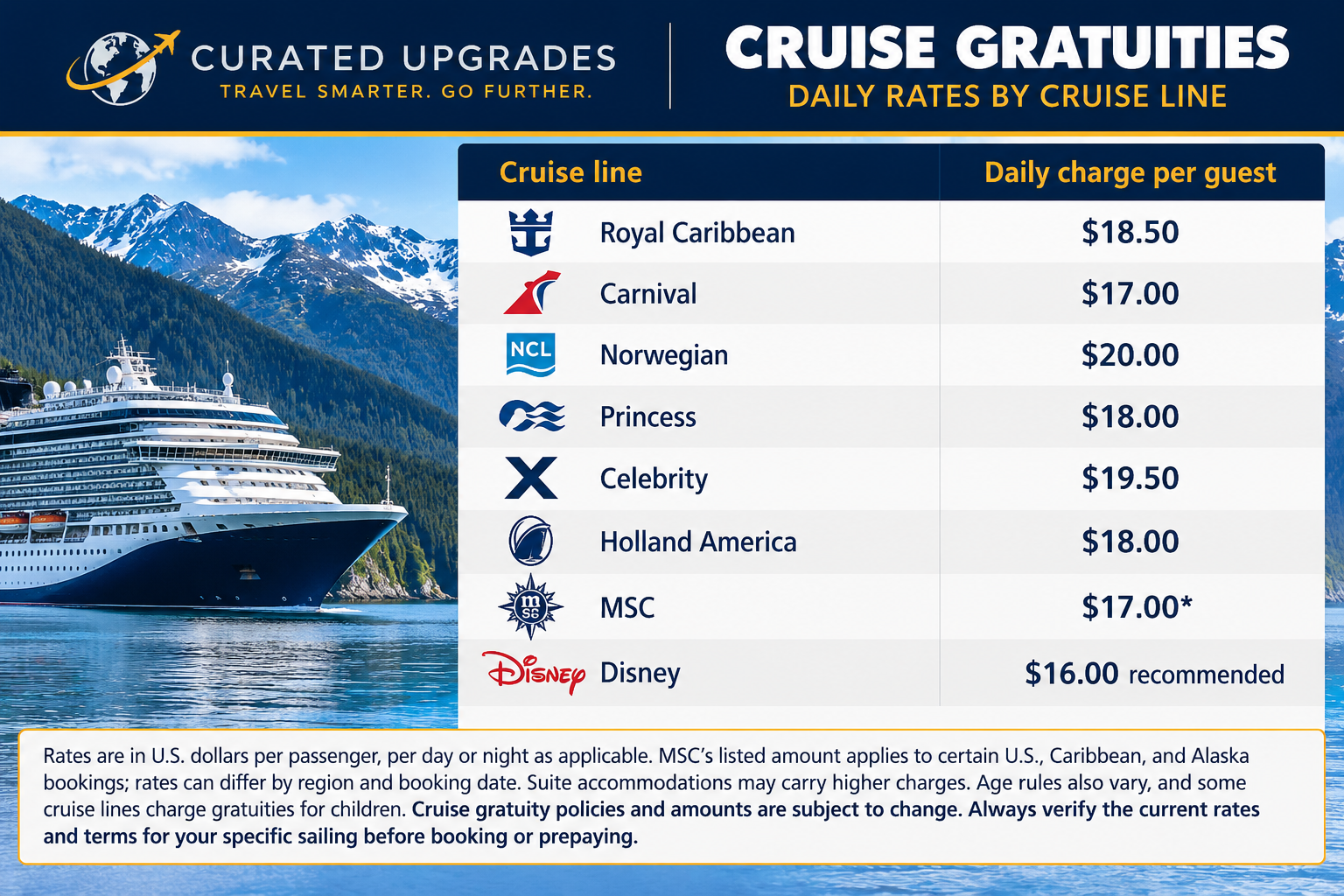
And remember, the charge is generally per person, not per cabin.
For example, at $20 per passenger per day, two adults on a seven-night cruise would pay $280 in daily gratuities, before separately charged services and optional additional tips.
That's real money, and it belongs in your vacation budget from the beginning.
But what are you getting for it?
Why I Prepay My Gratuities
I generally prepay my cruise gratuities, and personally, I consider them money well spent.
Think about the service you receive during a typical cruise.
At dinner, you might enjoy bread service, water, tea, soup, salad, appetizers, an entrée, dessert, and perhaps coffee afterward.
And occasionally, when you can't decide between two appetizers or desserts, you order both.
No judgment here.
Now consider the service.
Your waiter greets you by name, pulls out your chair, remembers your favorite drink, and knows how you like your coffee.
At a restaurant ashore, a comparable multicourse dinner could easily cost $100 or more for a couple. For that level of attentive service, I wouldn't hesitate to leave a $20 to $25 tip.
And dinner is only part of the equation.
There's breakfast and lunch, including the employees clearing tables and keeping the buffet areas clean.
Then there's your cabin steward.
Fresh towels. A clean bathroom. A made bed. Trash emptied. And depending on the cruise line and cabin category, perhaps evening turndown service.
These are things we can easily take for granted when we're on vacation.
When I consider the entire experience, a daily gratuity of around $20 per person strikes me as a bargain.
I also like having my vacation paid for before I step aboard.
Prepaying gratuities means I don't have to think about that expense when I'm enjoying my cruise.
That doesn't mean I never tip anything extra.
If someone goes above and beyond, I'll happily give them additional cash toward the end of the voyage.
That's my approach, not a rule everyone else needs to follow.
And it's worth remembering that daily gratuities are typically distributed according to the cruise line's compensation arrangements. They aren't necessarily handed directly to the waiter or cabin steward you see every day.

Prepaid Gratuities Versus Paying Onboard
Prepaying gratuities generally means paying the daily charge before your cruise instead of having it added to your onboard account during the voyage.
It doesn't automatically mean you're paying more, and it doesn't necessarily mean you're getting a discount.
For me, the benefit is simplicity.
The cruise is paid for, the gratuities are handled, and I can board without mentally adding another daily expense.
But before prepaying, check your fare or package.
Some cruise packages already include daily gratuities.
For example, Princess Plus and Princess Premier include Crew Appreciation as part of their package benefits.
If you've purchased a package that includes the daily gratuity, you shouldn't be charged that same daily amount again as a separate onboard expense.
Check your booking confirmation, package benefits, and onboard account to make sure everything matches.
Also remember that prepaid gratuities and gratuities included in a package may have different adjustment or refund rules from charges added daily to your onboard account.
That Cocktail May Already Include a Tip
Here's where passengers can become confused.
You've prepaid your daily gratuities.
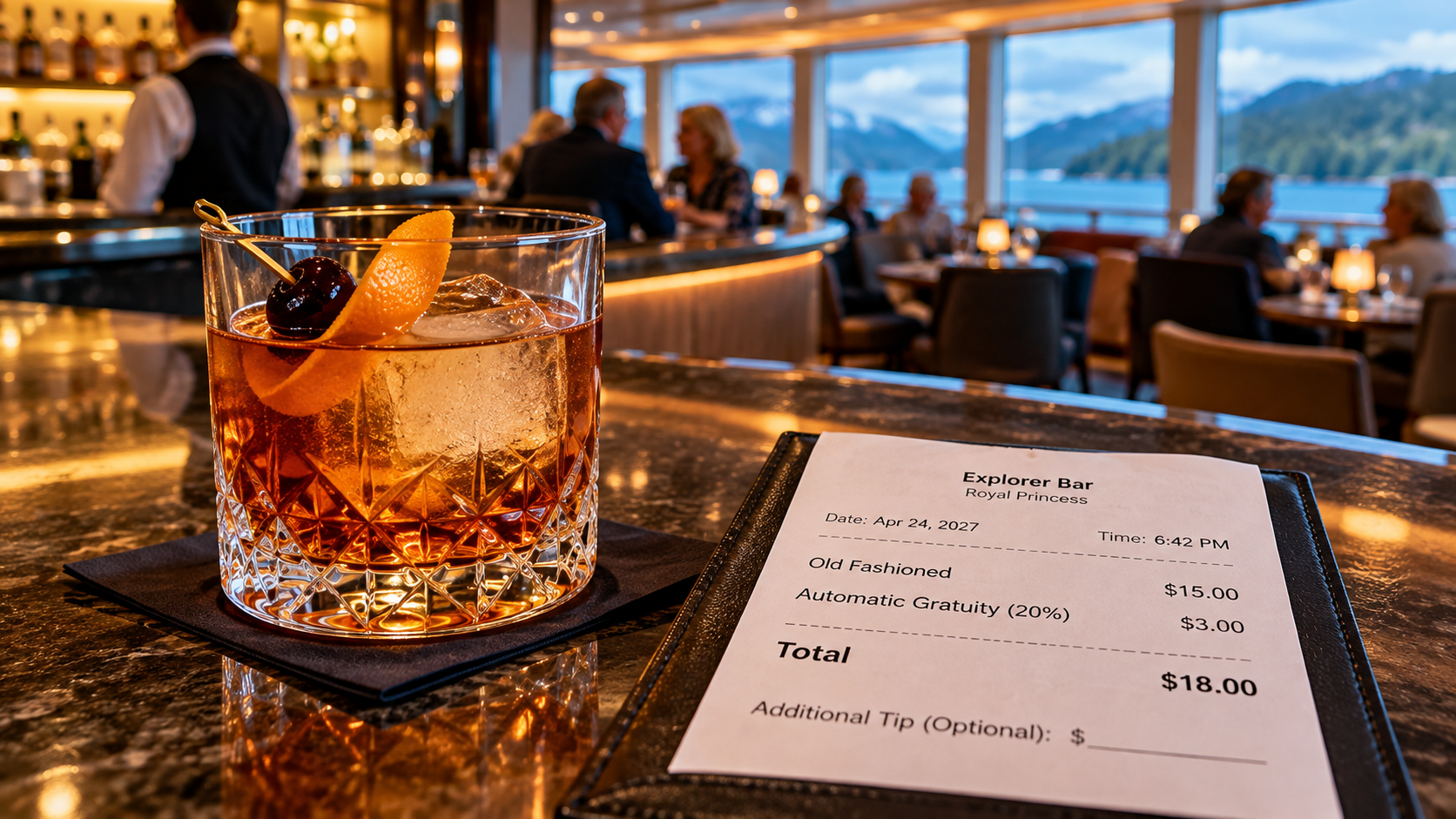
You walk up to the bar and order a $15 cocktail.
The bartender hands you a receipt showing a 20% automatic gratuity.
And below that?
A blank line labeled Additional Tip.
So what are you supposed to do?
First, understand that daily gratuities and beverage service charges are generally separate charges.
The daily gratuity helps compensate crew members across various hospitality services. The beverage charge applies specifically to the drink or package you've purchased.
And the additional tip line?
That's generally optional.
Let's look at that $15 cocktail.
A 20% automatic gratuity adds $3, bringing the total to $18.
If you leave another $3, you've paid $6 in gratuities on that drink, or 40% of its original price.
There's nothing wrong with that if it's what you intended.
But there's a difference between choosing to tip 40% and accidentally tipping 40% because you didn't notice the first charge.
And that's our point.
Before adding another tip, check the receipt.
Beverage Packages and Specialty Dining: Know the Final Price
A beverage package or specialty dining reservation may look like a good deal until you discover additional service charges or gratuities.
For example, that $50 specialty dinner might already include the service charge, or the cruise line might add another percentage at checkout.
The same principle applies to beverage packages.
Before purchasing, check what's included and what the final charge will be.
Is the gratuity already included? Will an additional service charge be added? Is there an optional tip beyond that?
The important number isn't always the advertised price. It's the total you'll actually pay.
Once you understand that number, you can decide whether the experience is worth it.
An informed decision beats an unexpected charge every time.
When Should You Tip More?
This is where personal preference comes in.
I don't believe passengers need to hand someone cash every time they receive routine service. That's one reason I prepay my daily gratuities.
But exceptional service is different.
Maybe your cabin steward goes out of the way to accommodate a special request.
Perhaps a waiter remembers your preferences throughout the voyage, handles an unexpected problem beautifully, or makes a special occasion even more memorable.
Or a bartender consistently provides outstanding service.
For me, those are good reasons to recognize someone with a little additional cash.
It's appreciation, not an obligation.
I generally prefer to give extra cash toward the end of the cruise, when I've had an opportunity to appreciate the service over several days.
I also bring cash for the luggage porters at embarkation.
Those porters may be shoreside workers rather than members of the ship's hospitality crew, so don't assume your onboard gratuities cover them.
The same consideration applies to independent tour guides, drivers, and other people providing services ashore.
Local tipping customs vary, and it's worth understanding them before you travel.

The People Behind the Gratuities
I've spent much of my professional life working around ships and international crews, and that experience has influenced how I view gratuities.
Many of the people serving you aboard cruise ships come from countries where employment overseas offers economic opportunities that may be difficult to find at home.
They're often away from their families for months at a time.
Some send a substantial portion of their earnings home to support spouses, children, parents, and extended family.
Shipboard accommodations and meals are generally provided, but that doesn't mean personal expenses disappear.
Consider a crew member enjoying a few hours ashore.
That $15 frozen drink at the beach costs them the same $15 it costs me.
But depending on their earnings and circumstances, that purchase may represent a very different financial decision.
I don't mention this because I believe passengers should feel guilty or obligated to tip beyond their means.
I mention it because I think understanding the people who make our vacations possible matters.
And I also recognize that cruise lines have responsibilities as employers. Crew compensation is ultimately an employment matter, not something passengers should be expected to solve through voluntary tipping.
For me, understanding the people behind the service makes it easier to appreciate what they do.
It also reinforces a principle we've discussed in When Dining Out, Your Server Is Not Your Servant.
Respect doesn't have to be expensive.
And generosity doesn't have to be performative.

What If the Service Is Poor?
I haven't personally experienced service aboard a cruise that made me feel I needed to remove my gratuities.
But that doesn't mean poor service should be ignored.
If my cabin were consistently unclean or a server repeatedly provided poor service, I'd bring it to management's attention.
I'd explain the problem, give the staff an opportunity to correct it, and follow up if necessary.
That's important because daily gratuities may support numerous employees, including people working behind the scenes who had nothing to do with the problem.
Removing a pooled charge in response to one employee's performance may affect more than the individual you're unhappy with.
That doesn't mean passengers have no recourse.
Some cruise lines allow adjustments to daily gratuities during the voyage. Others have specific rules governing prepaid gratuities or service charges included in a package.
If you have a legitimate service concern, address it while you're still aboard.
Waiting until you've disembarked can make resolution considerably more difficult, and some adjustment opportunities expire before the cruise ends.
Ultimately, it's your money and your decision, within the cruise line's published terms.
But I'd rather give management an opportunity to fix a problem than immediately assume the only solution is withholding gratuities.
The Curated Upgrades Take
Cruise gratuities shouldn't be a mystery, and they shouldn't turn every vacation conversation into an argument.
Here's how we'd approach them.
🟢 Go for it! Prepay your daily gratuities if you appreciate having expenses settled before sailing. Check whether they're already included in your fare, and recognize exceptional service with additional cash when you choose.
🟡 Maybe. Adding another tip to a bar, specialty dining, or spa receipt. Look for the automatic service charge first, then decide whether the service deserves something extra.
🔴 Pass on it. Paying gratuities twice simply because you didn't understand the package or receipt, or waiting until the end of the cruise to raise a service problem that could have been addressed earlier.
I consider prepaid gratuities a worthwhile part of my cruise vacation.
Other passengers may approach them differently, and that's their choice.
What matters is understanding the charges, knowing which services are already covered, and recognizing that an optional tip is exactly that: optional.
You don't have to tip twice to be generous. And you don't have to feel guilty about paying what you've already agreed to pay.
Know what you're paying. Appreciate good service. Address problems fairly.
Travel Smarter. See More.