

Your Luggage Was Damaged: Who Pays for It?
Airline baggage claim or cruise terminal handoff, here’s what to do when your suitcase arrives broken, torn, crushed or missing pieces.
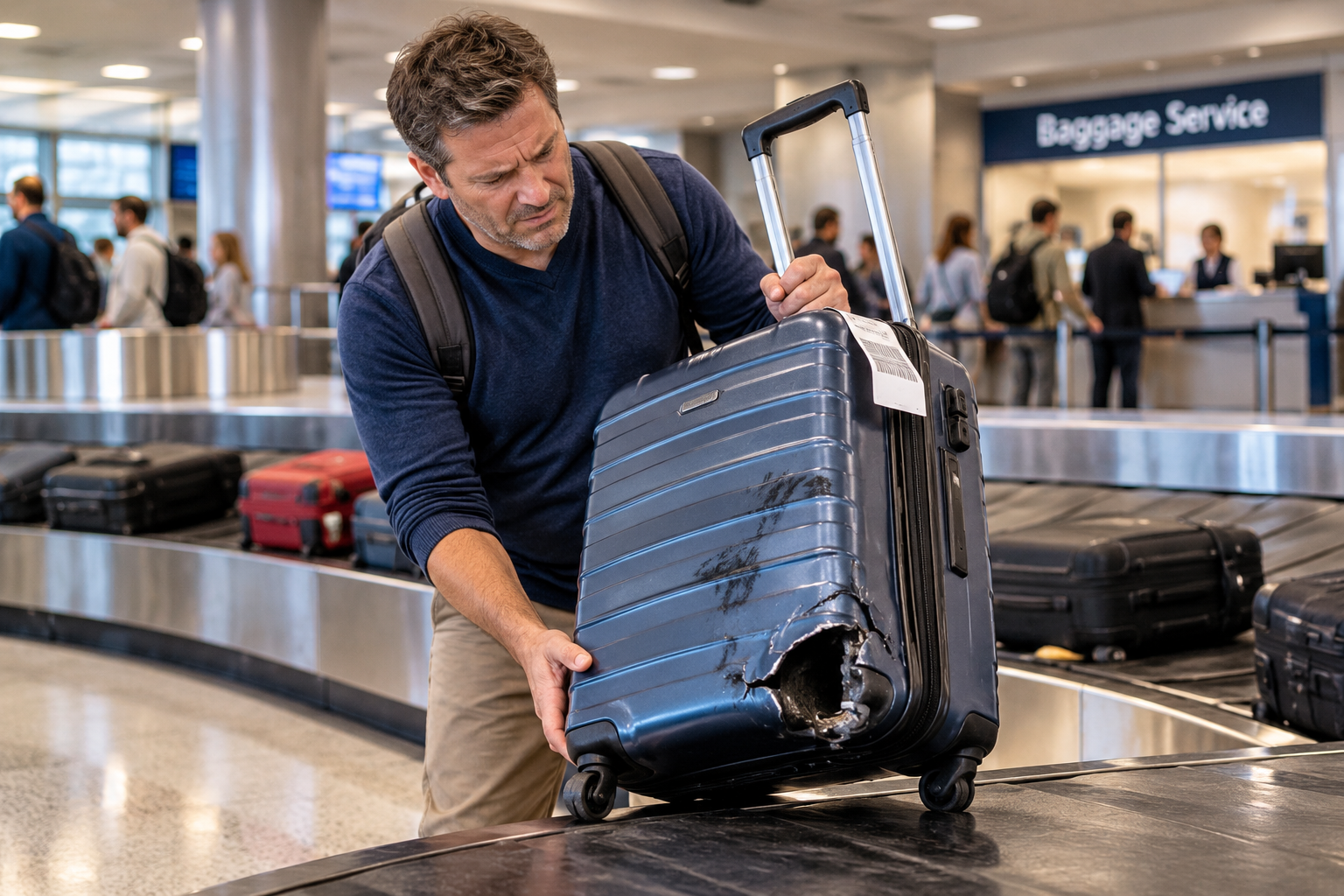
Your suitcase finally appears on the baggage carousel.
Except one wheel is gone.
The handle is bent. There’s a new crack in the shell. And judging by the black streak across the side, your bag may have spent part of the trip underneath the airplane instead of inside it.
Now what?
First:
Don’t leave.
Whether you’re standing at an airport baggage carousel or staring at a battered suitcase outside your cruise cabin, don’t decide you’ll deal with it tomorrow.
Document the damage. Check the contents. Report it. Get a claim or incident number.
Then we can figure out who owes what.
Before You Leave, Report It
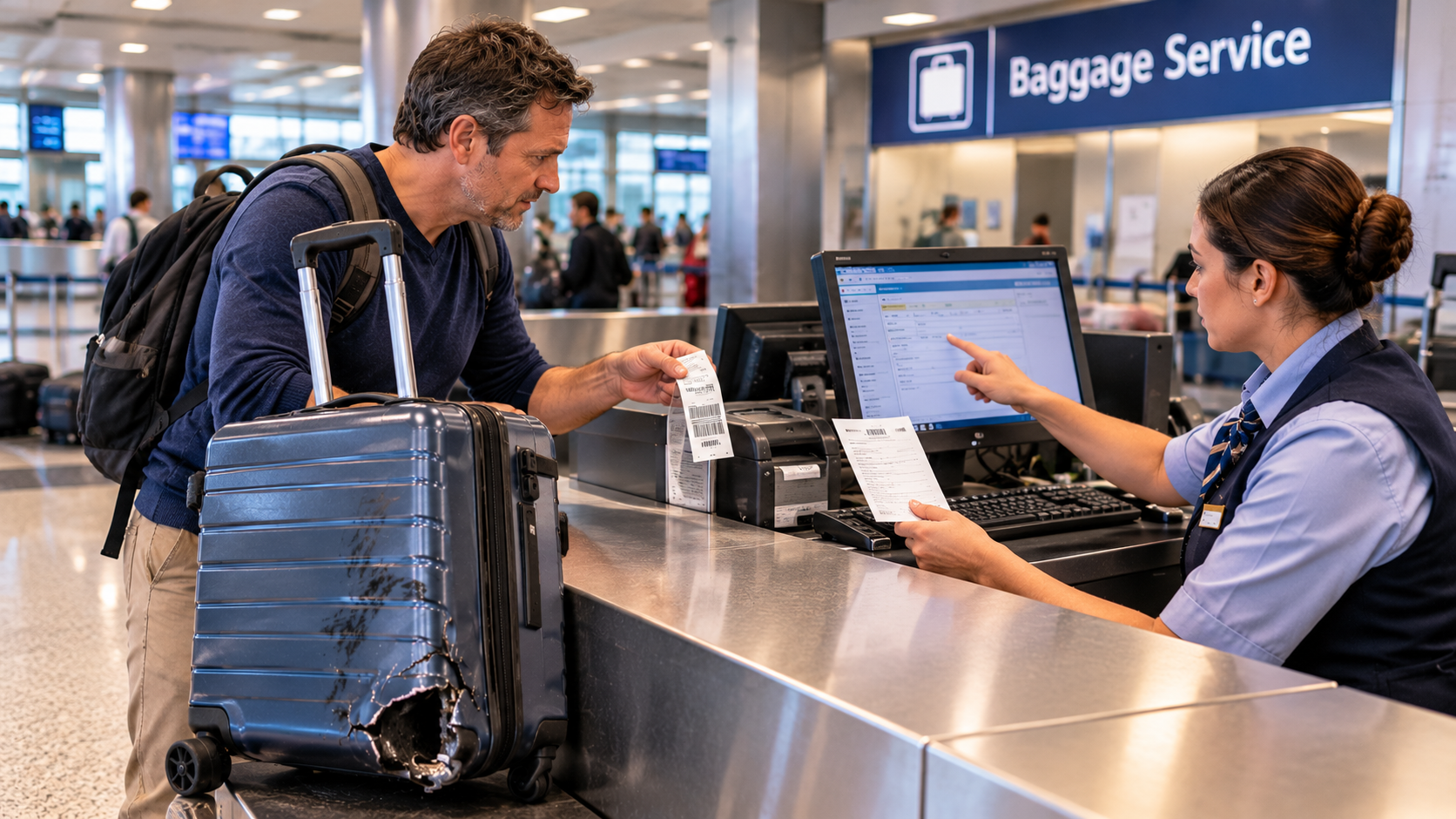
At the airport, inspect the bag and what’s inside. Then find the airline’s baggage-service desk.
The U.S. Department of Transportation’s damaged-baggage guidance says airlines are responsible for repairing or reimbursing passengers for damage that occurs while checked baggage is under the airline’s control, subject to applicable liability limits. DOT also advises passengers to file the baggage claim as soon as possible. Department of Transportation
Airline reporting procedures and deadlines can be surprisingly short.
So don’t roll a three-wheeled suitcase out to the Uber pickup area thinking:
I’ll call them tomorrow.
Tomorrow may make your claim considerably harder.
The Airline Can’t Automatically Shrug at a Broken Wheel
You’ve probably heard some version of:
“We don’t cover wheels, handles or zippers.”
That’s not quite how it works.
DOT specifically says airlines cannot categorically exclude damage to wheels, handles, straps and other components of checked baggage. Fair wear and tear is different, but legitimate damage to those parts cannot simply be dismissed because of what part of the suitcase broke. Department of Transportation
Your well-traveled suitcase acquiring another scuff isn’t necessarily a claim.
But a wheel that was attached when you checked the suitcase and isn’t attached when you pick it up?
File the claim.
Does That Mean the Airline Owes You $4,700?
Nope.
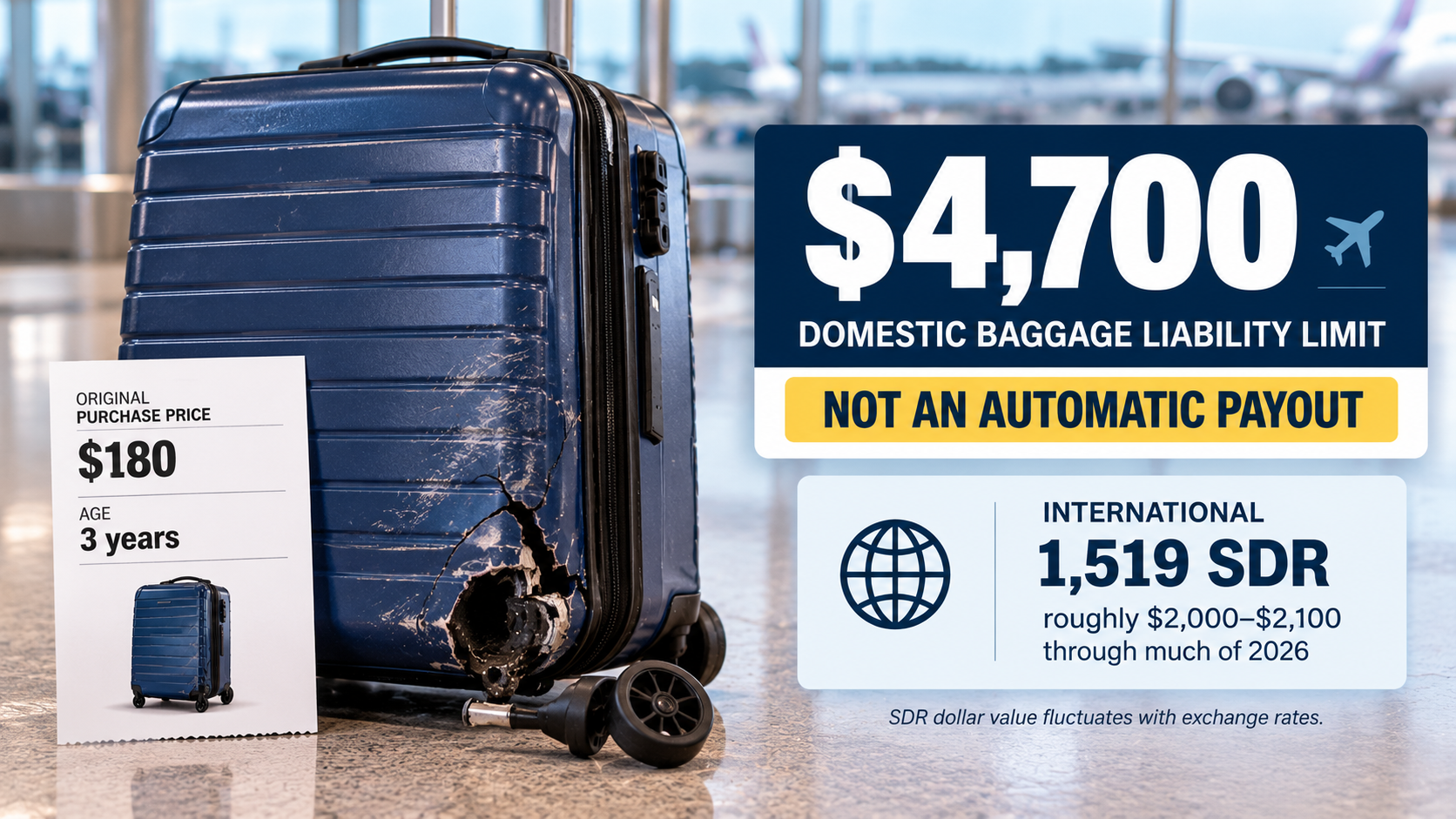
For domestic U.S. flights, the current maximum baggage-liability amount airlines are permitted to impose is $4,700 per passenger.
That’s a ceiling, not a baggage-claim lottery ticket.
If baggage handling destroys your three-year-old $180 suitcase, you haven’t suddenly acquired a $4,700 suitcase.
Depending on the damage, the airline may repair the bag, reimburse the cost of repair or compensate you based on its value. DOT specifically notes that when damaged baggage cannot be repaired, compensation can take depreciation into account.
Proof of purchase can certainly help with an expensive or relatively new bag. If you don’t have the original receipt, an order confirmation, card record or other reasonable evidence may help establish what you owned and what it cost.
Flying Internationally? Different Math
For many international itineraries, baggage liability falls under the Montreal Convention.
The current limit for destruction, loss, damage or delay of baggage is 1,519 Special Drawing Rights, or SDR, per passenger. ICAO increased the limit from 1,288 SDR to 1,519 SDR effective December 28, 2024. ICAO
So what does that mean in actual money?
Think roughly $2,000 to $2,100 during much of 2026.
For example, on October 20, 2026, the IMF valued one SDR at $1.35465, making 1,519 SDR worth about $2,058 USD. The IMF calculates the SDR’s dollar value daily when it is open for business, so the exact dollar equivalent fluctuates with currency exchange rates. International Monetary Fund
The important number legally is still 1,519 SDR, not $2,058.
And just like the $4,700 domestic limit, this doesn’t mean your damaged suitcase automatically earns you a roughly $2,000 check.
It’s a liability ceiling, and it’s per passenger, not per suitcase.
What About What’s Inside?
Damage to the suitcase and damage or loss of its contents aren’t necessarily treated the same way.
For domestic travel, airline contracts can exclude certain categories of items, including some fragile, electronic or valuable property. International rules can differ. DOT specifically distinguishes the treatment of excluded items on domestic and international itineraries.
So when a bag comes back seriously damaged, check what’s inside before leaving too.
If something inside is broken or missing, include that in the report.
And Then There Are Cruises
At the airport, figuring out who had your suitcase is usually pretty simple.
You handed it to the airline.
The airline gave it back looking like an accordion.
Cruises can get considerably murkier.
Think about embarkation day.
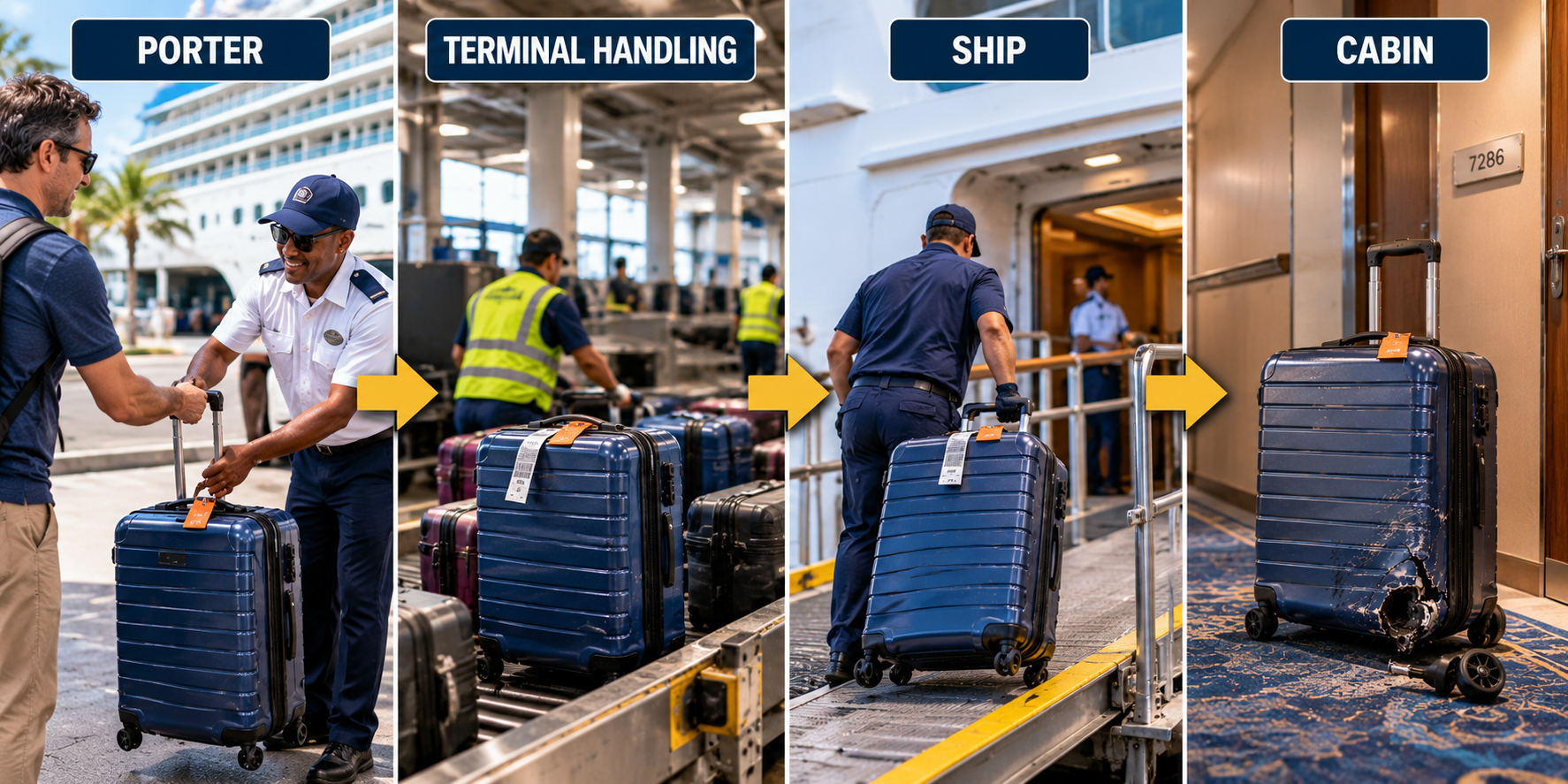
You pull up to the terminal and hand your suitcase to a porter. From there, it can pass through terminal baggage handling before eventually making its way aboard the ship.
Hours later, it appears outside your cabin.
Except now the handle is broken and there’s a hole where one of the wheels used to live.
You naturally think:
The cruise line broke my suitcase.
Maybe.
The cruise contract may have a different opinion.
Who Actually Had Your Bag?
This is where the fine print suddenly stops being theoretical.
Carnival’s current Cruise Ticket Contract, for example, generally limits its baggage liability to $250 per bag per guest, up to two bags per guest on sailings of 14 days or less and three on longer sailings. But the same contract says Carnival isn’t liable for baggage damage before the bag enters its actual custody onboard, after that custody ends, or while the baggage is in the custody of stevedores.
That’s why we can’t give you one universal:
“Cruise line breaks suitcase = cruise line owes $X.”
The cruise line, the terminal and the people physically handling your luggage may not all be the same company.
Different cruise contracts can also contain different liability limits, exclusions and reporting requirements.
But here’s the part that matters while you’re standing there looking at your broken suitcase:
You don’t need to solve the custody mystery before reporting the damage.
Your Bag Arrives Damaged at the Cabin. Now What?
Contact Guest Services right away.
Ask for an incident or irregularity report and a reference number.
Some cruise-line reporting requirements are remarkably unforgiving.
Norwegian Cruise Line’s current Terms and Conditions, for example, say baggage damaged while boarding or disembarking must be reported and an Irregularity Report filed with Guest Services or NCL personnel before the ship departs the port or before the passenger leaves the local customs area, depending on when the damage occurs. NCL’s published terms currently state baggage liability is limited to $100 per passenger or otherwise in accordance with its Guest Ticket Contract.
That’s not something you want to discover after unpacking, going to dinner and deciding you’ll deal with the suitcase tomorrow.
If Guest Services tells you the terminal operator, stevedore or another baggage handler had custody of the bag, ask for the appropriate claim instructions.
Your job is to report the damage promptly. You don’t need to solve the custody chain first.
Keep the Paper Trail
Keep the baggage tag, claim or incident number, proof of the bag’s value, any requested repair estimate and correspondence until the claim is resolved.
You’re not preparing exhibits for the Supreme Court.
You just want enough information to establish:
This was my bag. This is what happened. This is when I reported it. This is what it was worth.
What If They Say No?
Ask why.
There’s a meaningful difference between:
“That’s normal wear and tear.”
and:
“You missed the reporting deadline.”
For an airline claim, escalate through the carrier first. If you believe an airline isn’t complying with federal baggage requirements, DOT’s Aviation Consumer Protection office also accepts complaints.
For a cruise claim, check the ticket contract and written claims procedure. If another company actually handled the bag when it was damaged, follow the claim instructions provided by the cruise line or terminal.
Travel insurance or credit-card baggage protection may provide another avenue depending on your coverage.
But start with the company that had your suitcase.
The Curated Verdict
🟢 REPORT THE DAMAGE BEFORE YOU LEAVE
At an airport, go to baggage services. On a cruise, contact Guest Services. Get a claim or incident number.
🟡 KNOW WHAT YOUR BAG WAS WORTH
A liability ceiling isn’t the value of your claim. Repair or reimbursement may be based on the bag’s actual or depreciated value.
🔴 DON’T ACCEPT “WE DON’T COVER WHEELS” AS THE FINAL ANSWER
For airline baggage, DOT specifically says carriers cannot categorically exclude components such as wheels, handles and straps from legitimate damage claims. Department of Transportation
The Bottom Line
Your suitcase coming back damaged is aggravating.
It doesn’t need to take over the trip.
Report it before you leave and get a claim number.
Then go enjoy the trip while the paperwork catches up.
Airline regulations, international liability limits, cruise ticket contracts and carrier policies can change. This article provides general travel information, not legal advice. Information current as of October 2026.