

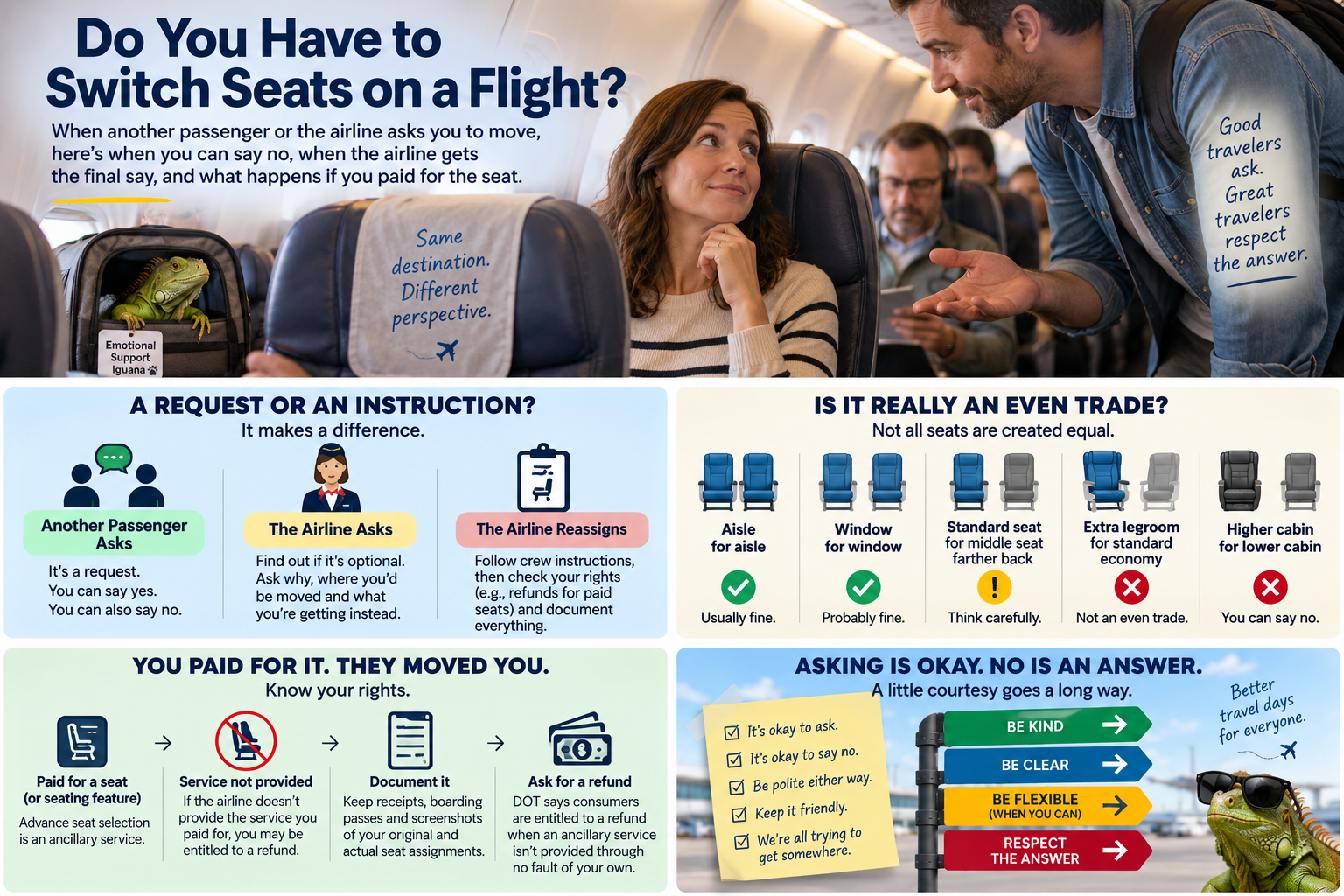
Do You Have to Switch Seats on a Flight?
When another passenger or the airline asks you to move, here's when you can say no, when the airline gets the final say, and what happens if you paid for the seat.
You've boarded the plane, found your row, put your bag away and settled into the seat you selected months ago.
Then comes the question.
“Would you mind switching seats so we can sit together?”
Maybe it's a parent trying to sit with a child.
Maybe it's a couple who booked separate seats.
Maybe someone has a tight connection and wants to sit closer to the front.
Or perhaps they simply like your window seat considerably more than the middle seat printed on their boarding pass.
Social media has turned seat-switching disputes into their own peculiar genre of entertainment. Some are undoubtedly genuine. Others may have about as much connection to reality as an emotional-support iguana demanding a window seat.
🦎 Iggy has entered the chat.
But underneath all the internet drama is a legitimate question:
Do you actually have to move?
If another passenger is asking you to trade seats, the answer is generally simple:
No.
They can ask.
You can agree.
You can also politely decline.
Things get more complicated when the airline wants you to move.
A Passenger Asking Is Just That: A Request
Your fellow passenger doesn't acquire a claim to your seat because sitting there would make their trip more convenient.
Maybe you specifically selected an aisle.
Maybe you paid extra for that seat.
Maybe you need to be near the front because you have a short connection.
Maybe you're sitting beside your own traveling companion.
Or maybe you simply prefer the seat you selected.
You don't need to present Exhibit A through Exhibit F to justify keeping it.
A simple:
“I'd prefer to keep my assigned seat, thanks.”
is enough.
Of course, you're also perfectly free to switch.
If someone offered me another comparable aisle seat and the move helped a family sit together, I might happily do it.
That's courtesy.
It's not an obligation created by the other passenger asking.
🟢 CURATED VERDICT: GREEN
AN EQUIVALENT OR BETTER TRADE
Someone asks politely.
The replacement seat is equivalent or better.
The switch doesn't interfere with your own plans.
And you're happy to help.
Sure. Why not?
Sometimes being a good fellow traveler really is that simple.
But Who Is Actually Asking You to Move?
This distinction matters.
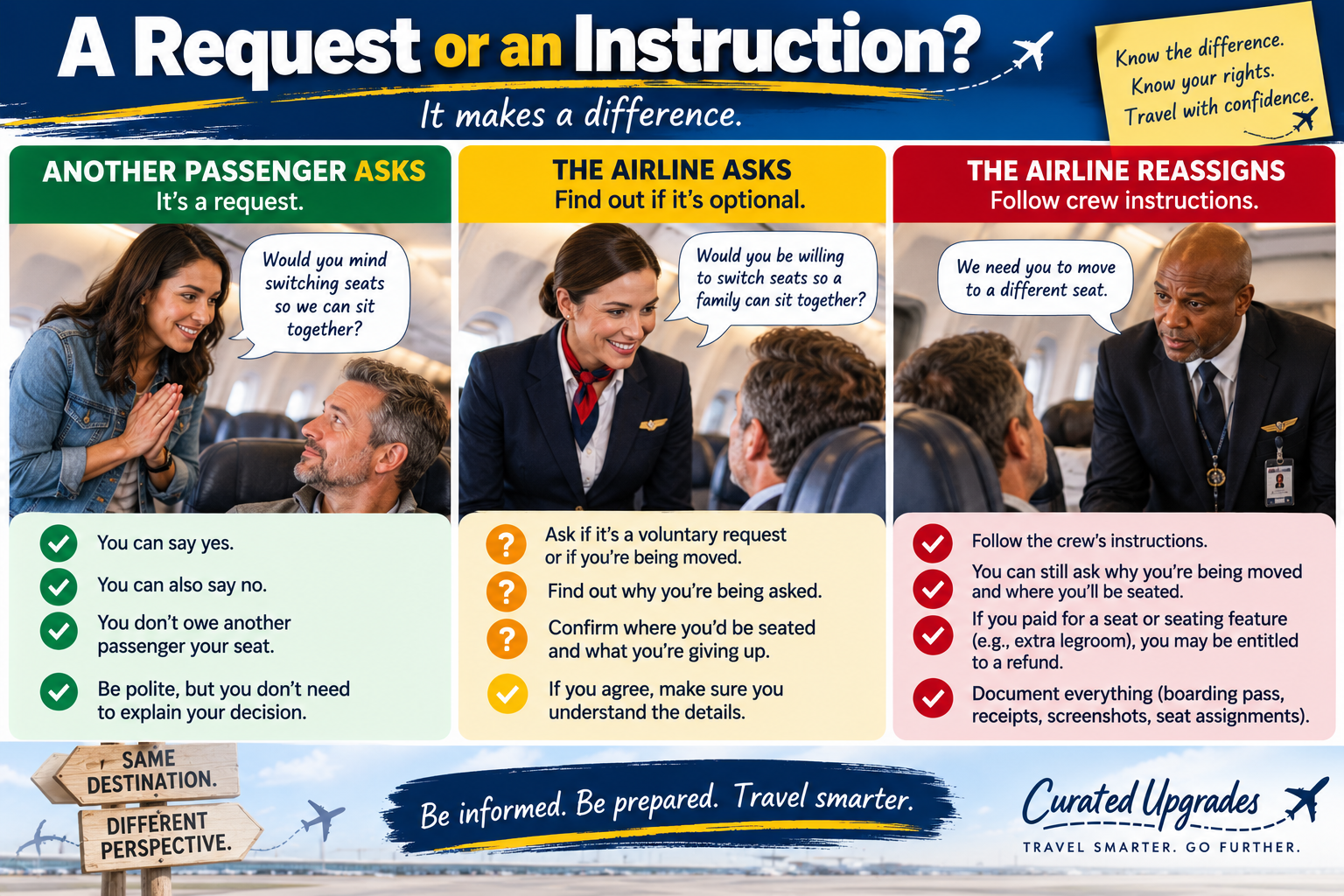
There are really three different situations:
Another passenger asks.
That's a request. You decide.
An airline employee asks whether you're willing to switch.
Before agreeing, find out whether it's voluntary and where you'd be sitting.
The airline actually reassigns you.
Now you're dealing with an airline instruction rather than another passenger's request.
That distinction should determine what you do next.
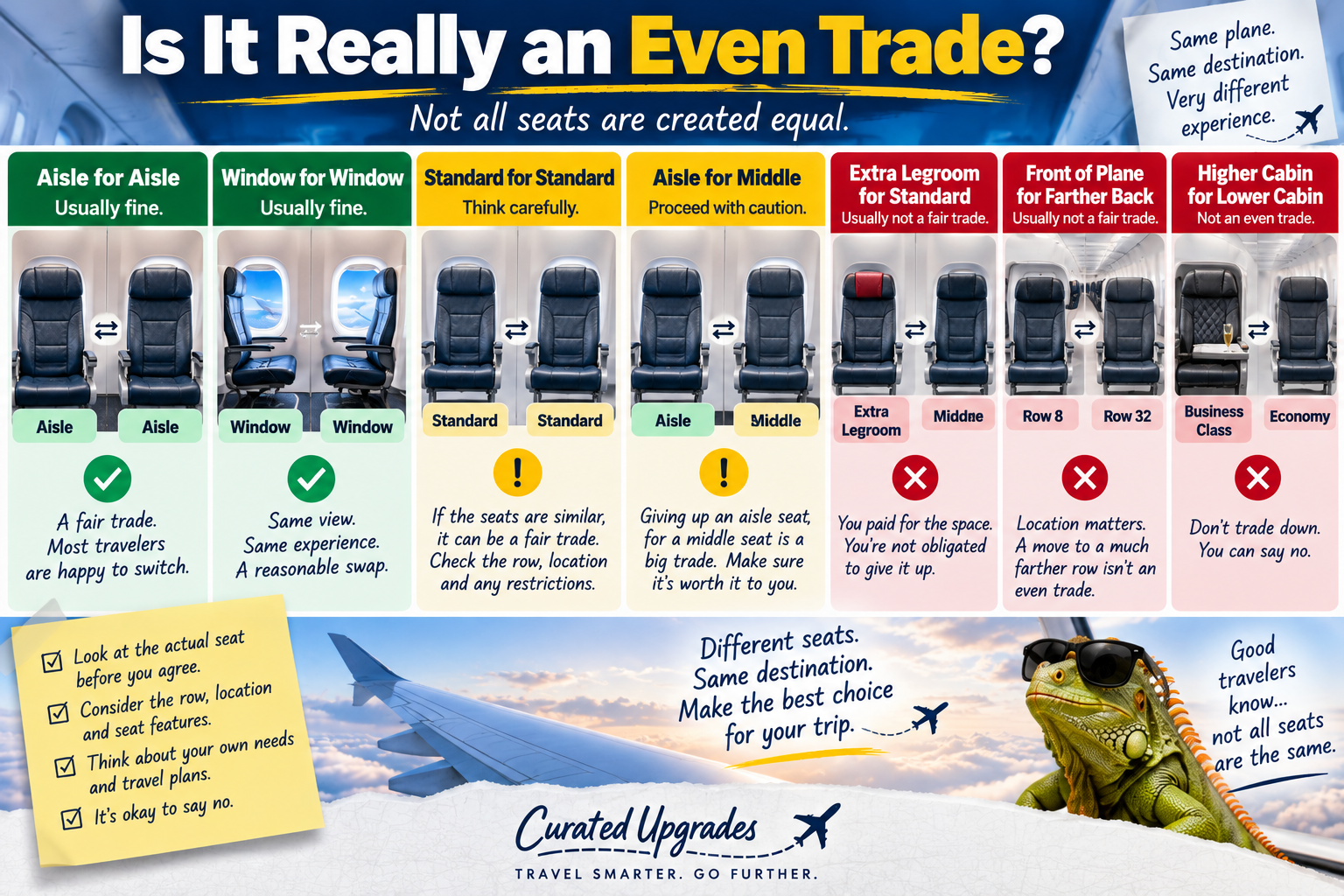
Is It Really an Even Trade?
Before saying yes, find out exactly where you're going.
Aisle for aisle?
Probably easy.
Window for window?
Same idea.
Your extra-legroom aisle seat for a standard middle seat six rows back?
That's an entirely different proposition.
Seat number alone doesn't tell the whole story.
Consider the seat type, legroom, location in the cabin, proximity to the lavatory or galley, whether the seat reclines, whether you'll still be sitting with your traveling companion and whether you paid extra for the seat you're giving up.
Location can matter too.
If you have a tight connection, moving from Row 8 to Row 32 may have more significance than it would on your flight home with nowhere particular to be.
And if you're trading down from a premium seat?
That's not generosity you owe another passenger.
🟡 CURATED VERDICT: YELLOW
LOOK BEFORE YOU MOVE
Don't agree to “switch seats” until you know what seat you're getting.
An aisle isn't a middle.
Extra legroom isn't standard economy.
And Row 8 isn't necessarily equivalent to Row 32.
Know what you're trading before you say yes.
What About Families Who Want to Sit Together?
This is where the discussion gets more emotional.
A parent and young child sitting apart isn't the same situation as two adults who simply prefer sitting beside one another.
But there's an important distinction:
Family seating is primarily something the family and airline should address. It shouldn't automatically become the responsibility of an unrelated passenger after boarding.
DOT maintains an Airline Family Seating Dashboard showing which airlines commit to seating children age 13 or younger next to an accompanying adult at no additional charge, subject to certain conditions. Those commitments aren't identical across every airline.
If I'm asked to make a reasonable switch so a young child can sit beside a parent, I'm certainly going to consider it.
But that doesn't automatically mean the parent is entitled to the extra-legroom, window or premium seat another passenger selected or purchased.
Ideally, the airline resolves that seating problem before everybody is buckled into Row 23 negotiating real estate.
Think Beyond Window, Middle or Aisle
Two seats in the same cabin can produce surprisingly different trips.
You might be giving up more legroom.
You might be moving beside a galley or lavatory.
You might lose a window.
You might lose access to power.
You might move farther back and make a tight connection more difficult.
You might separate yourself from the person you planned to sit beside.
None of those automatically means you shouldn't switch.
They simply belong in the calculation.

What If You Paid for Your Seat?
Now we've crossed directly into Know Your Rights territory.
DOT considers advance seat selection an ancillary service. Its current refund guidance says consumers are entitled to a refund of fees paid for an ancillary service when that service becomes unavailable through no fault of the consumer. Advance seat selection is specifically included among the examples of ancillary services.
So if the airline moves you and doesn't provide a paid seating service you purchased, don't simply write off the money.
Document it.
Keep or screenshot your original seat assignment.
Keep the receipt showing what you paid.
Keep your boarding pass.
Make a note or screenshot showing the seat you actually received.
Then pursue the refund you're entitled to for the service that wasn't provided.
There's an important distinction here, though.
If you voluntarily trade away a seat you paid for with another passenger, don't assume that creates the same refund entitlement.
You chose to give up the seat.
That's another good reason to understand exactly what you're trading before saying yes.
A Worse Seat Isn't Necessarily a Cabin Downgrade
We should distinguish between two different problems.
Moving from your preferred aisle seat to a middle seat in the same economy cabin may be irritating.
Being moved from Business Class to Economy is something else entirely.
DOT treats an involuntary downgrade to a lower class of service as a significant change for refund purposes.
What If the Airline Tells You to Move?
Here's where I wouldn't turn Row 17 into a tiny courtroom.
There's an important difference between:
“Would you be willing to move?”
and:
“We need you to move.”
If you're unsure which one you're hearing, ask.
“Are you asking whether I'd be willing to switch, or has my seat been reassigned?”
That's not confrontational.
It's clarification.
If the airline has actually reassigned you, follow legitimate crew instructions rather than escalating the disagreement aboard the aircraft.
You can still ask why you're being moved.
You can still ask where you're being seated.
And if you're losing a seating feature or service you paid for, document what happened and pursue the appropriate refund afterward.
🔴 CURATED VERDICT: RED
DON'T FIGHT THE CREW OVER THE SEAT
A disagreement with another passenger is one thing.
A legitimate instruction from the operating crew is another.
Ask questions. Understand what changed. Document anything you paid for and didn't receive.
But handle the refund or complaint afterward, rather than allowing a seat dispute to become a bigger problem aboard the aircraft.
What About Disability-Related Seating?
This is one area where the normal “just say no” seat-switch conversation doesn't tell the whole story.
Under the Air Carrier Access Act, airlines have specific obligations to provide certain seating accommodations to qualified passengers with disabilities who identify their need to the airline.
Depending on the disability-related need, that can include a seat with a movable aisle armrest, an adjoining seat for certain assistants, a bulkhead or other appropriate seat, or greater legroom for a passenger with a fused or immobilized leg. These accommodations are generally provided within the class of service purchased.
Some airlines use a priority seating system in which passengers assigned to certain seats may be notified that they can be reassigned if the seat is later needed for a qualifying disability accommodation.
That's an airline accommodation issue, not a negotiation between passengers.
And there's another important piece of etiquette here:
You don't need to interrogate another passenger about their disability.
If an accommodation requires a seating change, let the airline handle it.
What If Someone Is Already Sitting in Your Seat?
This one doesn't need to become complicated either.
Start with:
“I think that's my seat.”
Maybe they misread the row.
Maybe their seat assignment changed.
Maybe there's a legitimate problem.
Or perhaps they decided your window seat looked considerably nicer than 29B.
If the discrepancy isn't immediately resolved, involve a flight attendant.
Let the airline determine the correct seating assignments.
There's very little upside to beginning your vacation with an argument in the aisle.
Asking Isn't the Problem
This ties directly into something we talked about in Should You Volunteer to Give Up Your Seat?
If you don't ask, the answer is always no.
I don't have a problem with another traveler politely asking me to switch.
Maybe you're in 12C and I'm in 12B, and swapping would let you sit beside your spouse.
Ask.
I may happily say yes.
But there's another half to that philosophy:
If you ask, you have to be willing to accept no for an answer.
The problem isn't the question.
It's behaving as though another passenger somehow owes you the answer you wanted.
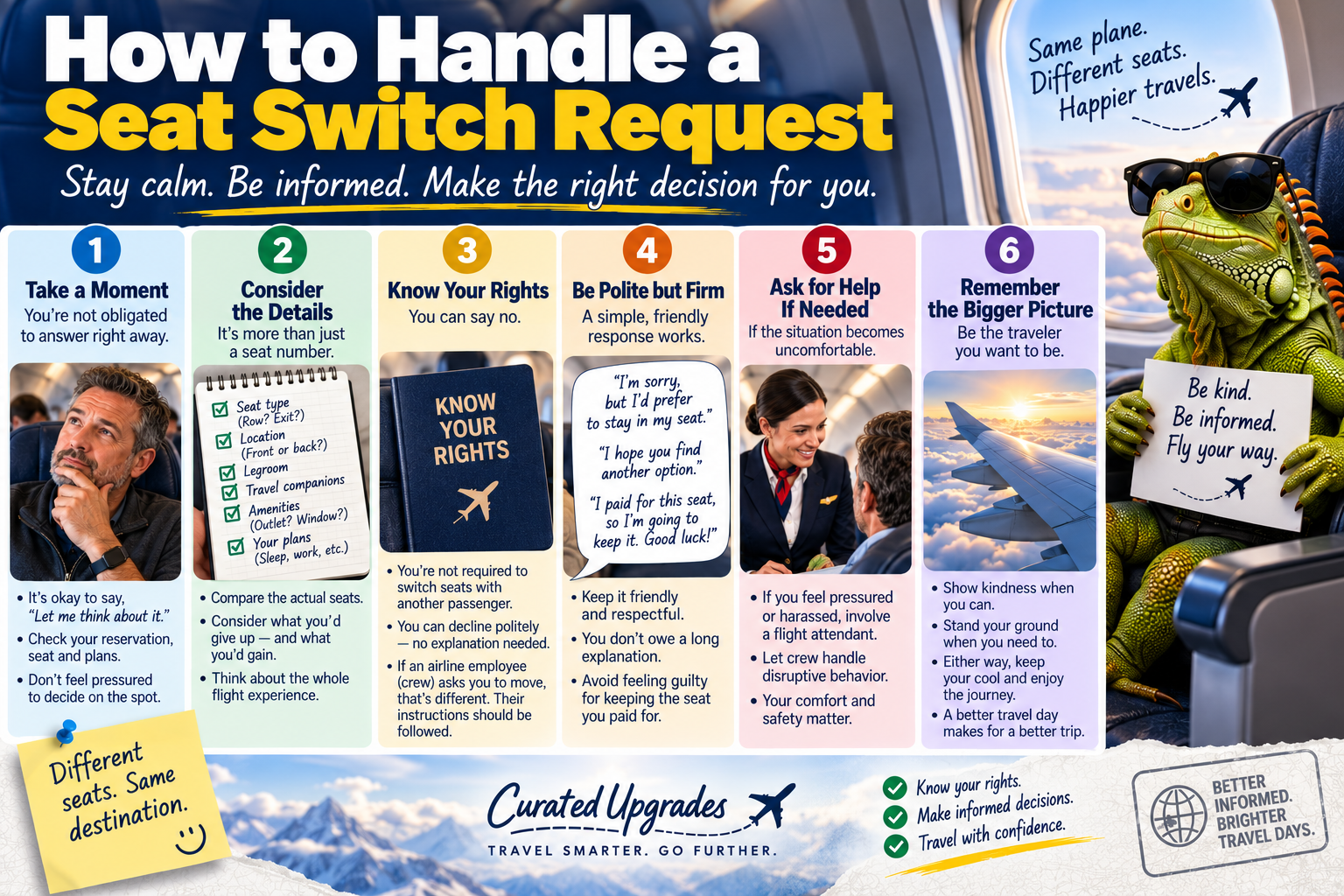
How to Handle a Seat-Switch Request
You don't need an immediate answer.
Take a moment.
Find out where the other seat is.
Think about what you're giving up and what you're getting.
If you want to switch, great.
If you don't:
“I'm sorry, but I'd prefer to keep my seat.”
That's enough.
You don't owe a stranger your travel history, medical information, connecting itinerary or a dissertation about why you selected 14A.
If another passenger won't accept your answer or the situation becomes uncomfortable, involve a flight attendant.
Then get back to your trip.
So, Do You Have to Switch Seats?
If another passenger asks?
Generally, no.
If you're happy with the trade, switch.
If you're not, politely decline.
If the airline asks whether you're willing to move?
Clarify whether it's voluntary and find out exactly what you're being offered instead.
If the airline actually reassigns your seat?
Follow legitimate crew instructions, document what happened, and determine whether you're entitled to a refund for a paid service you didn't receive.
And if someone offers you 32B in exchange for the First Class seat you paid for?
Well...
They're certainly allowed to ask.
🦎 Even Iggy knows you don't owe them the answer they want.
CURRENT INFORMATION
This article reflects U.S. Department of Transportation passenger-rights guidance available as of September 2026. Airline policies and government regulations can change. Always verify current rules with DOT and your airline when a seating issue involves paid services, disability accommodations or other passenger protections.