

Should You Volunteer to Give Up Your Seat?
An airline is offering money for your seat. Before you raise your hand, know what to negotiate, what to confirm, and when the smartest answer is simply no.
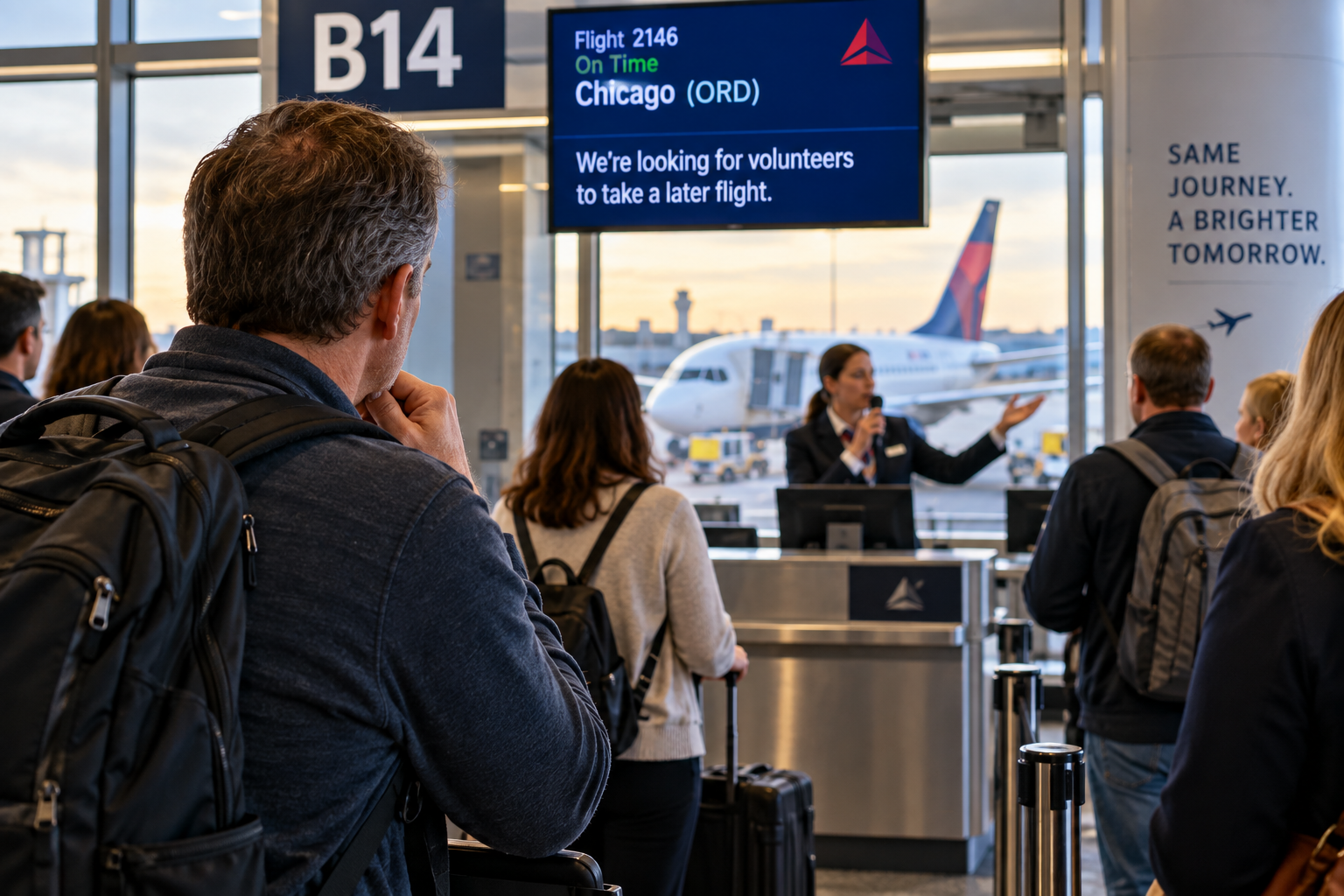
You're sitting at the gate waiting to board when the announcement comes over the speaker:
“We're looking for volunteers willing to take a later flight...”
Then comes the interesting part.
Maybe they're offering $300.
Nobody moves.
A few minutes later, it's $500.
Now people are paying attention.
At $800, you may start doing some mental arithmetic.
Should you take it?
Maybe.
But the number being announced at the gate is only one part of the deal.
Giving up your seat voluntarily can be a terrific opportunity when your schedule is flexible. I've done it myself.
I've also walked up to the counter, asked what the airline was offering, considered everything that would have to change and said:
No thanks. I'll keep my seat.
Both decisions were right.
The trick is knowing what you're actually agreeing to.
Volunteering Is Different From Getting Bumped
This distinction comes first.
When an oversold flight has more passengers ready to travel than available seats, U.S. airlines must seek volunteers before involuntarily denying boarding to passengers.
But when you volunteer, you're making a deal with the airline.
The U.S. Department of Transportation says there is no limit to the amount of money or vouchers an airline may offer volunteers, and passengers are free to negotiate. If the airline offers a voucher, free ticket or reduced-rate ticket, it must disclose restrictions that apply before you agree to give up your confirmed reservation.
That's very different from being involuntarily bumped, where federal denied-boarding compensation rules may determine what you're legally owed.
We cover that side of the story separately in Involuntarily Bumped? Your Denied Boarding Rights.
For this article, the airline is asking.
You still have the choice.
One Time, $400 Was an Easy Yes
Years ago, I was flying from Jacksonville to Seattle for work.
The government had purchased my ticket, and, as government travel sometimes works, the least expensive itinerary involved a long connection somewhere along the way.
I had an early-morning departure from Jacksonville when the airline announced that it needed volunteers.
The offer was $400 in airline credit to take a later flight.
Normally, taking a later flight could create all sorts of complications.
This time it didn't.
The replacement flight would still get me to the same connecting flight I was already scheduled to take. I wasn't going to arrive in Seattle any later. I was essentially trading part of a long layover for some extra time in Jacksonville.
I also already had personal travel planned with that airline, so I knew I'd use the credit.
I took the deal.
For me, that $400 airline credit had real value, and I gave up very little in exchange for it.
That's the kind of situation where volunteering can work beautifully.
🟢 CURATED VERDICT: GREEN
TAKE A SERIOUS LOOK
If the compensation has real value to you, your replacement flight is confirmed, and the change causes little or no meaningful disruption to your trip, volunteering can be an excellent deal.
Don't Look at the Number. Look at the Whole Deal.
Suppose an airline offers you:
$1,000 in airline credit.
That sounds considerably better than:
$700 cash.
But what if the $1,000 offer means flying tomorrow?
You need a hotel.
You need dinner and breakfast.
The airline isn't paying for either.
Your replacement flight isn't confirmed yet.
And the credit expires before you're likely to use all of it.
Meanwhile, the $700 cash offer includes a confirmed seat on a flight later that evening.
Suddenly the smaller number may be the considerably better deal.

Cash and Airline Credit Aren't the Same Thing
If the airline says “$800,” your next question should be:
$800 in what?
Cash is cash.
An airline credit has value only if you can actually use it.
If you're offered a voucher or credit, find out when it expires, whether there are blackout dates or other restrictions, whether it can be used for the flights you normally take, and whether there are other significant limitations.
DOT specifically requires airlines offering certain tickets or vouchers in exchange for volunteering to disclose applicable restrictions before you give up your confirmed space.
That doesn't mean airline credit is bad.
My $400 credit from Jacksonville worked perfectly because I already knew I had another trip coming on that airline.
For somebody who rarely flies that carrier, the exact same $400 credit might be worth considerably less.
Value is personal.
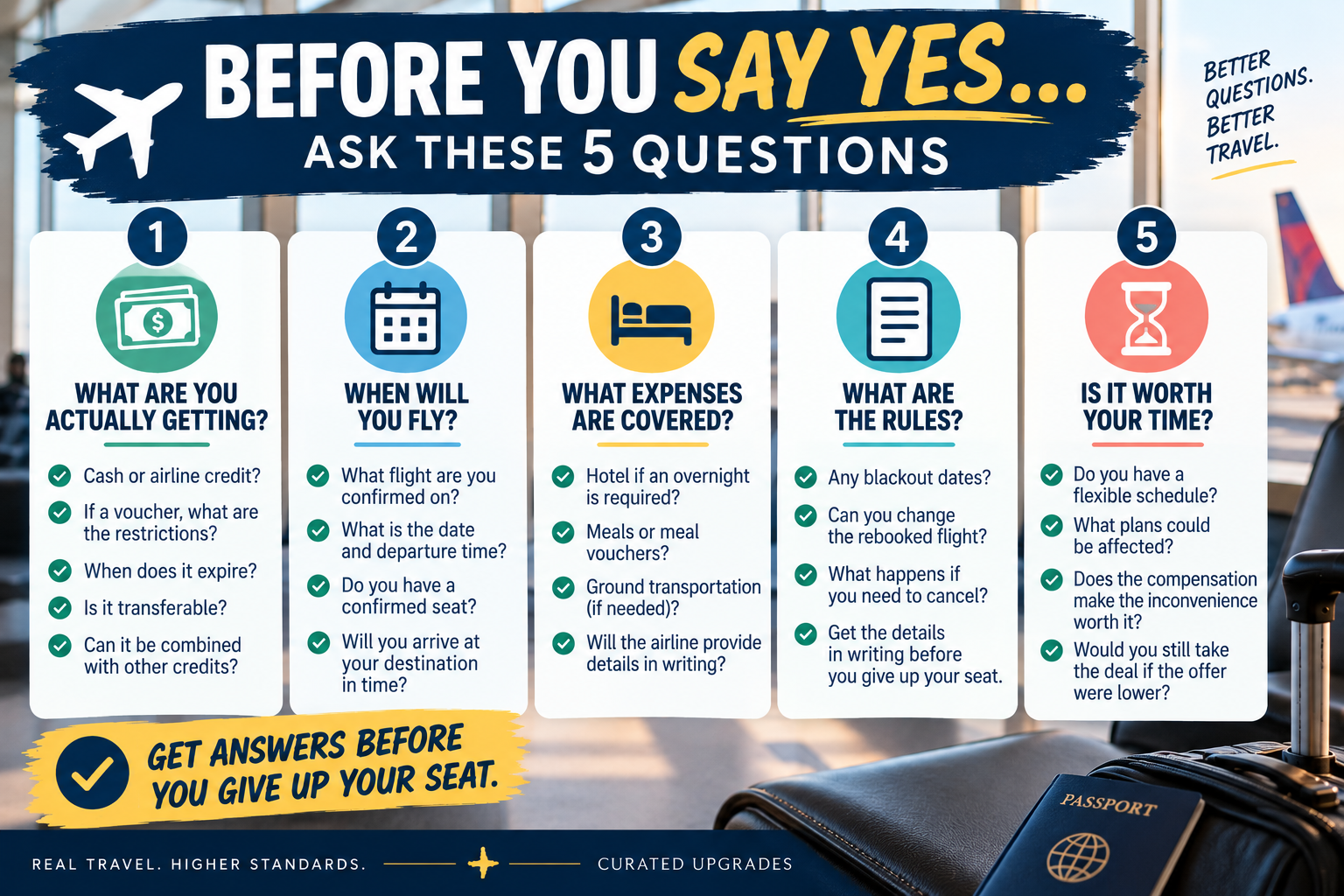
Before You Say Yes, Ask Questions
The worst time to discover the details of your deal is after you've surrendered your seat.
First, find out exactly what you're receiving.
Then find out exactly how the airline plans to get you where you're going.
A later flight isn't necessarily a problem.
Standby on a later flight can be.
DOT itself recommends asking when the next flight is on which the airline can actually confirm your seat, warning that accepting standby on another full flight could leave you stuck at the airport much longer.
Negotiate More Than Money
This is where I think travelers sometimes leave value sitting on the counter.
The airline needs your seat.
You're considering giving it to them.
The compensation doesn't have to be the only part of the conversation.
If the replacement flight requires an overnight, ask about a hotel.
Ask about meals.
If the hotel is away from the airport, ask about transportation.
And if you're simply going to be sitting in the airport for another four or five hours:
Ask for a lounge pass.
The airline may say no.
That's okay.
As I tend to look at these things:
If you don't ask, the answer is always no.
And that works both ways.
The airline needs something from you, so it asks.
You need something from the airline to make giving up your seat worthwhile, so you ask too.
A lounge pass, meal voucher, hotel room, ground transportation, a better replacement seat or a more convenient routing might make an otherwise mediocre offer considerably more attractive.
DOT specifically suggests that volunteers ask whether the airline will provide amenities such as meals, a hotel and transportation between the hotel and airport. Those aren't automatically guaranteed simply because you volunteered, which is precisely why you want them settled as part of the deal.
🟡 CURATED VERDICT: YELLOW
ASK BEFORE YOU AGREE
If the compensation looks good but the rest of the arrangement is fuzzy, don't surrender the seat yet.
Get the replacement flight settled. Ask about expenses. Ask about lounge access if you're facing a long airport wait. Understand the restrictions on any credit.
Then decide.
What About Your Checked Bag?
This should be one of your questions too, especially if you've already checked luggage.
If you're moved to a different flight or routed through another airport, ask the agent:
“What's happening with my checked bag?”
Don't simply assume it will automatically follow whatever new itinerary you've negotiated.
Depending on where your bag is in the process and how the airline handles the change, it may continue on the original flight or require different handling.
And if your new itinerary involves an overnight, ask whether you'll actually have access to your checked luggage.
This is another reason medications, essential electronics, documents and anything you absolutely need overnight belong in your carry-on rather than your checked bag.
We have first-hand experience about not getting our baggage upon arrival. Seven Days Without Our Baggage addresses some lessons from Ireland.
Put a Value on Your Time
This is where the decision becomes intensely personal.
Suppose an airline offers $600 for you to arrive four hours later.
For one traveler, that's fantastic.
For another, it's ridiculous.
Are you going home with nothing planned tomorrow?
Are you heading to an ordinary business meeting?
Or are you flying to meet a cruise ship, attend a wedding, catch a separately ticketed international flight or make an event that won't wait for you?
A four-hour delay has completely different values in those situations.
And don't forget the possibility of additional disruption.
A replacement flight tonight may look perfectly reasonable until thunderstorms begin rolling through the hub.
Tomorrow morning may seem fine until you discover every flight is already nearly full.
You're not merely selling the airline a few hours.
You're accepting whatever additional risk comes with changing your itinerary.

Sometimes Asking Is Enough
I've been on the other side of this decision too.
Another time, I heard an airline asking for volunteers.
I was interested.
So I went to the counter and asked what they were offering.
Once I heard the details, I realized accepting would mean changing my connecting flight and rearranging my rental car reservation at the destination.
One change was beginning to knock over several other dominoes.
The offer wasn't worth that much disruption.
So I passed.
And that's something worth remembering:
Walking up to the gate agent and asking about the offer doesn't mean you've volunteered.
Find out what they're offering.
Find out what the replacement itinerary looks like.
Do the math.
Then decide.
Be Especially Careful With Connections
My Jacksonville example worked because the later first flight still connected with my original onward flight.
That's nearly ideal.
If volunteering means changing multiple flights, the calculation gets more complicated.
Don't just ask:
“When does the next flight leave?”
Ask:
“When will this new itinerary get me to my final destination?”
A perfectly reasonable two-hour delay at your originating airport can become an eight-hour arrival delay if it destroys a connection.
And if your trip includes separate tickets, the risk can be even greater.
If you end up getting further delayed or cancelled, you have other rights. Delayed or Canceled? What Airlines Owe You
A Confirmed Seat Matters
This deserves emphasis.
Before voluntarily surrendering a confirmed seat on the flight in front of you, I want to know what I'm getting in return.
“There's another flight at 6:00” isn't the same as:
“You're confirmed on the 6:00 flight.”
And neither necessarily tells you whether you have an actual seat assignment.
Ask.
DOT specifically warns travelers about the difference between a confirmed replacement and being placed on standby for another potentially full flight.
Giving up one confirmed seat only to join a standby list for another oversold airplane isn't much of an upgrade.
When Should You Take the Deal?
There isn't a magic dollar amount.
That's actually the point.
A $300 offer could be fantastic if you're moved two hours later, still arrive at the same time because your original connection was long, and you know you'll use the credit.
A $1,500 offer could be terrible if it causes you to miss the first day of a cruise.
Look at the complete trip.
🟢 CURATED VERDICT: GREEN
TAKE THE DEAL
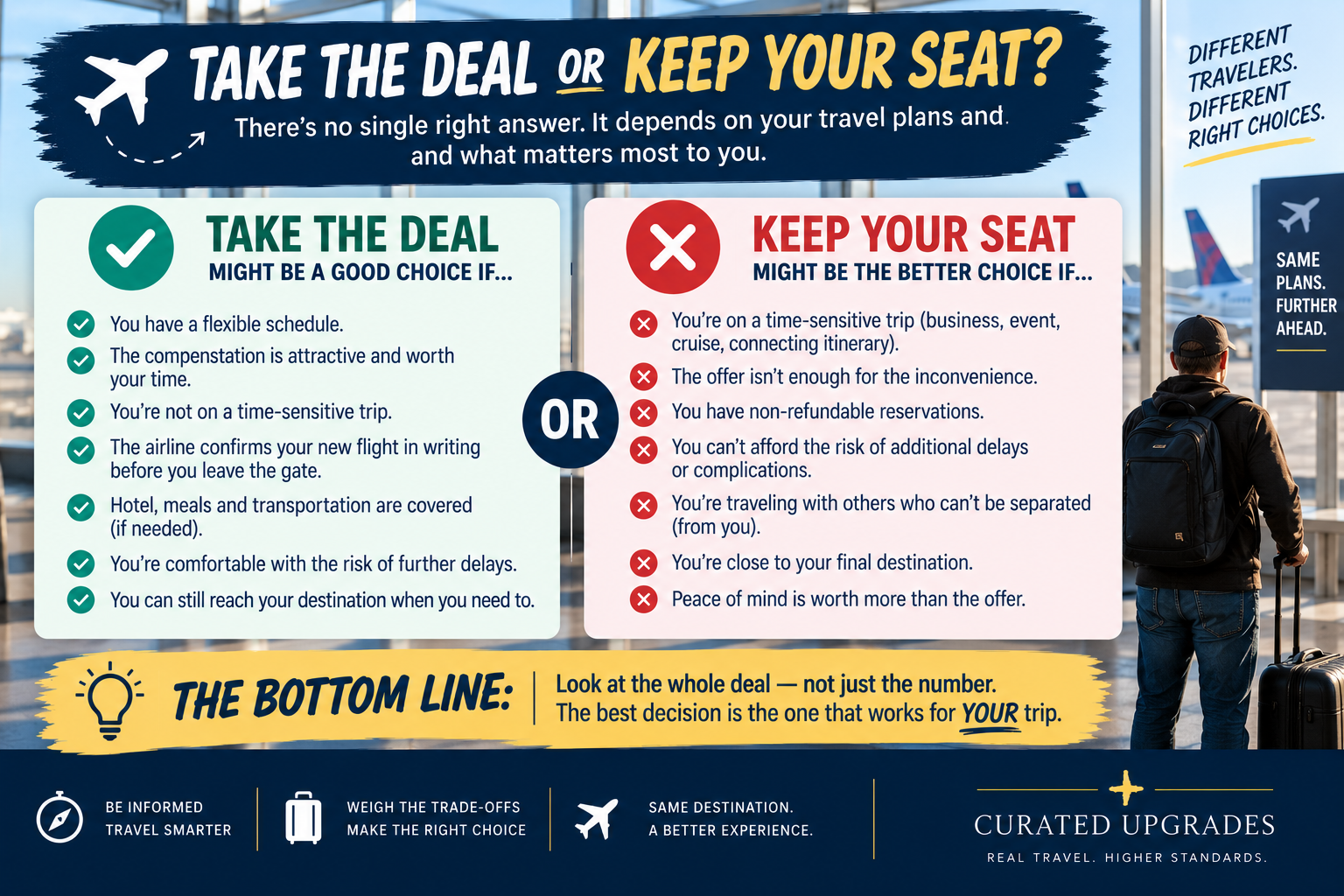
I'm leaning yes when the schedule is flexible, the compensation is genuinely useful, the replacement itinerary is confirmed, any significant additional expenses have been addressed, and I'm still getting where I need to be when I need to be there.
A long layover that can simply become a shorter layover?
That's exactly how I ended up $400 ahead.
🟡 CURATED VERDICT: YELLOW
KEEP NEGOTIATING
The offer is interesting, but you're not yet sure about the replacement flight, hotel, meals, transportation, checked baggage or other details.
Don't rush.
The airline is asking you for something.
This is the moment to get answers and see whether the deal can be improved.
🔴 CURATED VERDICT: RED
KEEP YOUR SEAT
You're traveling to a cruise, wedding, important meeting or other time-sensitive event.
The replacement flight is standby rather than confirmed.
The change threatens another connection or reservation.
Bad weather or other disruptions make later flights increasingly risky.
Or maybe the compensation simply isn't worth the inconvenience.
You don't need a more sophisticated reason than:
“No, that doesn't work for me.”
What If Nobody Volunteers?
Then we're back to the other half of the story.
If the airline doesn't get enough volunteers and begins selecting passengers who will not be allowed to board, this is no longer simply a negotiation.
It may become involuntary denied boarding, with specific passenger protections and compensation rules.
That's when you'll want our companion guide:
Involuntarily Bumped? Your Denied Boarding Rights
The Best Deal Is the One That Works for Your Trip
When the gate agent announces $500, $800 or $1,000, it's easy to focus on the number.
Don't.
Look at the whole deal.
What are they actually giving you?
When are you actually flying?
When will you actually arrive?
What expenses will the airline cover?
What's happening to your luggage?
What restrictions come with the compensation?
What else in your trip needs to change?
And how much is your time and certainty worth?
Sometimes volunteering can turn an oversold flight into a surprisingly profitable travel day.
Sometimes the smartest move is to smile, thank the gate agent and walk back to your seat.
I've done both.
The airline asked.
So did I.
That's how a negotiation is supposed to work.
OFFICIAL RESOURCE
For current U.S. rules and guidance on oversold flights, volunteering and involuntary denied boarding:
U.S. Department of Transportation: Bumping & Oversales