

Involuntarily Bumped? Your Denied Boarding Rights
When an oversold flight leaves you behind, the airline may owe you more than another ticket. Here’s what happens when volunteering ends and involuntary denied boarding begins.
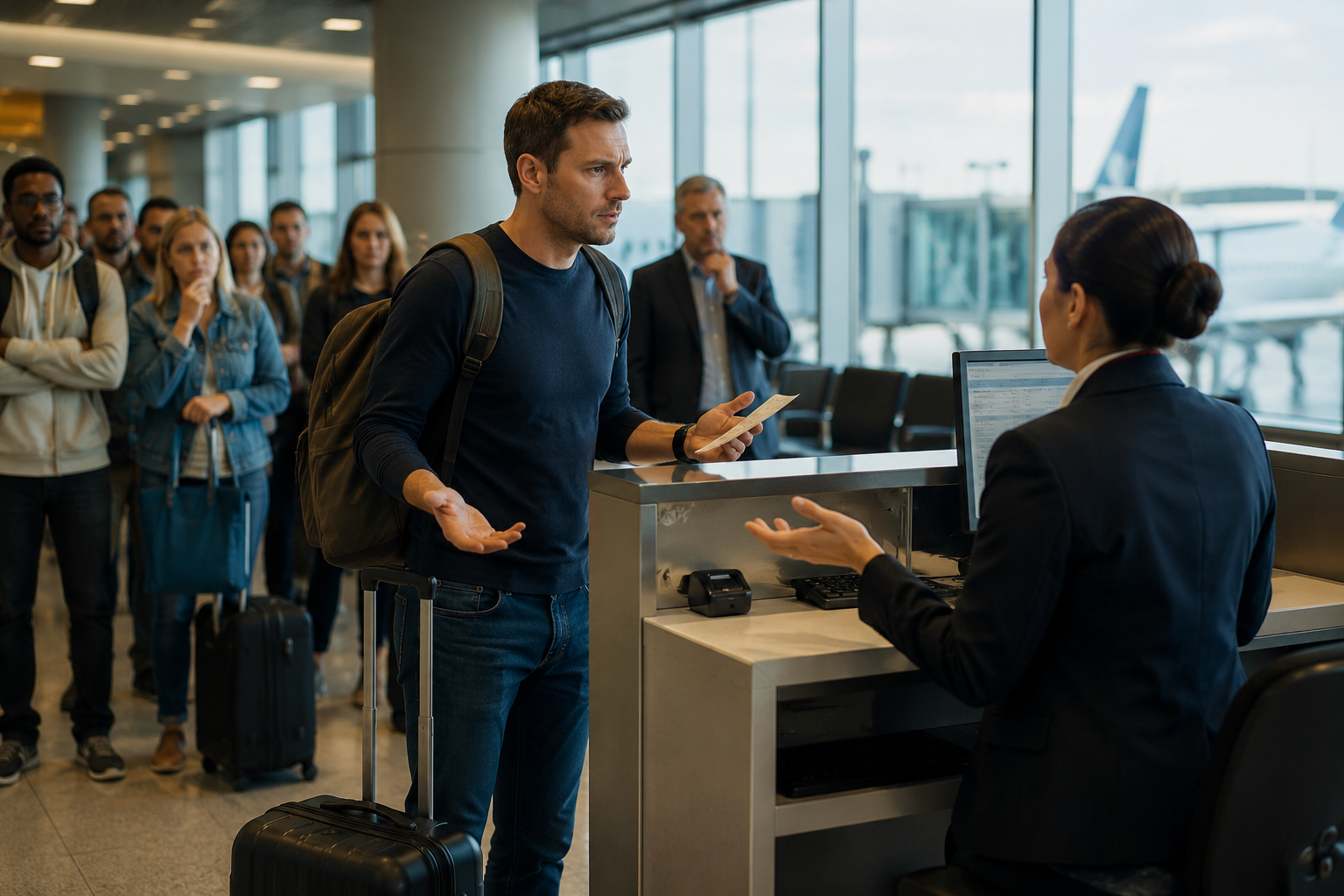
There are few stranger moments in air travel than standing at the gate with a confirmed reservation, your boarding pass in hand and the airplane sitting outside the window, only to be told:
You're not getting on.
Airlines are allowed to oversell flights. Most of the time, enough passengers change plans or don't show up and nobody notices.
But occasionally everybody shows up.
The airline starts asking for volunteers.
Nobody takes the offer.
And eventually someone's name gets called.
That's when an oversold flight stops being an inconvenience and can become a passenger-rights issue.
I learned that firsthand more than two decades ago.
My First Experience Getting Bumped
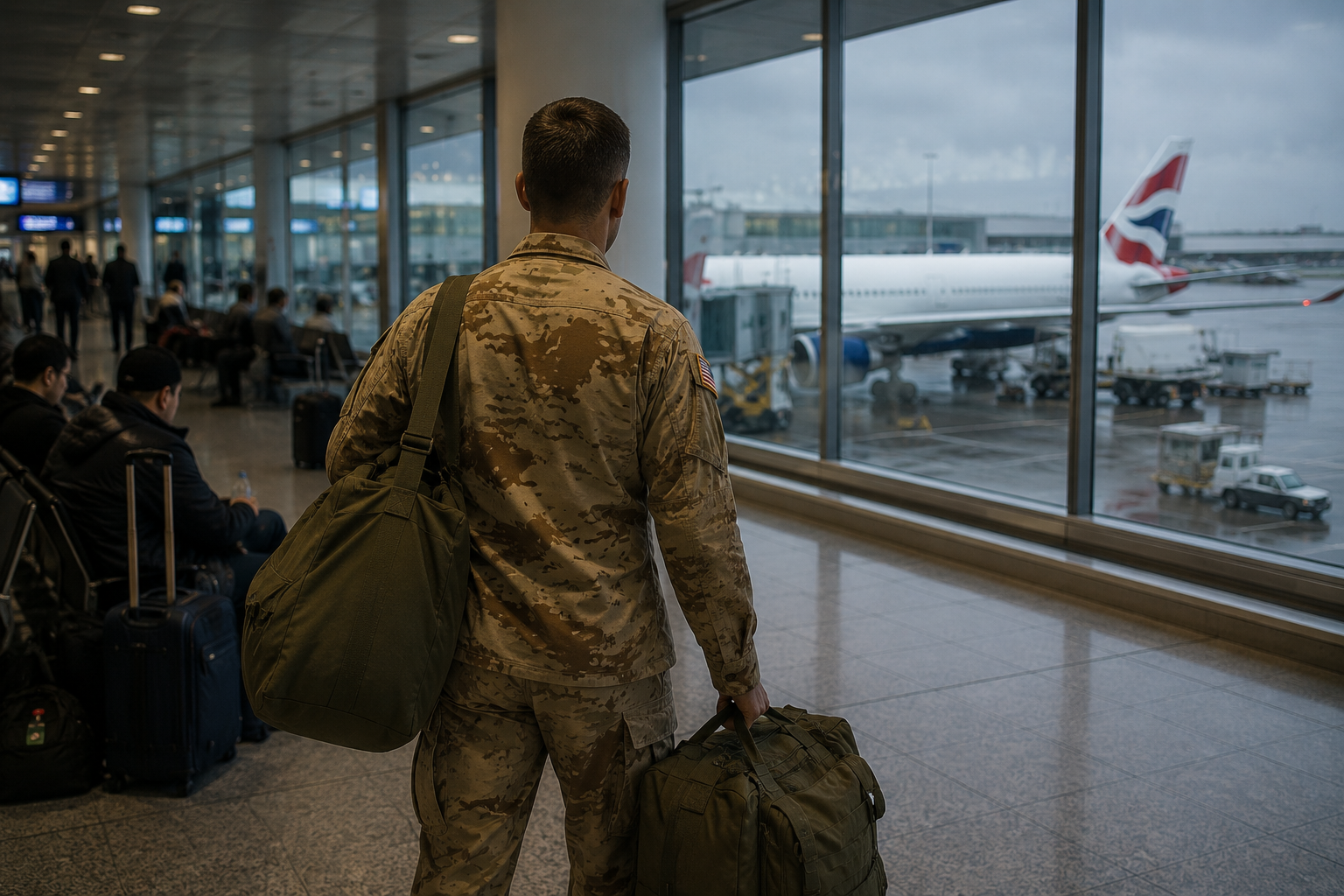
In the winter of 2002, not long after 9/11, I was returning home from a military deployment to Kuwait.
The U.S. Embassy in Kuwait had booked my flights at the last minute. My itinerary took me from Kuwait City to London Heathrow on British Airways, then Heathrow to JFK, followed by a final flight into Norfolk.
This was a very different travel world.
There were no airline apps. No mobile boarding passes. No push notifications telling you to check in. Internet access where I'd been deployed was limited, and my connection at Heathrow wasn't particularly generous.
By the time I got to my next flight at Heathrow, I was one of the later connecting passengers to check in.
The flight was oversold.
I had been bumped.
What happened next deserves some context, because my circumstances were anything but typical.
I wasn't an average business traveler standing at the counter. I was an American servicemember in camouflage uniform, returning from a deployment in a war zone. This was shortly after 9/11, when emotions were still running extraordinarily high and public respect and support for the military were particularly strong.
That may have made some difference in what happened next.
British Airways rerouted me onto its next available flight to the United States. Instead of JFK, I'd fly to Boston.
They upgraded me to First Class.
They rebooked my onward flight from Boston to Norfolk. Because the new itinerary required an overnight in Boston, they also provided a hotel.
I lost some time.
But I felt very well compensated.
Would an ordinary traveler have received exactly the same treatment? I have no idea, and I certainly wouldn't suggest that my experience represents what someone should expect today.
The circumstances were unusual. The world was different. And a First Class upgrade wasn't something I was legally entitled to.
But the experience illustrates an important distinction that still matters today:
What an airline chooses to do for you and what it is legally required to do for you aren't necessarily the same thing.
Volunteering and Being Bumped Are NOT the Same Thing
You've probably heard the announcement:
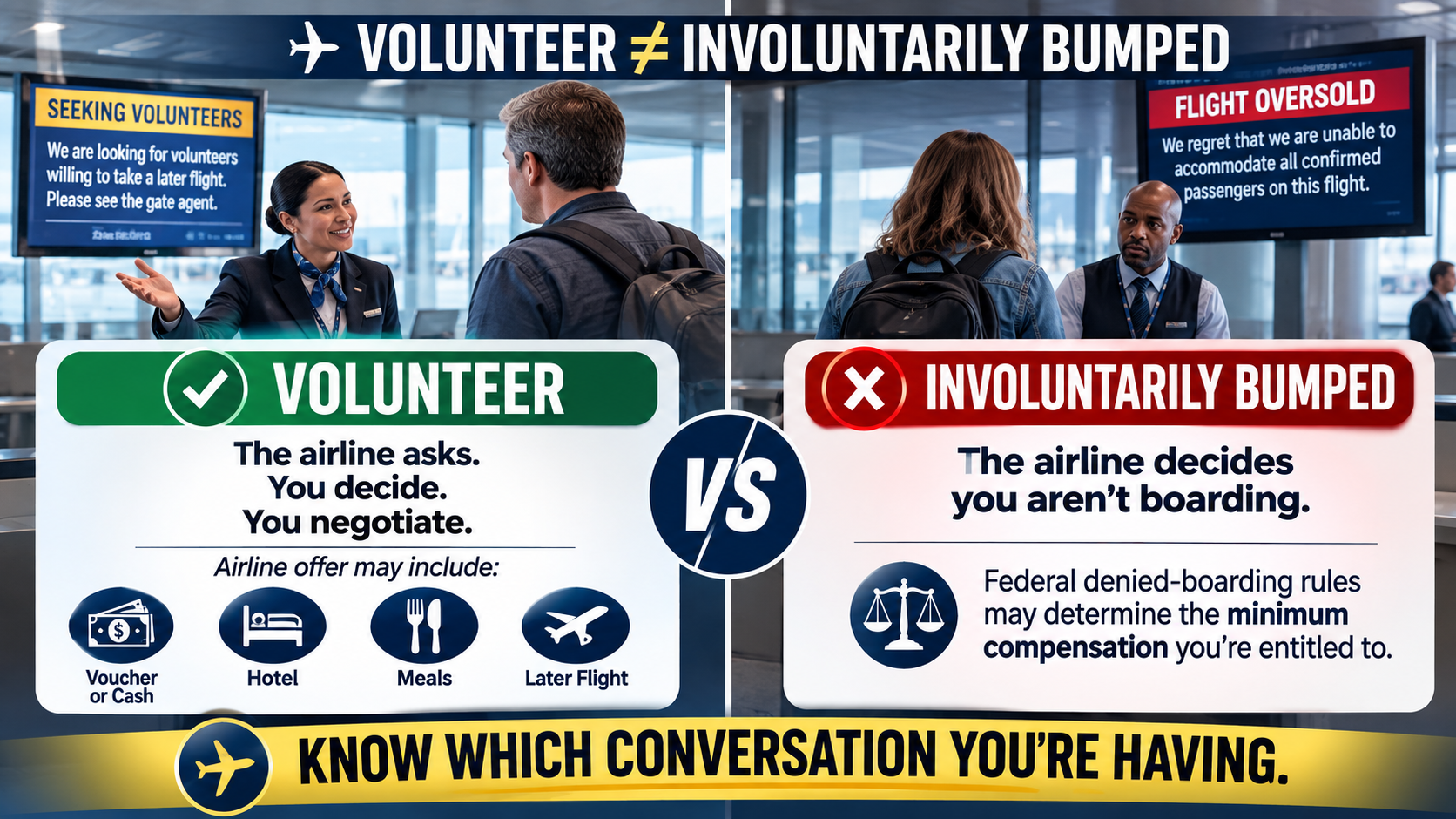
"We're looking for volunteers willing to take a later flight..."
That's not involuntary denied boarding.
That's a negotiation.
The airline needs something from you: your seat.
You get to decide what giving it up is worth.
The airline might offer cash, a voucher, meals, a hotel or another flight. If nobody takes the initial offer, it may increase.
There is no federal maximum on what a U.S. airline can offer someone who voluntarily gives up a seat. In fact, before involuntarily bumping passengers from an oversold flight, airlines must first ask for volunteers.
We're going to tackle the strategy behind volunteering in a separate article because there's quite a bit to consider before raising your hand.
But this article is about what happens when you don't volunteer.
You have a confirmed reservation. You followed the rules. You're ready to fly.
And the airline tells you that you're not getting on.
That's involuntary denied boarding, commonly called getting bumped.
Yes, Airlines Can Legally Overbook Flights
Overbooking itself isn't illegal in the United States.
Airlines know from years of data that some passengers won't show up for their flights. Selling more reservations than there are physical seats can reduce the number of empty seats flying around the country.
Usually the numbers work.
Sometimes they don't.
When more passengers show up ready to fly than the aircraft can accommodate, the airline must seek volunteers before it starts involuntarily denying boarding.
If there aren't enough volunteers, the airline can select passengers to bump using its established boarding priorities.
Those criteria can include things such as check-in time, fare paid and frequent-flyer status, although they cannot unfairly discriminate against passengers.
That gives us one very practical takeaway:
Don't Make Yourself an Easy Candidate
Having a ticket isn't enough if you don't follow the airline's requirements.
Check in on time.
Be at the gate on time.
Pay attention to boarding announcements.
For U.S. denied-boarding compensation to apply, you generally need a confirmed reservation, must have met the airline's check-in and gate requirements, and must actually have been involuntarily denied boarding because of an oversale. The flight also must depart from a U.S. airport, and the airline must be unable to get you to your destination within one hour of the originally scheduled arrival time.
So How Much Could the Airline Owe You?
This is where the distinction between a normal flight delay and involuntary denied boarding becomes important.
For qualifying U.S. involuntary denied boarding, compensation is tied to:
The price of your one-way fare.
Whether the flight is domestic or international.
How much later the replacement transportation gets you to your destination.
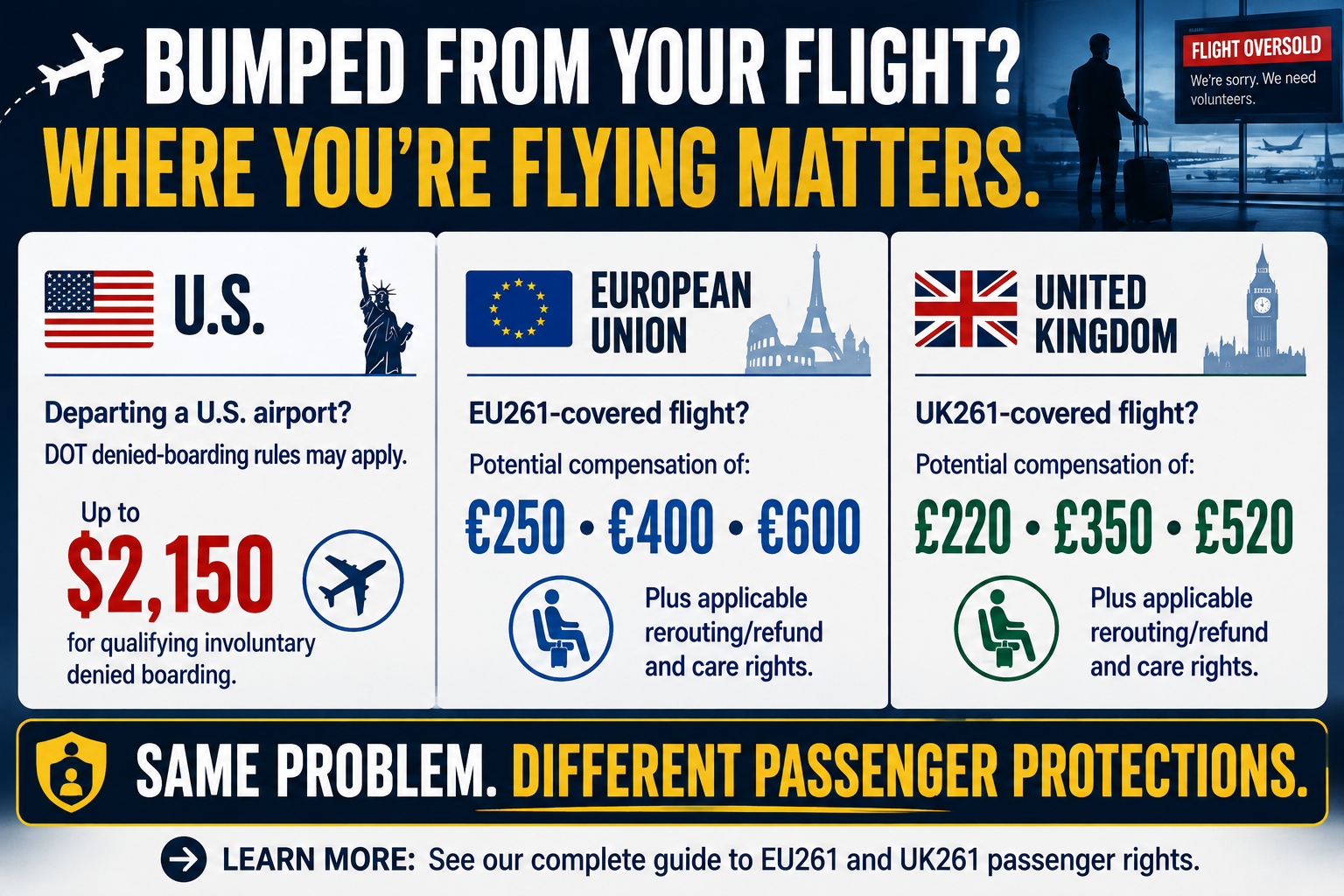
The current maximum can reach $2,150 per passenger for qualifying involuntary denied boarding.
Rather than turn this into a wall of percentages and numbers, here's the current breakdown:
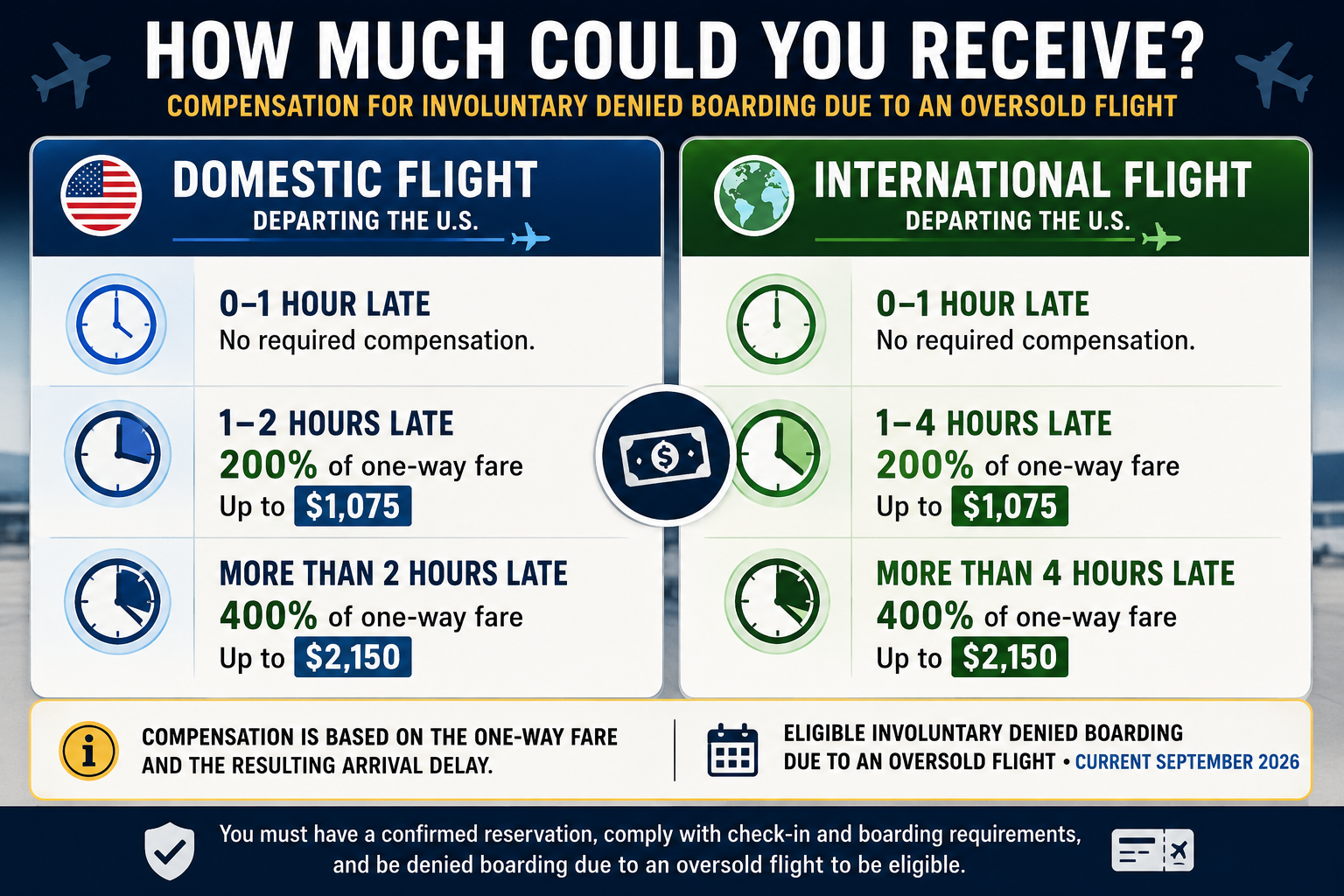
And remember: these are the amounts the airline may be required to pay.
They're not a legal ceiling on generosity.
DOT specifically says airlines are free to pay an involuntarily bumped passenger more than the required amount if they choose.
My First Class ride from Heathrow certainly falls into the category of the airline choosing to make a bad situation considerably better.
Don't Automatically Say Yes to a Voucher
This is where knowing which conversation you're having becomes important.
If you're voluntarily giving up your seat and the airline offers you a $1,000 travel voucher, you're negotiating an agreement.
But if you've already been involuntarily bumped and qualify for denied-boarding compensation, don't assume an airline voucher is your only choice.
Ask:
“Is this my involuntary denied-boarding compensation?”
Under U.S. rules, eligible passengers are entitled to the applicable denied-boarding compensation. DOT says that compensation must generally be offered at the airport on the same day. If the substitute transportation departs before the airline can pay you, the airline generally has 24 hours to provide payment.
A travel credit with restrictions or an expiration date is not necessarily the same thing as the compensation you're legally entitled to.
So before accepting something, understand what you're accepting and why you're receiving it.
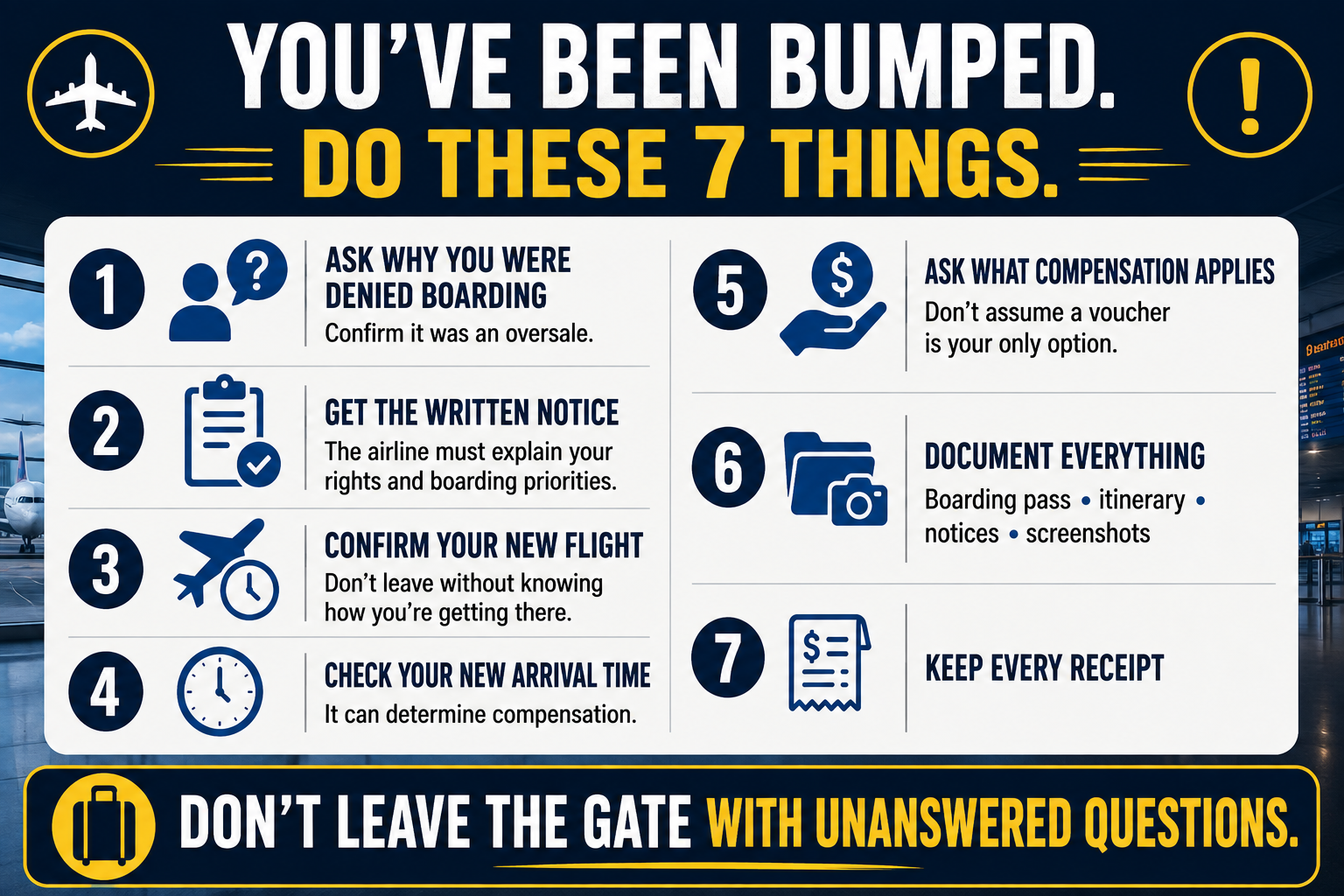
Get Your Rights in Writing
This may be one of the most useful things to know while you're standing at the gate.
If a U.S. airline involuntarily bumps you, DOT requires it to provide you with a written statement explaining your rights and how the airline determines who gets bumped.
Ask for it.
And while you're there, document what happened.
Take screenshots. Save the original itinerary. Keep the replacement itinerary. Photograph your boarding pass. Save notices from the airline.
Most importantly, know when your replacement flight is expected to reach your destination.
That arrival time can directly affect your compensation.
Already Boarded? The Rules Change
Here's one denied-boarding protection that I suspect many travelers don't know.
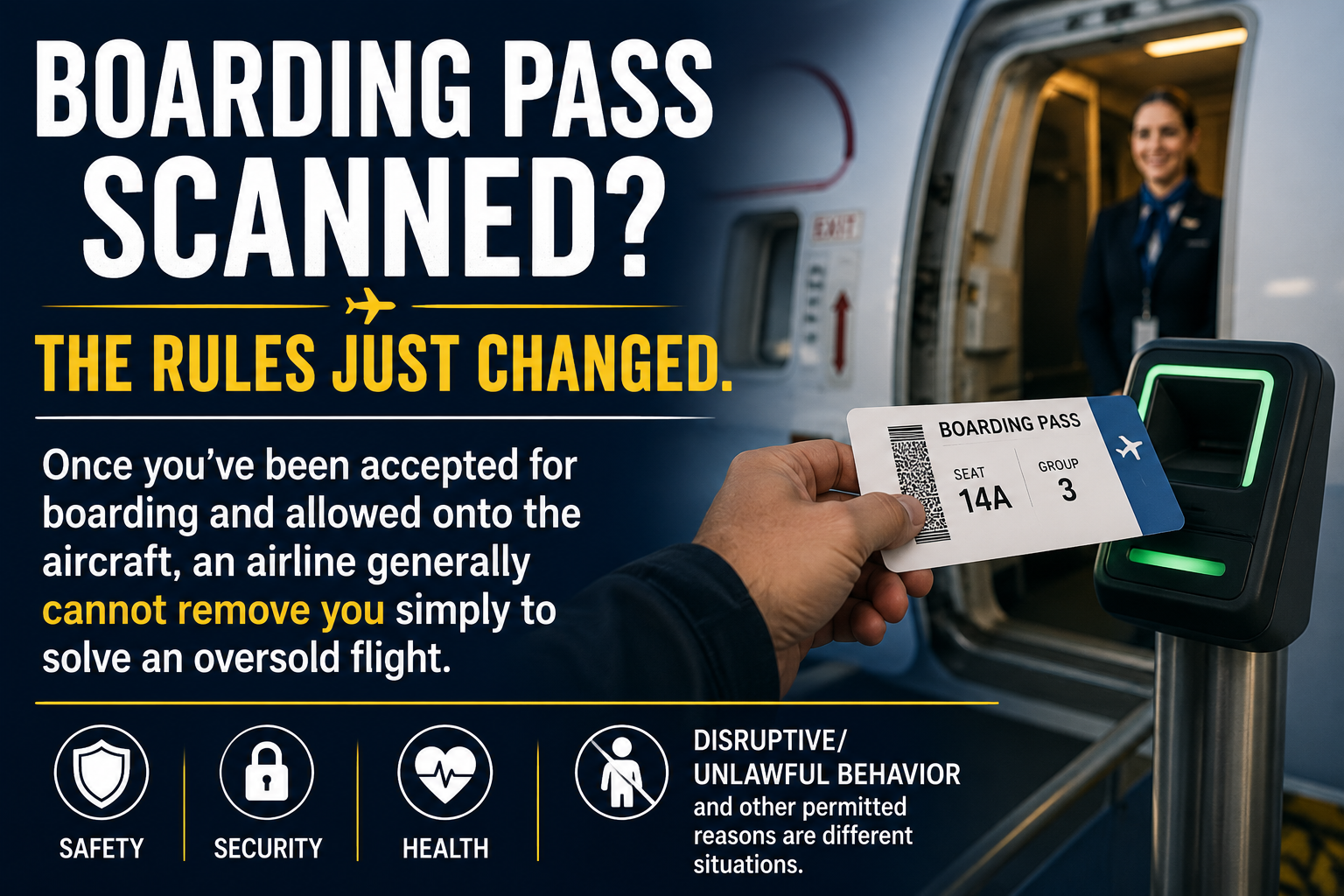
Generally, once you've properly checked in, had your boarding pass accepted or scanned by the gate agent and been allowed to board, the airline cannot remove you simply because it needs to solve an oversold-flight problem.
There are important exceptions.
An airline can still deny boarding or remove someone for legitimate safety, security or health reasons, or for obscene, disruptive or otherwise unlawful behavior.
But those are very different circumstances from:
"Sorry. We sold too many tickets and need your seat."
Not Every Refusal to Board Means You're Owed Compensation
This distinction matters.
An airline refusing to let you onto an airplane doesn't automatically make it compensable involuntary denied boarding.
U.S. denied-boarding compensation may not apply in situations involving things such as certain aircraft substitutions, some weight-and-balance restrictions involving smaller aircraft, charter flights and certain small aircraft. It also doesn't apply simply because an international flight is arriving in the United States from a foreign airport.
And then there are entirely different situations.
Show up too late?
Don't have the required passport or visa?
Present a legitimate safety or security problem?
Those aren't the same as arriving properly documented and on time with a confirmed reservation only to discover that the airline sold more seats than it can provide.
Why you were denied boarding matters.
Flying Internationally? Where You Were Bumped Matters Too
Here's where things get interesting.
Suppose you're flying:
New York → London
Because you're departing a U.S. airport, U.S. denied-boarding rules may apply.
But reverse the trip:
London → New York
U.S. denied-boarding compensation rules don't suddenly follow you to Heathrow simply because you're flying to America.
UK passenger protections may apply instead.
And qualifying flights covered by EU261 have their own denied-boarding protections.
Under current EU rules, passengers who properly present themselves for travel and are involuntarily denied boarding because of overbooking or certain operational reasons can be entitled to compensation, reimbursement or rerouting, and assistance. Current compensation levels are €250, €400 or €600 depending primarily on flight distance, although rerouting that gets you to your destination relatively quickly can reduce compensation by 50%.
UK261 follows a similar structure. Current denied-boarding compensation can reach £220, £350 or £520 depending on flight distance and how much later the alternative transportation gets you there. Passengers can also have rights to an alternative flight or refund and applicable care while waiting.
We've already gone much deeper into European passenger protections in our Flight Delays in Europe: Your EU261 & UK261 Rights guide.
Official Passenger-Rights Resources
For current rules, these are the sources I'd bookmark rather than relying on something somebody posted on social media three years ago
European Union: Air Passenger Rights
UK Civil Aviation Authority: Denied Boarding
Don't Get So Focused on Your Original Flight That You Miss a Better Solution
This is another lesson I took from my experience at Heathrow.
My original itinerary was:
London → JFK → Norfolk
Once that stopped working, British Airways found another way:
London → Boston → Norfolk
That wasn't what had originally been booked.
It didn't matter.
It got me moving.
If you're involuntarily bumped, absolutely understand what the airline owes you. But that doesn't mean you have to insist on recreating your original itinerary exactly.
Ask about alternatives.
Could another connecting airport get you there sooner?
Could another routing work?
Could a nearby airport be an option?
What is the earliest confirmed replacement the airline can offer?
And before agreeing to a new itinerary, make sure you understand the whole trip, not merely the next flight.
If an alternative requires an overnight, ask what the airline is providing.
Flexibility and passenger rights aren't mutually exclusive.
Sometimes knowing your rights gives you the confidence to consider a creative solution rather than simply fighting to get back onto the flight that's already leaving without you.
Know Whether You're Negotiating or Exercising a Right
That's the distinction I want you to remember the next time you hear an announcement looking for volunteers.
If the airline says:
“Who will take $500 to fly tomorrow?”
You're negotiating.
You can say yes.
You can say no.
You can wait and see whether the offer gets better.
But if you've followed the rules and the airline tells you:
“You aren't getting on this flight.”
The conversation has changed.
You may now have specific passenger rights and legally required compensation.
Before leaving the gate, understand:
Why you're being denied boarding.
How you're getting to your destination.
When you're expected to arrive.
What compensation applies.
What additional assistance the airline is providing.
My experience at Heathrow in 2002 ended remarkably well. I lost some time, but British Airways found another way to get me home, put me in First Class across the Atlantic and provided a hotel for the unexpected overnight.
I felt very well taken care of.
You don't need a First Class upgrade for an involuntary bump to end reasonably well.
But you do need to know the difference between what the airline is offering you and what you're actually entitled to.
IMPORTANT
Airline passenger-rights regulations and compensation limits can change. This article reflects rules and official guidance available as of September 2026 and is intended for general informational purposes, not legal advice. Always verify current requirements with the appropriate government authority and airline.