


Downgraded on an Asian Airline: What Are You Owed?
In Asia, the first question may not be how far you're flying. It may be which airline you're flying.
Europe gave us 30, 50 and 75.
The United States gave us a much less satisfying answer involving fare differences, ticket prices and the occasional headache.
Asia gives us another answer entirely:
Which airline are you flying?
There isn't one Asia-wide passenger-rights regulation governing airline cabin downgrades.
That doesn't mean you're simply out of luck if you paid for Business Class and ended up in Economy.
Quite the opposite.
Some Asian airlines publish remarkably specific downgrade policies.
The catch is that those policies can look completely different from one airline to another.
Same Problem. Three Very Different Answers.
Imagine three passengers who each bought Business Class and were involuntarily moved to Economy.
One is flying ANA.
One is flying Japan Airlines.
One is flying Air China.
All three have essentially the same complaint:
I paid for this cabin. You put me in that one. What do I get back?
The answers are surprisingly different.
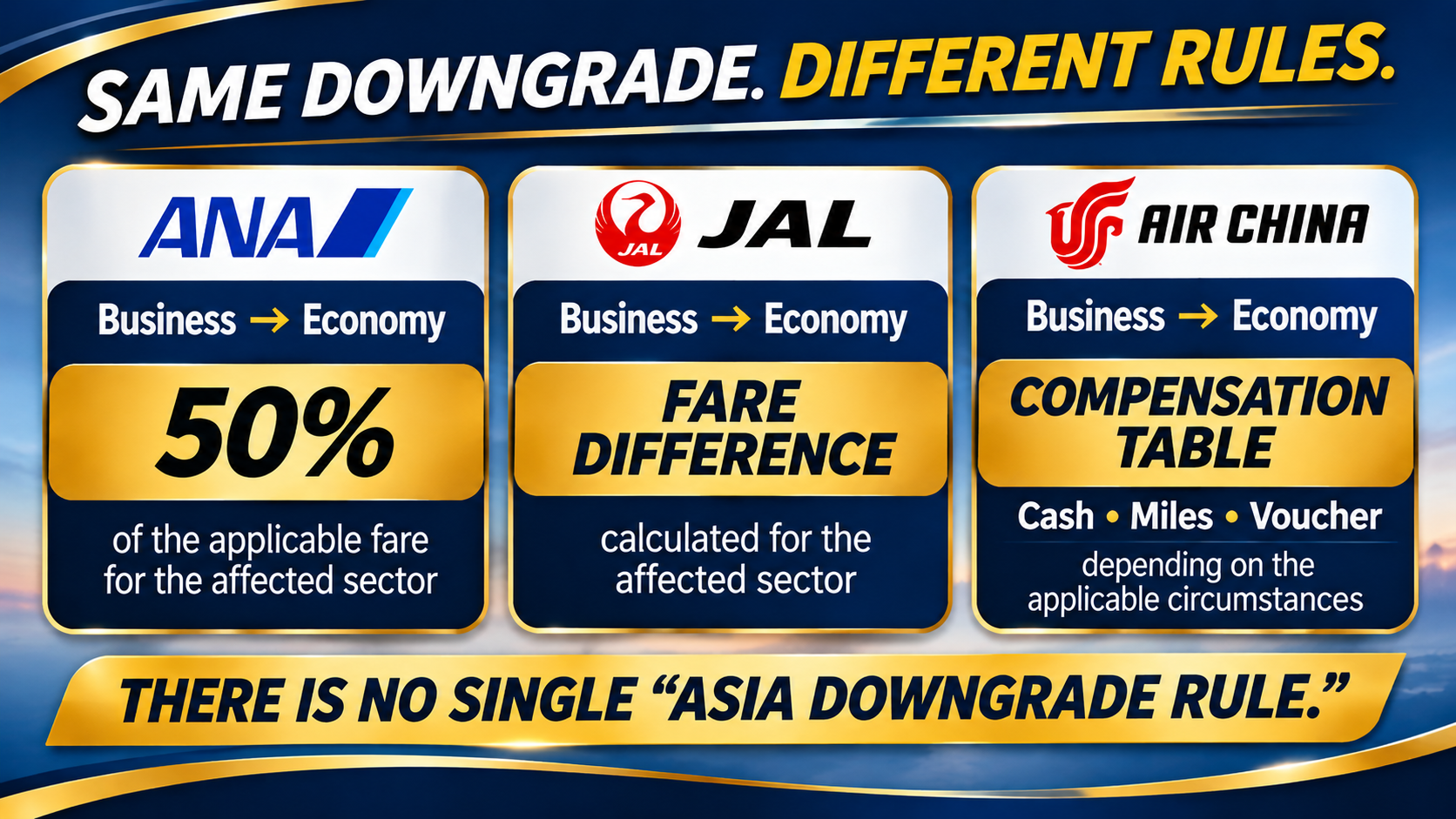
ANA: Here's Your Percentage
ANA gives us something that feels almost European.
Its current International Conditions of Carriage publish specific percentages when a passenger who paid for one class is required by ANA to travel in a lower one.
They currently work like this:
First Class → Business Class: 50%
Business Class → Premium Economy: 40%
Business Class → Economy: 50%
Premium Economy → Economy: 30%
The percentage is applied to the applicable fare for the affected sector. If that sector is part of a through fare, ANA says the amount is prorated by distance.
That's a very different calculation from Europe's 30 / 50 / 75 system.
But at least ANA gives you numbers.
There's another important wrinkle.
For a codeshare flight operated by another carrier, ANA's Conditions of Carriage specifically say the operating carrier's terms and conditions apply to the downgrade refund.
So the airline name at the top of your reservation may not tell you the whole story.
Japan Airlines: Calculate the Fare Difference
Japan Airlines takes another approach.
Under JAL's current International Conditions of Carriage, when a passenger who paid for one class is required to use a lower class, JAL calculates the refund based on the fare difference for the sector where the downgrade occurred.
JAL also tells passengers dealing with irregular operations that when a cancellation or aircraft change results in travel in a lower class, the fare difference is refunded, although it notes that there may be no refund depending on the fare type.
So now we have two major Japanese airlines dealing with essentially the same problem differently.
ANA: published percentages.
JAL: fare-difference calculations.
And then Air China enters the conversation.
Air China: Cash, Miles or a Voucher
Air China's current Passenger Compensation Standards look completely different again.
Air China publishes detailed tables for involuntary class downgrades, revised in April 2026.
The compensation varies depending on factors including the route, the cabin purchased and the cabin actually flown.
And Air China currently allows the applicable compensation to be provided using one of three methods:
Cash.
Mileage.
A voucher.
The published tables contain specific compensation amounts rather than ANA's percentage formula or JAL's fare-difference approach.
At this point, the larger lesson becomes pretty hard to miss.
There isn't an “Asian downgrade rule.”
There are airline rules, route rules and sometimes government regulations layered on top of them.
The Operating Airline Can Matter More Than the Flight Number
This is particularly important with codeshares.
Suppose you buy a ticket carrying one airline's flight number, but another airline actually operates the airplane.
Which rules apply?
Don't assume it's automatically the airline whose code appears on your reservation.
ANA, for example, tells passengers that flights operated by partner airlines may be subject to the operating carrier's terms and conditions, and its downgrade provision specifically directs codeshare downgrade refunds to the operating carrier's terms.
So if you're involuntarily downgraded, look for two little words on your reservation:
OPERATED BY
That may tell you where to start.
Your Route Can Change the Answer Too
There's another reason we can't build one neat Asian chart.
Flying an Asian airline doesn't necessarily mean only that airline's home-country rules matter.
A flight departing the European Union, for example, can fall under EU passenger protections even when the operating airline is based in Asia.
A flight involving the UK can bring UK passenger-rights rules into the picture.
And flights involving the United States may be subject to U.S. requirements where those rules apply.
So:
“I'm flying an Asian airline.”
isn't enough information to determine what you're owed.
You may need to know:
Which airline actually operates the flight?
Where does the flight depart?
Where is it going?
Which cabin did you buy?
Which cabin did you actually fly?
That's less catchy than 30 / 50 / 75.
But it's much more useful.
What If You Used Miles?
This is where things get particularly interesting for Curated Upgrades readers.
A cash ticket and an award ticket don't necessarily produce the same answer.
ANA provides an excellent real-world example in its own international flight award rules.
For an involuntary downgrade, ANA recalculates the mileage required for the cabin actually flown and refunds a mileage difference when one exists.
Sounds straightforward.
Until you add a connection.
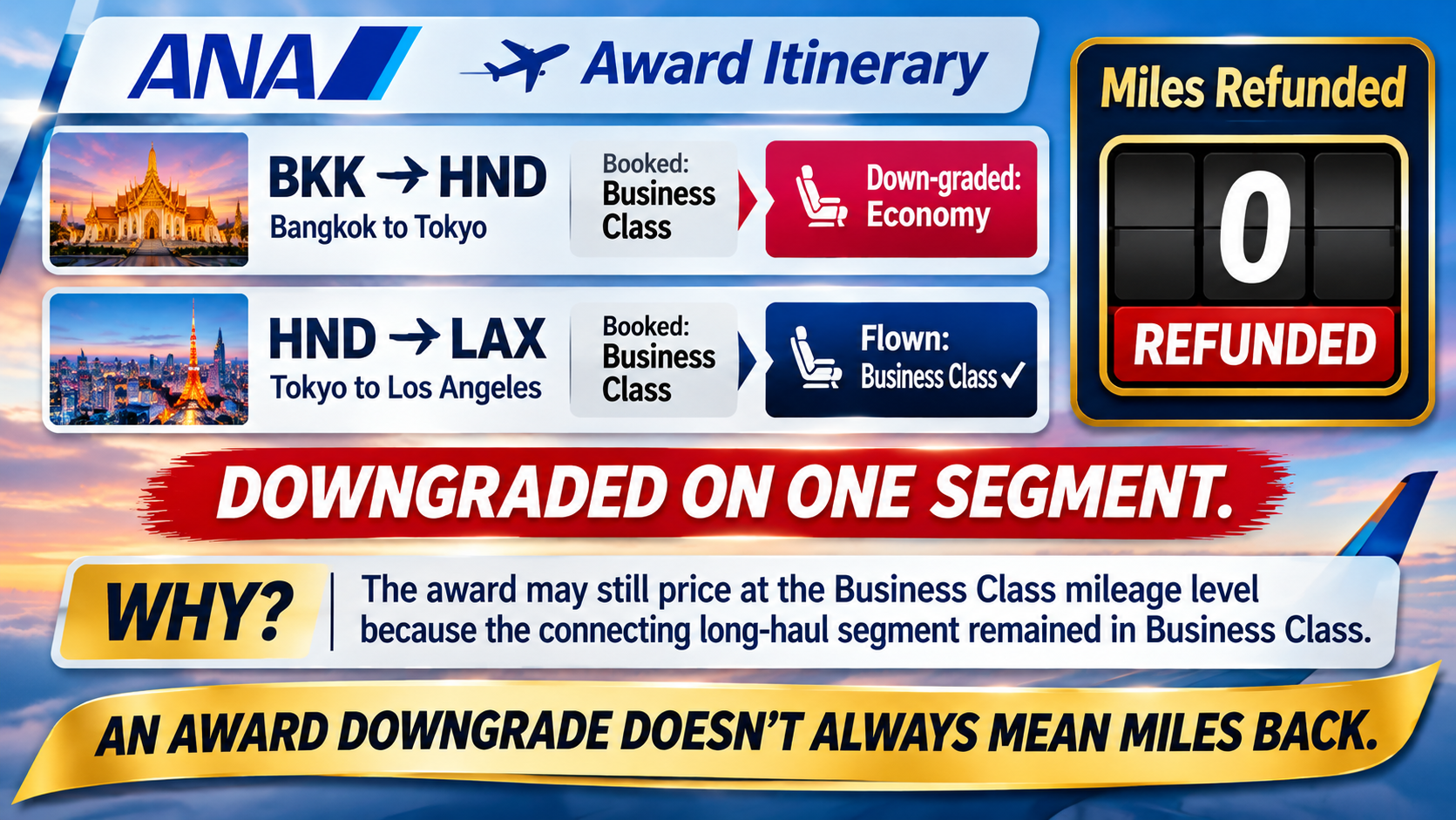
ANA prices connecting award itineraries containing multiple cabins using the higher cabin for each outbound or return journey.
And ANA actually gives an example very close to this:
Bangkok → Tokyo → Los Angeles
Suppose the outbound journey was booked using the Business Class mileage requirement.
Bangkok to Tokyo gets downgraded to Economy.
But Tokyo to Los Angeles remains in Business Class.
You did, unquestionably, fly one segment in a lower cabin than you booked.
Yet the outbound journey can still require the Business Class mileage amount because you flew the Tokyo-to-Los Angeles segment in Business.
Result?
Miles refunded: zero.
And ANA isn't the only program where this can happen.
JAL's current oneworld award rules state that when different cabins are included in a journey, the higher class mileage applies. JAL also specifically warns that no mileage is refunded when an aircraft change causes a downgrade to Economy on a oneworld award.
That's exactly why we don't want to tell someone:
“You were downgraded. Just ask for the difference in miles.”
Sometimes, under the award's pricing rules, there isn't one.
The better question is:
How does this specific loyalty program recalculate my award after an involuntary downgrade?
Take the Flight or Refuse the Downgrade?
This is the same practical decision we've encountered throughout this series.
You expected Business Class.
The airline offers Economy.
The next premium seat might be tomorrow.
What do you do?
There isn't one correct answer.
If arriving today matters more than the cabin, taking the lower seat may be the right decision.
If the premium experience was one of the main reasons you chose that flight, waiting or requesting another routing may make more sense.
But before voluntarily accepting a different arrangement, ask what happens to your ticket, fare, miles and downgrade compensation.
And make sure the record reflects what actually happened.
There's a meaningful difference between:
The airline involuntarily downgraded me.
and:
I voluntarily changed my reservation to Economy.
That distinction can matter when the refund or award is eventually calculated.
Keep the Evidence
The basics don't change just because you've crossed the Pacific.
Keep the original reservation showing the cabin you purchased.
Keep the boarding pass showing the cabin you actually flew.
Save airline emails, texts or app notifications explaining the change.
If compensation is offered at the airport, understand what you're accepting before agreeing to it.
Then check the operating airline's current Conditions of Carriage, loyalty-program rules if miles were involved, and any passenger-rights law that applies to your route.
Three Regions. Three Very Different Systems.
That's really what this series has uncovered.
In the United States, an involuntary downgrade may entitle you to a refund of the difference between the service you purchased and the service you received, but calculating that amount isn't always beautifully transparent.
See Downgraded From First, Business, or Premium Economy: What Are You Owed in the U.S.?
In the European Union and UK, covered downgrades give us the much cleaner 30 / 50 / 75 reimbursement structure.
See Downgraded on a European or UK Flight: What Are You Owed?
In Asia, there is no equivalent continent-wide formula.
ANA publishes percentages.
JAL calculates fare differences.
Air China publishes compensation tables.
Other airlines may have different policies again, while passenger-protection laws applicable to the route can add another layer.
Same problem.
Very different answers.
And that completes our trip around the downgrade world.
The Curated Verdict
🟢 CHECK THE OPERATING AIRLINE
Don't stop at the airline code printed on your ticket. On a codeshare, the carrier actually operating the aircraft may have rules that affect how the downgrade is handled.
🟡 CHECK THE ROUTE TOO
An Asian airline doesn't automatically mean only that airline's own rules apply. Passenger protections from another jurisdiction may cover the flight.
🔴 DON'T ASSUME YOUR REFUND WORKS LIKE EUROPE
There is no Asia-wide 30 / 50 / 75 rule. ANA, JAL, Air China and other carriers can calculate downgrade refunds or compensation very differently.
The Bottom Line
If an airline in Asia moves you from the cabin you paid for to something farther back, don't start with:
“What's the Asian rule?”
There may not be one.
Start with:
Who actually operates my flight?
Then:
What does that airline's downgrade policy say?
And finally:
Does another passenger-rights law apply to this route?
Europe gave us three numbers.
Asia gives us three questions.
And if you remember those, you'll know where to start.
Passenger-rights regulations, airline Conditions of Carriage and loyalty-program rules can change. This article provides general travel information, not legal advice. Information current as of November 2026.