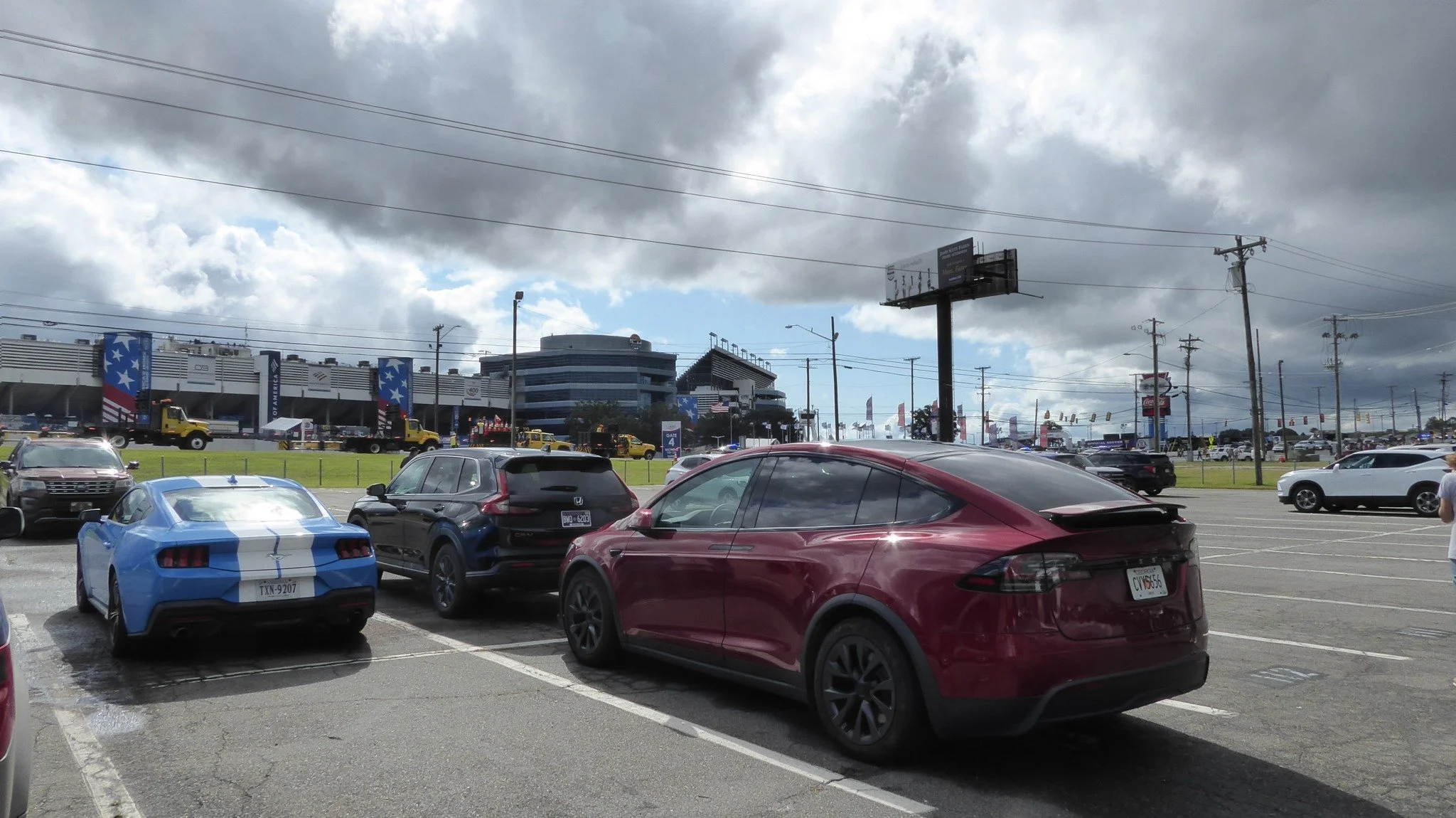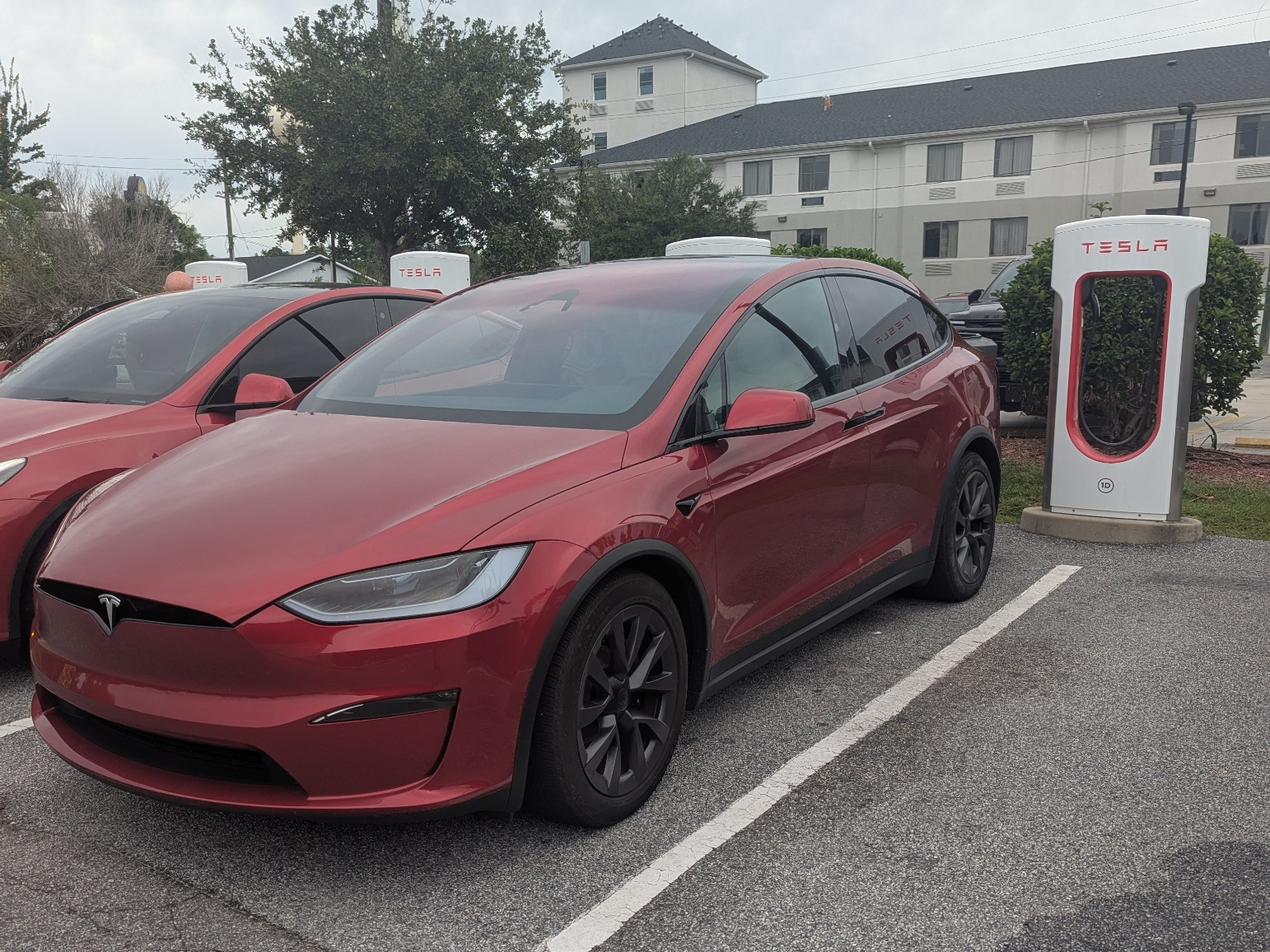
Driving 855 Miles to NASCAR in a Tesla Model X
Three nights in Charlotte, a weekend of racing, and an electric road trip that was considerably less complicated than some people might expect.
There are plenty of opinions about taking an electric vehicle on a long road trip. You'll hear about range anxiety, broken chargers, long waits, and the inconvenience of planning your travels around a battery.
We decided to drive our Tesla Model X from southeastern Georgia to Charlotte Motor Speedway for a NASCAR weekend in October 2026.
Our total round trip was 855 miles, including driving around the Charlotte area.
We spent $96.96 at Tesla Superchargers, encountered no charging problems, and never had to wait for an available stall.
And the lowest battery level we saw all weekend? 19%, when we arrived home.
This isn't an argument that everyone should drive an EV. It's simply what happened when we took ours to NASCAR.
Let the Car Handle the Planning
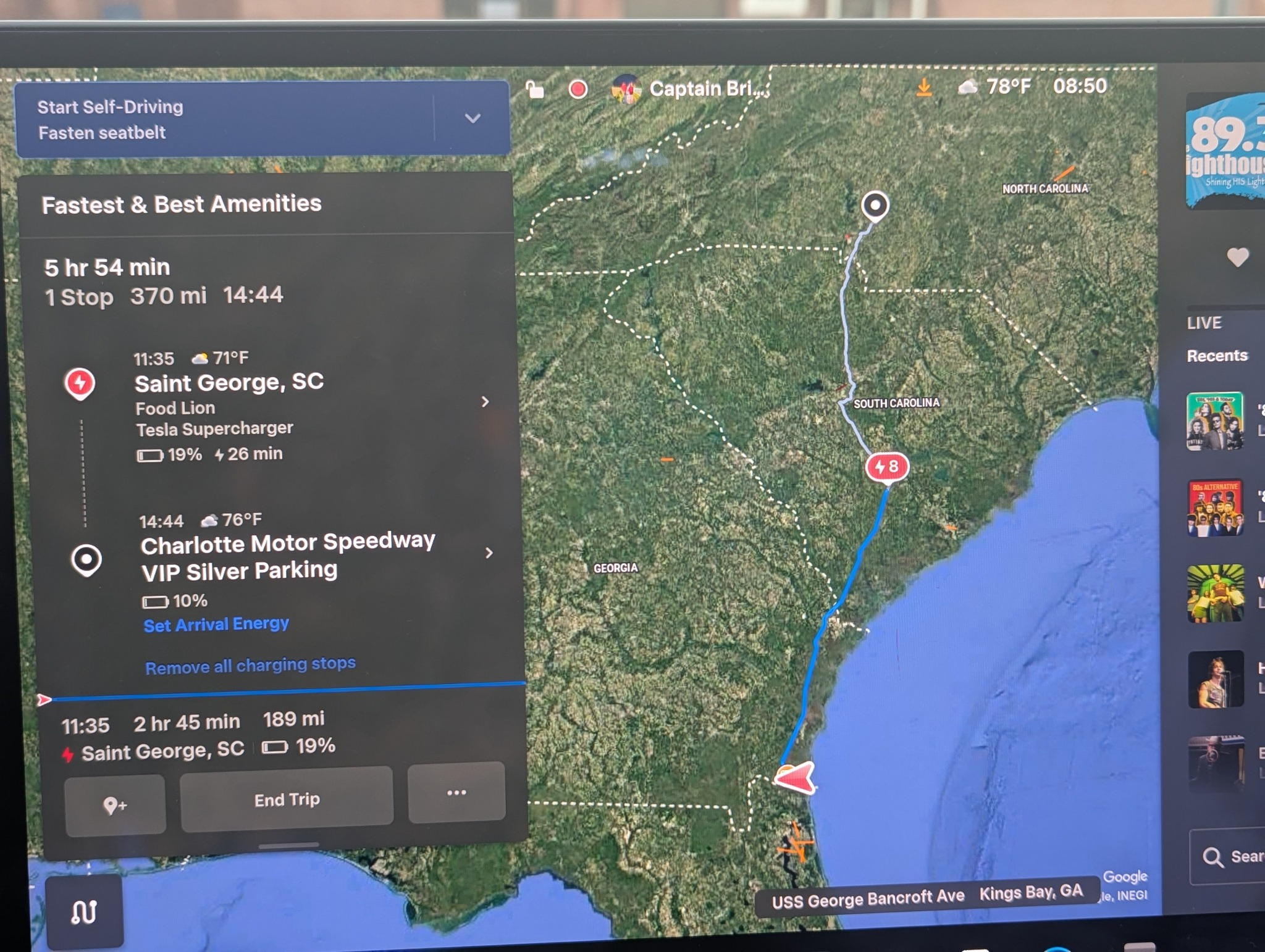
We left home with a full battery, entered Charlotte Motor Speedway into Tesla navigation, and let the car calculate the route.
The navigation system considers the vehicle's battery level, anticipated energy consumption, and available Superchargers. It recommends where to stop, how long to charge, and the estimated battery level at each destination.
We can also set our preferred arrival battery level. If a proposed stop leaves us with less reserve than we're comfortable with, we can look at other Superchargers along the route and select a different one.
The original route displayed on our screen proposed one charging stop in Saint George, South Carolina, with an estimated 19% battery remaining upon arrival there and 10% at the speedway.
Those were estimates, not instructions we were obligated to follow.
We have the option to change our plans whenever we like. If we decide it's time for a restroom break, food, or a gas station convenience store, we can ask the car for nearby options and have navigation adjust the route.
For this trip, the suggested charging times fit naturally with when we wanted to stop anyway.
We didn't spend hours developing a separate charging itinerary.
The Drive: Comfortable, With a Little Help From FSD
The Model X is a comfortable vehicle for a long drive.
One feature that made this trip particularly pleasant was Full Self-Driving (Supervised).
We subscribe to FSD for $99 per month, and for the amount of highway driving we do, we consider it money well spent.
We used it for approximately 99% of this trip and experienced no problems or situations requiring us to intervene.
That doesn't mean the vehicle is autonomous or that the driver can stop paying attention. FSD is a supervised driver-assistance system. The person behind the wheel must remain attentive and ready to take control.
But on a long highway drive, having the vehicle assist with steering, speed, lane changes, and navigation makes a noticeable difference in how tiring the journey feels.
We also appreciate how the car approaches Supercharger parking.
During our trip, we observed it selecting available stalls and, when practical, leaving a space between us and another charging vehicle.
Think of a public restroom with four urinals. If only one is occupied, most men aren't going to choose the one immediately beside it.
Apparently, the Model X understands the concept of personal space, too.
Charging While We Eat, Not Eating While We Charge
One of our favorite approaches to EV road trips is simple: combine charging with something we'd be doing anyway.
On the drive north, we stopped in Orangeburg, South Carolina, and decided to have lunch at Cracker Barrel.
The Superchargers were in the restaurant's parking lot.
We plugged in, went inside, and enjoyed our meal. We stayed longer than the car needed for charging, and the battery reached approximately 80% before we finished eating.
There was no sitting in the vehicle watching the charging percentage climb.
The lunch break was longer than the charging stop.
That distinction matters.
With a gasoline vehicle, you stop to refuel, then move the vehicle and go eat. With an EV, if a charger is conveniently located near a restaurant, you can accomplish both at the same time.
Of course, not every Supercharger has a restaurant next door. But on this trip, the charging locations worked well with our normal travel breaks.
Three Nights Without Charging at Our Airbnb
We stayed three nights at a detached pool-house Airbnb in Harrisburg, convenient to Charlotte Motor Speedway.
The property didn't provide us with EV charging, and we never asked about plugging into a standard 110-volt outlet near the garage.
We didn't need to.
After arriving in the Concord area, we used a Supercharger.
On Saturday evening, after dinner, we had some spare time and decided to top off the battery again.
That additional charging session wasn't necessary. It was simply convenient.
We didn't spend the weekend worrying about where to plug in, and the lack of overnight charging didn't affect our plans.
We often recommend charging while you sleep when accommodations offer that option. It's convenient to wake up with a full battery.
But this weekend demonstrated something equally important: You don't necessarily need overnight charging to enjoy an EV road trip.
For more about the accommodations themselves, including what worked and what didn't, see Our Harrisburg Airbnb: Convenient Location, Mixed Experience.
No Lines, No Broken Chargers, No Drama
Here's something that genuinely impressed us.
Throughout the entire weekend, we never encountered a line for a Supercharger, found ourselves unable to use a charging location, or had a problem finding an available stall.
That's particularly interesting given how many more Teslas we're seeing on the road.
Three years ago, we might have spotted one or two Teslas around our hometown. Today, it's not unusual to see seven or eight during a ten-minute commute.
Yet our charging experience throughout this trip was completely uneventful.
We also noticed that a couple of Supercharger locations had dedicated charging spaces designed for vehicles towing trailers.
That's a welcome improvement.
Anyone who has towed a trailer understands how inconvenient it can be to maneuver into a conventional parking space, particularly when you can't easily disconnect the trailer.
Seeing charging infrastructure designed to accommodate those vehicles was encouraging.
Naturally, our experience doesn't guarantee every Supercharger will be available or working on every trip. But it does challenge the idea that long-distance EV travel inevitably involves broken equipment and long waits.
What Did Charging Cost?
Let's keep the economics simple.
Our entire 855-mile weekend required $96.96 in paid Supercharging, including charging on the highway and around Concord.
We saw regular gasoline prices generally between $3.90 and $4.00 per gallon along our route.
For comparison, a gasoline vehicle averaging 25 MPG would use approximately 34 gallons over 855 miles, costing around $135 at $3.95 per gallon.
That's roughly $38 more than our Supercharging bill.
Our Tesla also started with a full battery charged at home, just as a gasoline vehicle could start with a full tank. The $96.96 figure doesn't include the electricity used before departure.
We're not suggesting an EV is always dramatically cheaper to operate. Different vehicles have different fuel requirements, and charging prices vary.
We chose the Model X because we enjoy driving it, not because we're trying to win an argument about the cheapest possible way to travel.
The charging cost is simply another piece of the experience.
The Return Trip: The Car Was Ready Before We Were
Our drive home was just as uneventful as the trip north.
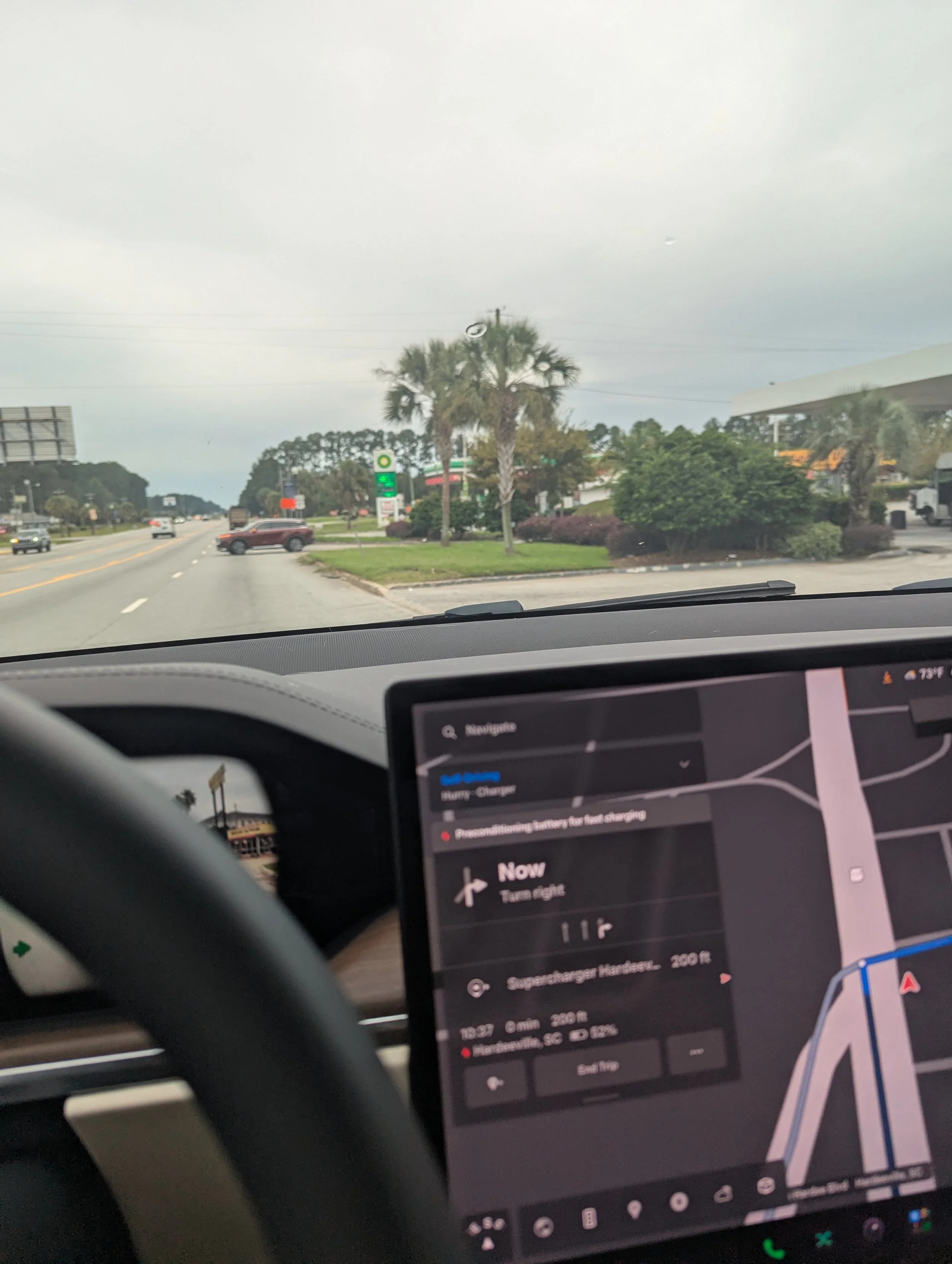
About two hours into the return journey, around 10 AM, we stopped at a Supercharger near a Hardee's.
We went inside for breakfast sandwiches and drinks.
The car finished charging before we even placed our order.
Around noon, we stopped again for a restroom break and something to drink. Once again, the vehicle was ready before we finished in the store.
Neither stop felt like time wasted waiting for electricity.
We simply took our normal travel breaks, and the car charged while we were occupied.
When we arrived home, the Model X pulled into our garage with 19% battery remaining.
That was the lowest battery level of the entire weekend.
At no point did we experience range anxiety or feel uncomfortable with the battery reserve.
After 855 miles, we were home. No charging emergencies, no stranded vehicle, and no unexpected complications.
We Went to NASCAR, Not to Test an Electric Car
The purpose of this trip wasn't to conduct an EV experiment.
We went to Charlotte to enjoy a NASCAR weekend, visit the NASCAR Hall of Fame, experience the racing, and explore a little of the surrounding area.
The Model X was simply our transportation.
And that's probably the most important thing we can say about the drive.
We didn't have to organize our weekend around charging. We didn't have to leave an activity early because the battery was low. We didn't have to search desperately for somewhere to plug in.
We drove, stopped when it suited us, charged when convenient, and enjoyed the trip.
For the rest of our Charlotte experience, start with Our Charlotte NASCAR Weekend: The Plan, the Races, and the Unexpected.
Our Recommendations
🟢 Go for it!
If you're considering a long-distance EV road trip, don't automatically assume charging will make the journey difficult.
Use your vehicle's navigation tools, choose a battery reserve you're comfortable with, and look for opportunities to combine charging with meals or other stops.
If overnight charging is available, wonderful. If not, check whether convenient public charging can meet your needs.
And remember that actual results depend on the vehicle, route, weather, charging network, and driving conditions.
For us, this 855-mile trip was comfortable, convenient, and remarkably ordinary.
The car was ready to leave before we finished breakfast.
That's about as complicated as our EV road trip got.