

You’re Already Spending the Money. Are You Getting the Points?
You don’t need complicated tricks or extra spending to build a useful stash of travel rewards. Sometimes the biggest opportunity is simply earning more points from money you were already going to spend.
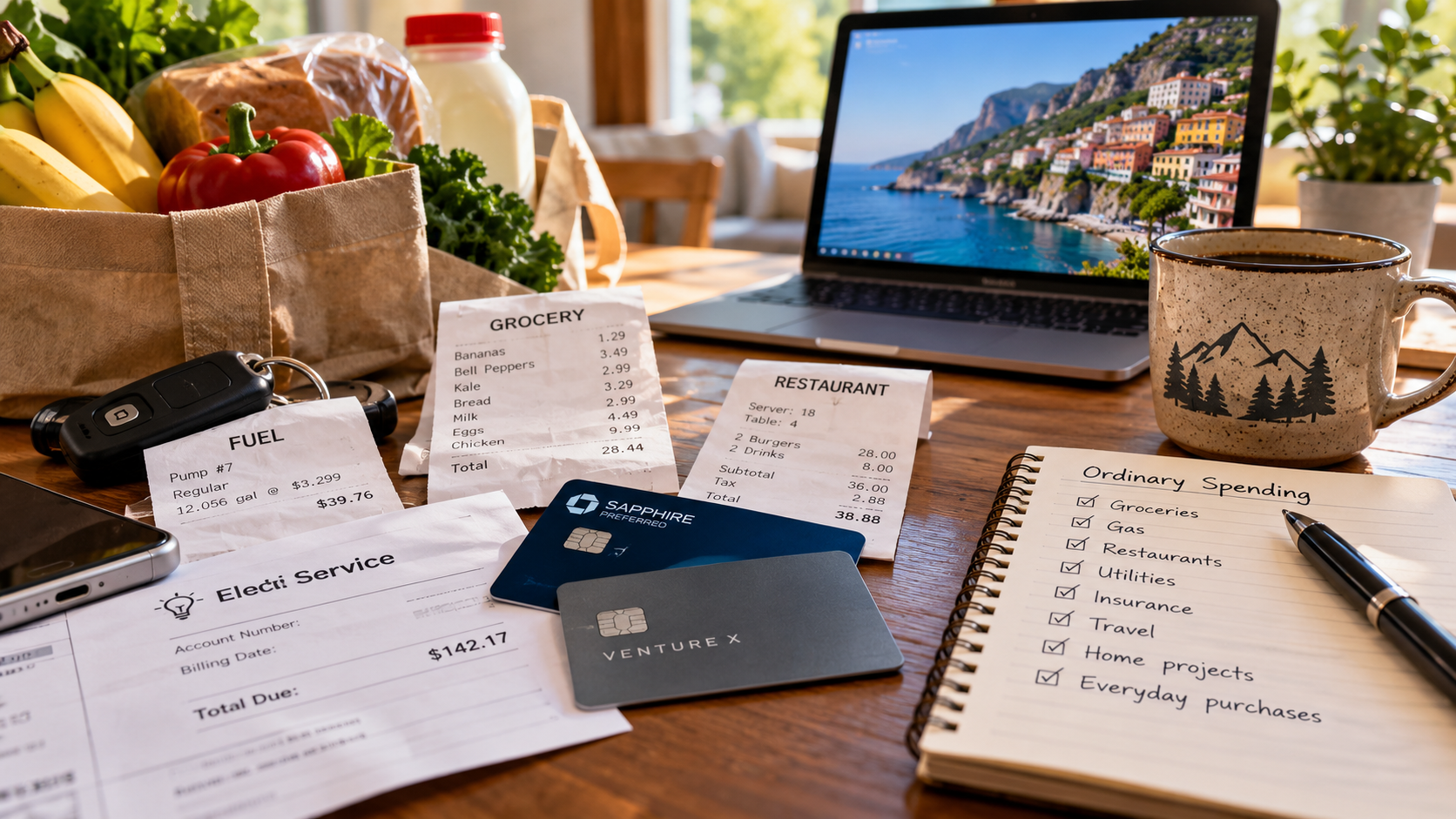
Groceries.
Gas.
Restaurants.
Utilities.
Insurance.
A hotel for the weekend. A new set of tires. The home improvement project you’ve been putting off since approximately the invention of drywall.
Most of us spend thousands of dollars every year on perfectly ordinary things.
If that spending is happening anyway, there’s a simple question worth asking:
Are you getting the points?
This is where earning travel rewards can be much simpler than the internet sometimes makes it sound.
You don’t necessarily need seventeen credit cards, elaborate manufactured-spending strategies or a laminated flowchart to determine which card should buy the toothpaste.
For many travelers, a good strategy can be much simpler:
Don’t spend for the points. Get points for the spending.
Start With the Money You Were Going to Spend Anyway
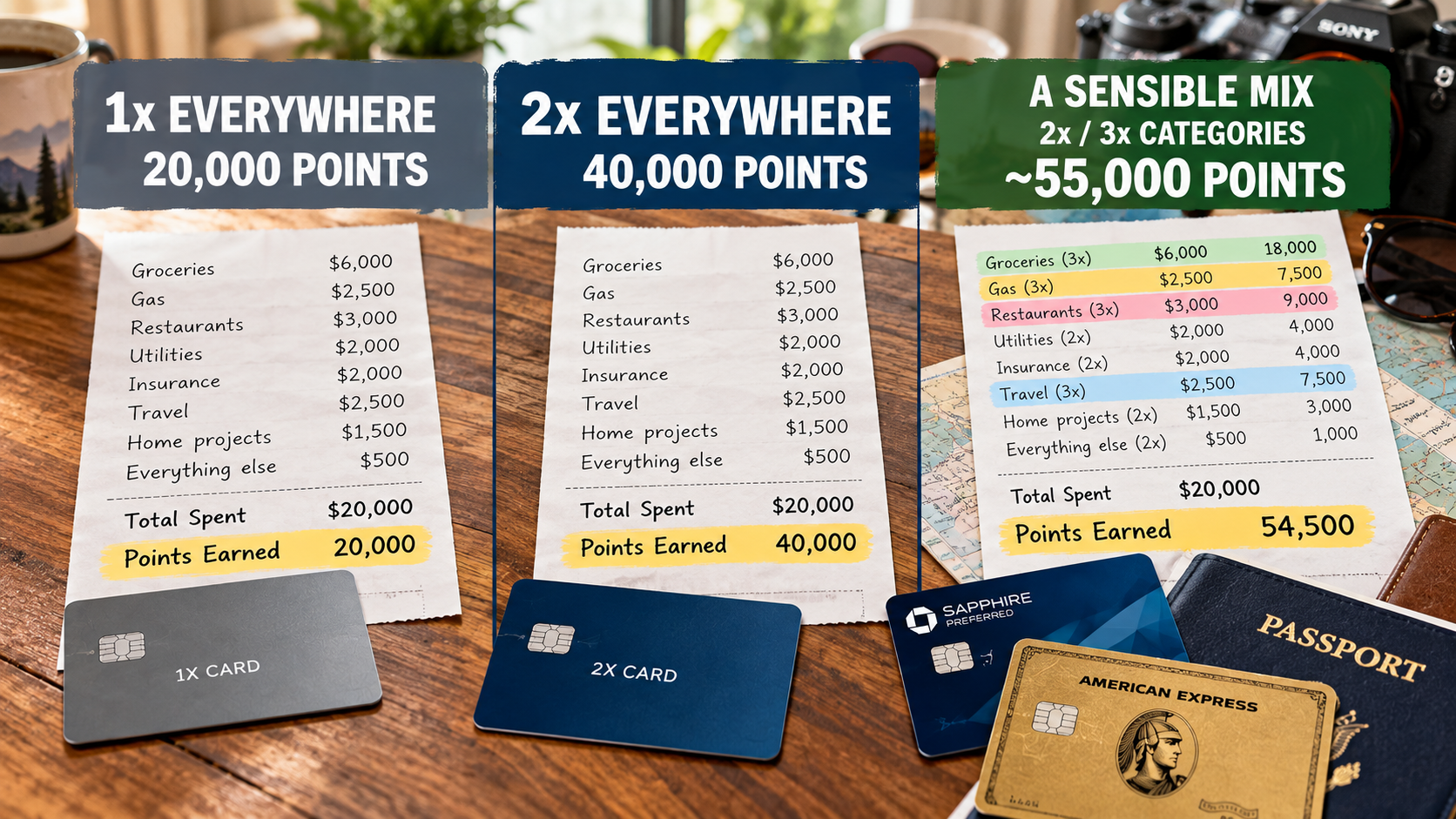
Suppose you normally put about $20,000 a year of regular expenses on credit cards.
That isn't an instruction to spend $20,000.
It's simply an illustration of spending that was already part of your budget.
If all $20,000 earns 1 point per dollar:
20,000 points
If that same $20,000 earns 2 points per dollar:
40,000 points
Same groceries.
Same restaurants.
Same utility bills.
Same household purchases.
Same $20,000 spent.
The only thing that changed was how the spending was rewarded.
And if some of those purchases naturally fall into useful 3x categories while the rest earns 2x, the total can climb higher without spending another dollar.
You Don't Need to Optimize Every Purchase
There's an entire corner of the travel-rewards world devoted to squeezing every possible fraction of a point from every transaction.
That can work.
It can also turn buying lunch into a strategic planning conference.
We prefer something simpler.
If you have a card that earns a useful bonus on categories where you spend regularly, use it there. Maybe that's dining, groceries, travel, fuel or EV charging.
For purchases that don't fit one of those categories, a card earning a solid return on ordinary spending can handle the rest.
That's essentially how we approach it ourselves.
We use higher-earning categories where they make sense and a 2x card for much of the otherwise stuff.
Could we squeeze out a few more points by carrying more cards and memorizing every bonus category?
Probably.
Do we want to consult a spreadsheet before buying dog food?
No.
The goal is to create a system simple enough that you'll actually use it.
If terms like multipliers, transferable points and award travel are still new territory, start with Points & Miles 101: The Travel Rewards Lingo You Need to Know.
A Welcome Bonus Is Only Valuable If the Spending Makes Sense
Large credit-card welcome bonuses understandably get attention.
Earn 75,000 points.
Earn 100,000 points.
Earn 150,000 points.
The number gets bigger, the type gets bolder, and suddenly somebody is staring at Amazon trying to figure out how to spend another $2,700 before Tuesday.
That's where the math can go sideways.
Suppose a card offers 100,000 points after spending $5,000.
If you were already going to spend $5,000 during the required period, the bonus might be extremely useful.
Maybe your normal household spending will cover it. Maybe you're about to pay an insurance bill, book a trip or replace an appliance that was already in the budget.
Fine.
But if you need to invent $5,000 worth of purchases to earn the bonus, those points aren't free anymore.
The spending requirement should fit your spending. Your spending shouldn't be changed to fit the requirement.
Spending More to Earn More Isn't a Travel Hack
The same problem can happen without a welcome bonus.
Imagine you normally put $10,000 a year on your cards.
Then you decide you really want enough points for a business-class ticket, so you push your spending to $20,000.
You may have earned more points.
You also spent another $10,000.
That's not saving money on a business-class ticket. That's changing your spending behavior because of a reward.
And that's precisely backwards.
Don't Spend for the Points
This is probably the simplest rule in the entire article.
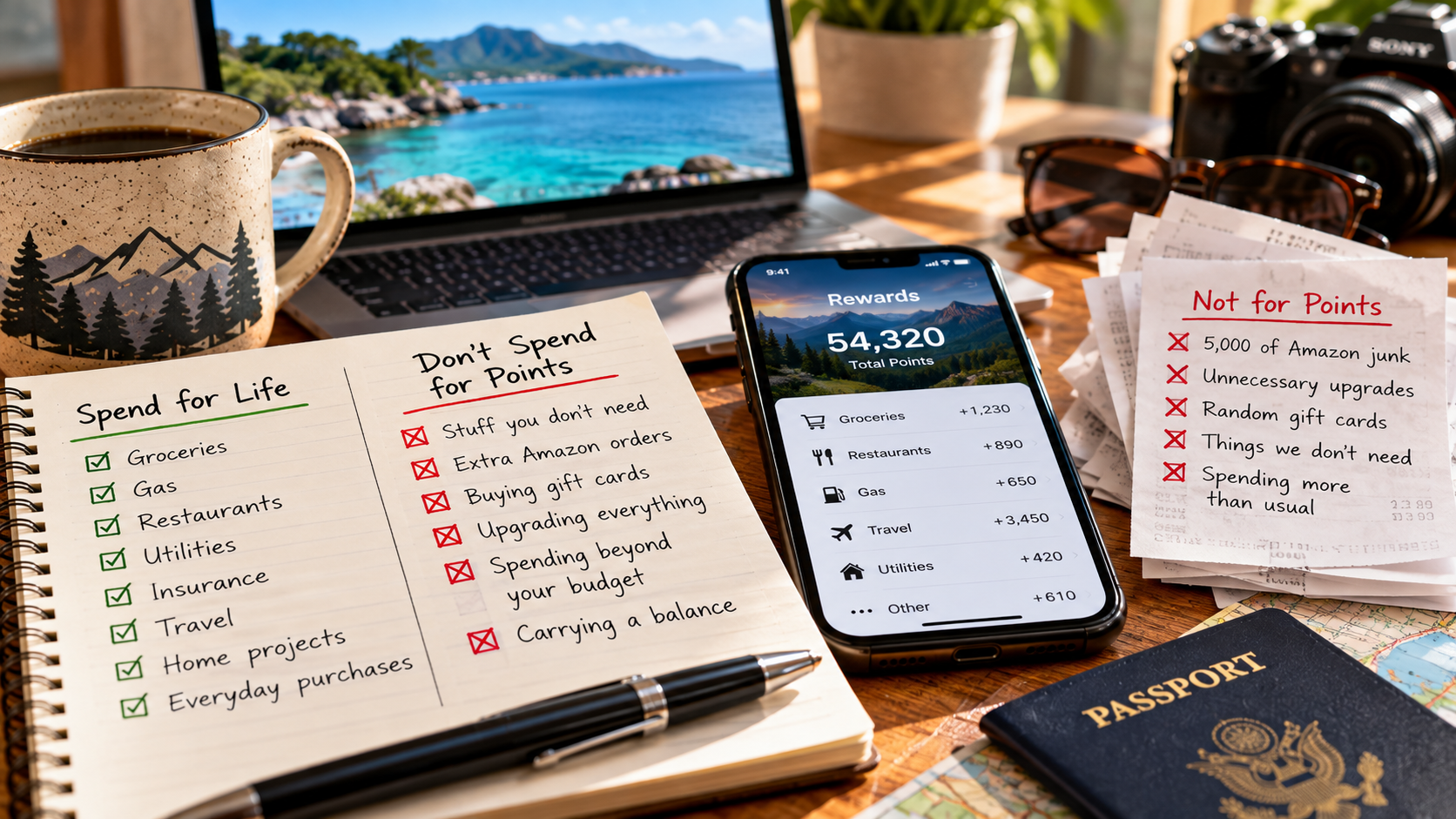
Spend for life. Not for points.
Buy the groceries because you need groceries.
Pay the electric bill because apparently the power company remains stubbornly committed to getting paid.
Book the hotel because you're taking the trip.
Replace the refrigerator because the old one has begun making noises suggesting it's communicating with another dimension.
Then, if those expenses can responsibly earn travel rewards, collect them.
Points should be a byproduct of your spending.
They shouldn't be the reason for it.
And Then There's Interest
This is the guardrail that matters more than every earning multiplier in this article.
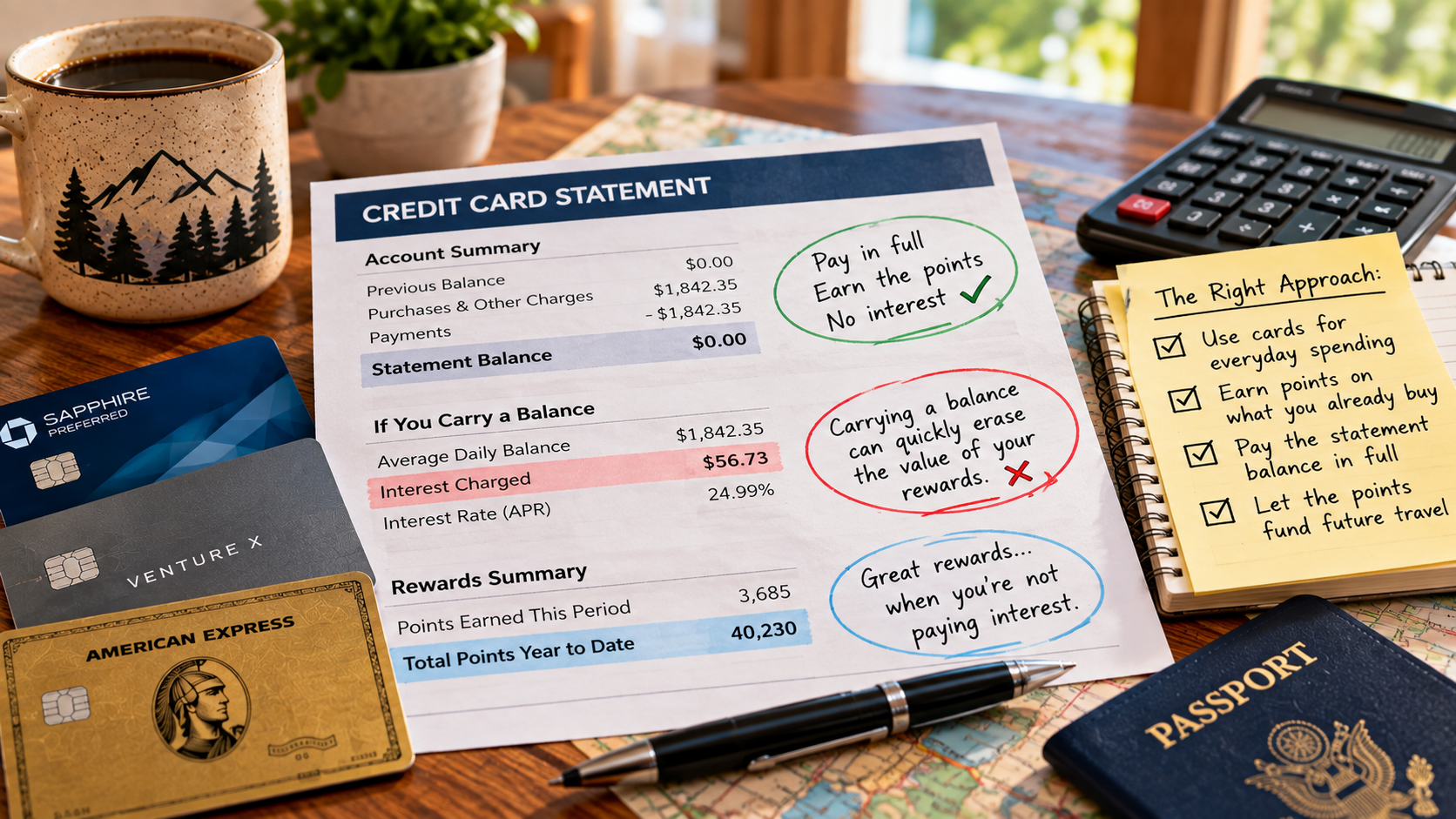
If you cannot pay the statement balance in full, don't chase travel rewards.
Credit-card rewards can return a few percentage points of value on your purchases.
Credit-card interest can cost dramatically more.
That means paying interest to earn points can erase the value of those rewards very quickly.
A 2x card doesn't rescue the math.
A 3x dining category doesn't rescue the math.
A shiny pile of airline miles doesn't rescue the math.
If carrying a balance is part of the equation, earning travel points should not be the priority.
Keep the System Simple
A rewards strategy doesn't have to be complicated to be useful.
For many people, something close to this is enough:
Use a card with useful bonus categories for spending you already do.
Use a solid everyday-earning card for purchases that don't fit those categories.
Don't buy things solely to trigger rewards.
Don't chase a welcome bonus that requires spending outside your normal budget.
And pay the statement balance in full.
That's not going to win an award for the world's most sophisticated credit-card strategy.
Good.
We're trying to fund travel, not qualify for the Points Olympics.
What Can Those Extra Points Actually Do?
This is where seemingly small differences start becoming interesting.
In our $20,000 example, moving from 1x everywhere to 2x everywhere creates another 20,000 points a year without increasing spending.
Do that for several years and the difference compounds.
Add sensible category bonuses and the gap can grow further.
Those points might eventually help with a hotel stay, domestic flight, positioning flight or part of a larger international trip.
They don't need to buy an around-the-world first-class itinerary to be useful.
They just need to make your trip more attainable.
And once you've accumulated the points, the next challenge is using them intelligently.
Before transferring flexible points to an airline or hotel, see Portal vs. Transfer Partner: Which Should You Use?
And if you've ever had plenty of points but couldn't find the flight you wanted, Award Availability: Why Having the Points Doesn't Mean You Can Book the Flight explains why.
Don't Let the Rewards Change the Behavior
There's an interesting psychological trap built into rewards programs.
The points start as a reward for spending.
Then, slowly, the spending can become a way to earn the reward.
That's the line worth watching.
A $200 purchase doesn't become cheaper because it earned 600 points.
An unnecessary $5,000 purchase doesn't become smart because it unlocked a 100,000-point bonus.
And spending twice your normal amount doesn't make a business-class award free.
The easiest way to keep travel rewards useful is to keep the relationship in the correct order:
Life creates the spending.
The spending earns the points.
The points help pay for travel.
Not the other way around.
The Most Important Thing to Remember
You don't have to become a points expert to earn meaningful travel rewards.
Start with the spending that's already happening.
Earn a reasonable return on it.
Take advantage of useful bonus categories when they're easy.
Ignore opportunities that require you to spend money you otherwise wouldn't.
Pay the statement balance in full.
Then let the points accumulate quietly in the background until there's somewhere you actually want to go.
Because the objective isn't to earn the most points.
It's to get more travel from money you were already going to spend.