


Flying in the Day Before Your Cruise: Why the Hotel Night Is Worth It
Arriving early does more than reduce stress—it gives delayed flights, missed connections and misplaced luggage time to recover before your ship leaves.
The advice to fly into your cruise departure city at least one day early can sound like an unnecessary expense.
You have already paid for the cruise and airfare. Now someone wants you to add a hotel, meals and perhaps another vacation day before you even board the ship.
But that hotel night is not merely another expense. It buys something that can be extremely valuable on embarkation day:
Time.
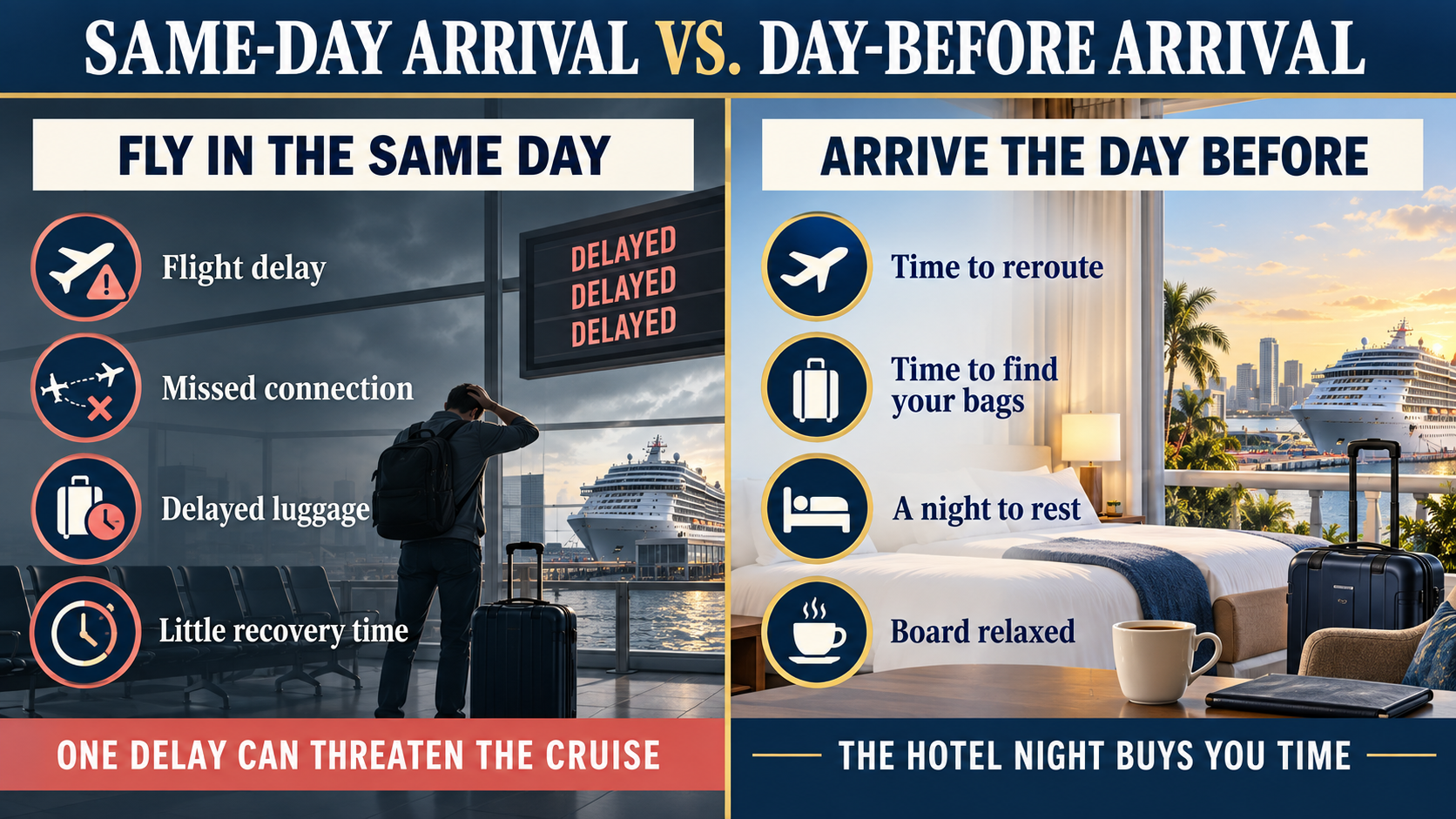
A delayed morning flight may be inconvenient when you arrive the day before. The same delay can threaten the entire vacation when your ship sails that afternoon.
Same-Day Flights Leave Little Room for Recovery
A cruise ship operates on its own schedule. Your assigned terminal arrival window will generally be several hours before departure, and final boarding can close well before the published sail-away time.
That means a flight scheduled to land at noon for a late-afternoon departure may not provide as much margin as it appears.
Several ordinary travel problems can consume that margin quickly:
A delayed first flight
A missed connection
A maintenance problem
Thunderstorms affecting several airports
A checked bag placed on a later flight
A long wait for airport transportation
Heavy traffic between the airport and cruise terminal
Confusion about the correct terminal
Arriving the previous day does not prevent those problems. It gives you more time to solve them.
You may be able to take a later flight, retrieve delayed luggage, arrange replacement transportation or simply get a full night’s sleep before boarding.
The Same Advice Applies When You Drive
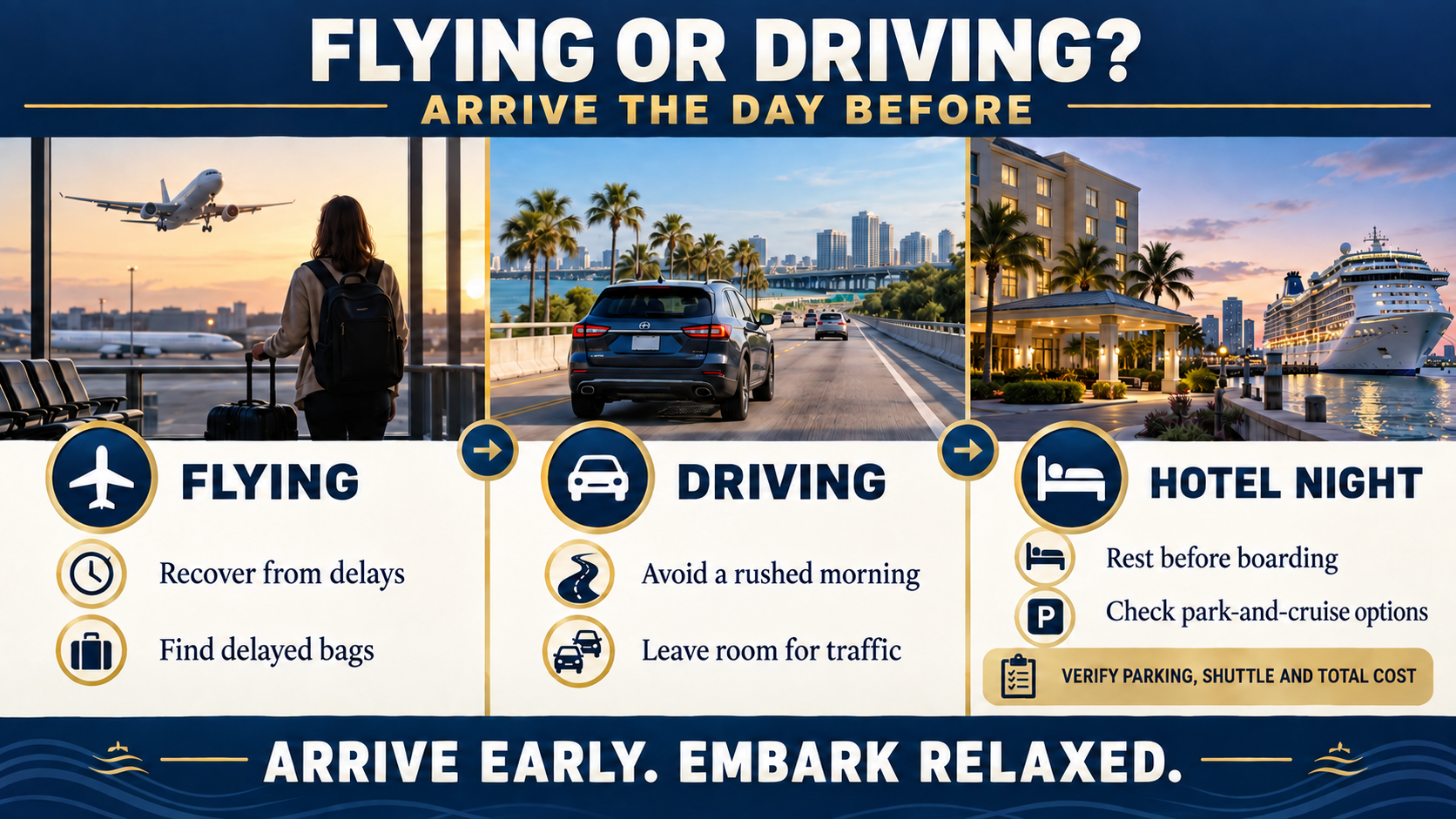
Flying is not the only way to arrive late and exhausted.
If the cruise port is five or six hours from home, driving there on embarkation morning still leaves you vulnerable to traffic, road construction, a flat tire, mechanical trouble or simply a much longer trip than expected.
Driving into town on Friday for a Saturday departure changes the experience. Instead of watching the clock for several hours, you can check into a hotel, eat dinner, sleep and begin embarkation morning already near the terminal.
A pre-cruise hotel can also create a parking opportunity.
Some hotels near major cruise ports offer park-and-cruise packages that include several nights of parking and, in some cases, transportation to or from the terminal. The package may cost less than parking at the cruise terminal—but that should never be assumed.
Before booking, verify:
How many nights of parking are included
Whether the parking area is secured
Whether a cruise shuttle is included or costs extra
Which terminals the shuttle serves
How frequently the shuttle operates
Whether shuttle reservations are required
Whether you must stay before, after or both before and after the cruise
Whether the total package actually costs less than booking the hotel and parking separately
The goal is not simply to find free parking. It is to compare the complete cost while creating an easier embarkation morning.
Arriving the night before does more than protect the cruise. It lets you begin it relaxed.
Make Sure the City in the Listing Is the Actual Port
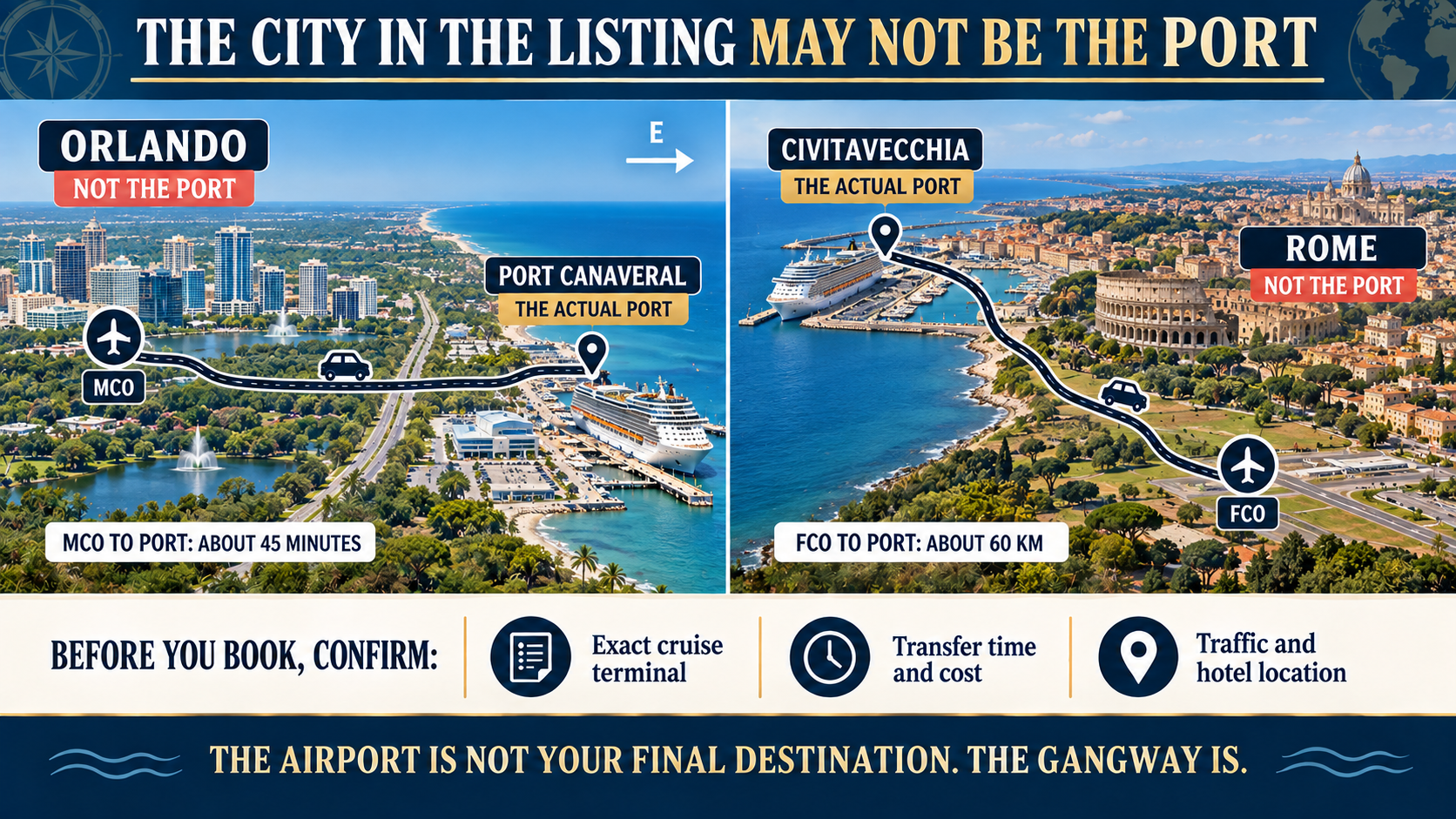
Cruise-search results often use the nearest recognizable major city even when the ship departs somewhere else.
A cruise listed as departing from Orlando actually leaves from Port Canaveral. Orlando is not a coastal city, and landing at Orlando International Airport does not place you five minutes from the ship.
According to Port Canaveral’s official directions, Orlando International Airport is approximately 45 minutes west of the port under normal conditions. You still need to collect your luggage, find your transportation and travel east to the cruise terminal.
Rome provides another good example.
Our Royal Caribbean cruise was shown as departing from Rome, but the ship actually departed from Civitavecchia on the coast. We arrived in Italy three days early, so the distance did not create an embarkation-day crisis. It did, however, reinforce the importance of identifying the actual port before arranging flights, hotels and transfers.
Rome Fiumicino Airport is approximately 60 kilometers from the Port of Civitavecchia, according to Port Mobility Civitavecchia’s transportation guide.
Similar distinctions appear at several major U.S. departure points:
An Orlando cruise may depart from Port Canaveral.
A Houston-area cruise may depart from Galveston.
A Los Angeles cruise may use San Pedro or Long Beach.
A New York-area cruise may depart from Manhattan, Brooklyn or Cape Liberty in Bayonne, New Jersey.
Do not book transportation based solely on the large city displayed in a search result.
Confirm:
The exact port
The cruise-terminal address
The nearest practical airport
The airport-to-port distance
Expected traffic
Transfer options and costs
Whether your hotel is near the airport, the port or neither
The airport is not your final destination. The gangway is.
Sometimes One Day Is Not Enough
One night is a useful minimum for many domestic departures. A longer buffer may make sense when:
The cruise departs internationally
Your itinerary requires multiple flight connections
You are traveling during a storm-prone season
You have limited alternative flights
The airport is a substantial distance from the port
You want time to recover from jet lag
You plan to explore the departure city
Missing the ship would make rejoining especially difficult
Our Rome departure was part of a larger Italy trip, so arriving three days early gave us both protection and time to enjoy the destination.
We made a different choice for a Viking river cruise departing from Budapest. We could not arrive several days early, so we booked the airfare through Viking because we valued the additional coordination between the air reservation and cruise.
That did not make delays impossible or guarantee that every problem would be covered. It was simply the option that best fit that particular trip.
The right buffer depends on the itinerary, available flights, distance to the port and consequences of arriving late.
The Buffer Can Become Part of the Vacation
Arriving early does not have to mean sitting in an airport hotel and waiting for the cruise.
Friends of ours from church recently took an Alaska cruise departing from Vancouver. Before booking, they mapped the entire journey instead of automatically flying into Vancouver.
Flying into Seattle saved them approximately $1,000 on airfare.
They used part of that savings to spend a night in Seattle and do some sightseeing. They then took the train from Seattle to Vancouver, turning the transfer into another experience rather than treating it as dead travel time.
The current Amtrak Cascades route connects Seattle with Vancouver, British Columbia, but schedules, equipment and service arrangements can change. Their return itinerary used a small Amtrak-arranged bus from Vancouver to Seattle, and their border check took about 15 minutes. That was their experience—not a travel time anyone else should assume or build a tight airline connection around.
Their plan illustrates an important Curated Upgrades principle:
They compared the complete journey before buying the airfare. The less expensive airport created room in the budget for a hotel, sightseeing and a scenic connection to the cruise.
Their arrival buffer did not merely reduce risk. It made the trip better.

Treat the Hotel Night as Part of the Cruise Budget
When comparing a same-day arrival with arriving early, do not look at the hotel cost in isolation.
Compare the complete plan:
Airfare into each reasonable airport
Checked-bag fees
Airport-to-port transportation
Hotel cost
Meals
Parking
Hotel shuttle charges
Cancellation flexibility
The value of an extra sightseeing day
The financial consequences of missing embarkation
The least expensive airfare may not produce the least expensive trip. Likewise, a hotel night that appears to add $200 may protect a cruise costing several thousand dollars.
More importantly, it can change the emotional tone of embarkation day.
Instead of landing, collecting luggage, finding transportation and watching the clock, you wake up near the port, eat breakfast and head to the terminal.
You begin the cruise rested instead of recovering from the journey.
If a delay still leaves you unable to reach the ship, read Missed Your Cruise? What to Do If You Can’t Reach the Ship before booking replacement travel or attempting to join at another port.
Arriving early cannot eliminate every problem. It simply gives ordinary travel disruptions less power over the vacation.
And sometimes, as the Seattle-to-Vancouver example shows, the buffer becomes one of the best parts of the trip.
Important Planning Note
Airline schedules, cruise-terminal assignments, rail and bus services, hotel parking packages, shuttle availability, border procedures and cruise-line assistance policies can change.
Always verify the current arrangements for your specific sailing before booking flights, lodging or ground transportation.
Information current as of September 2026.