

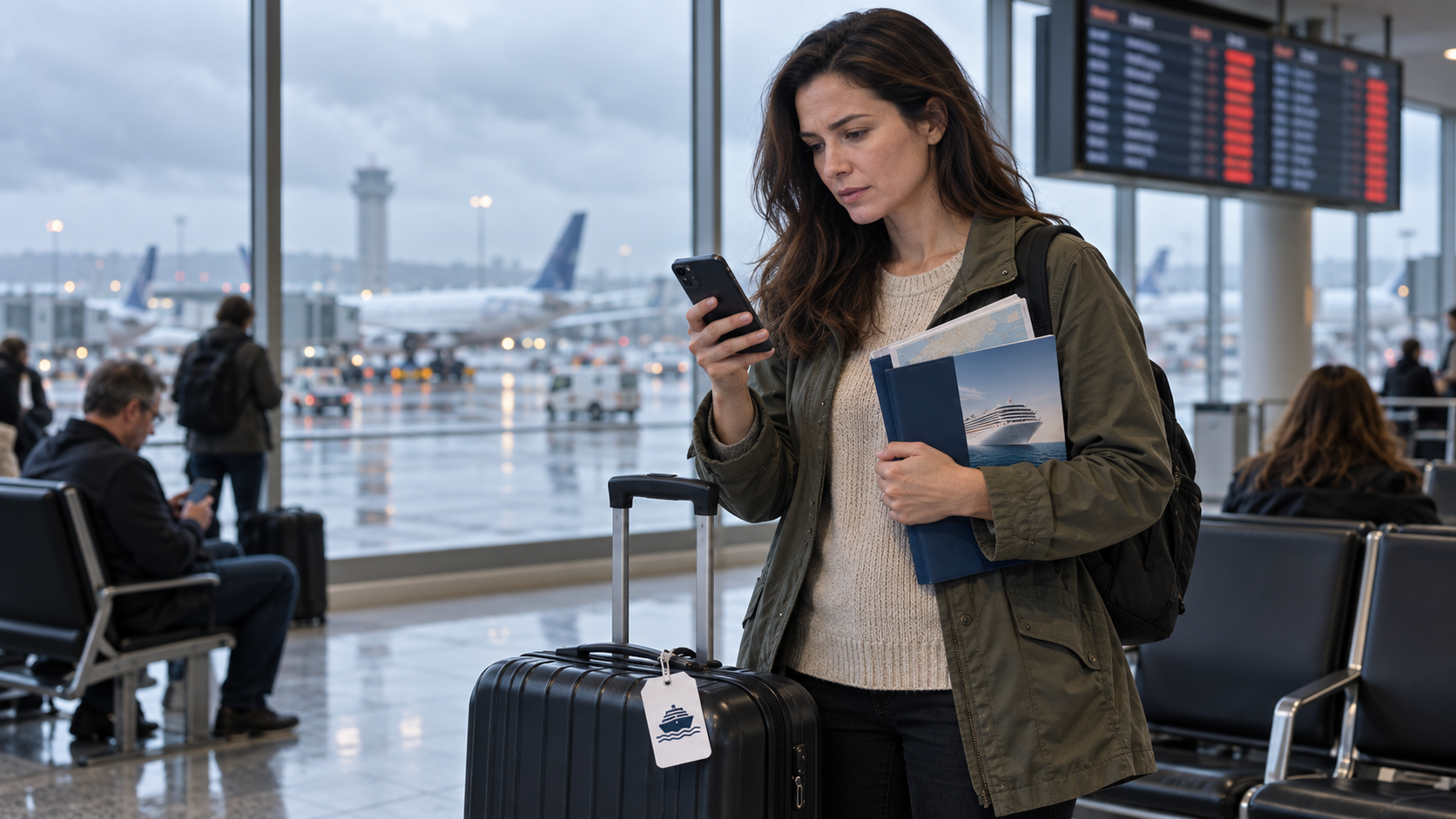
Missed Your Cruise? What to Do If You Can’t Reach the Ship
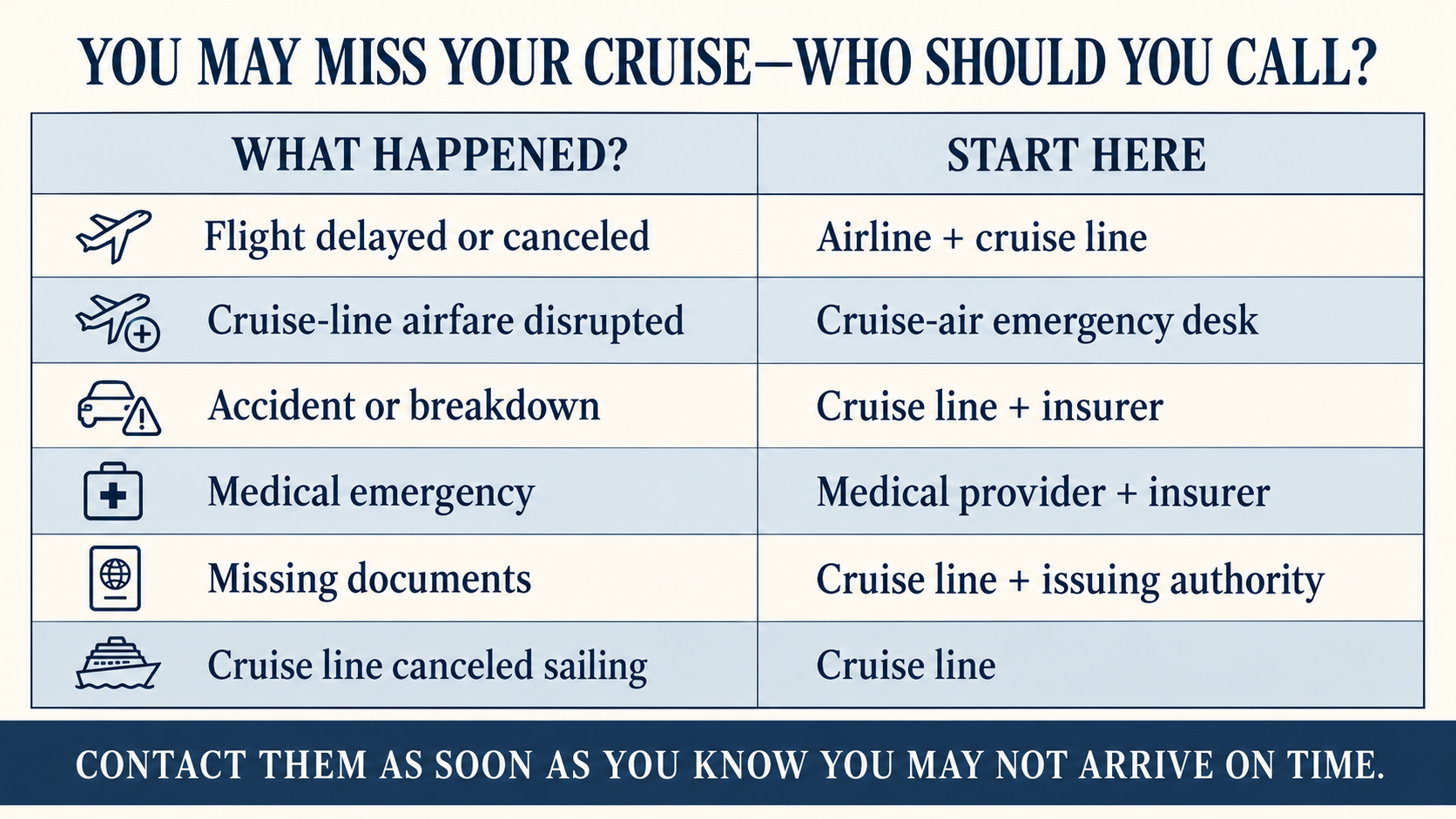
A canceled flight, highway closure, medical emergency or missing document can put embarkation at risk. What happens next depends on why you are late, how you booked and whether the cruise line can still get you aboard.
You planned the cruise, paid for the trip and packed your bags. Then something goes wrong before you ever reach the ship.
Your flight is canceled. Traffic comes to a standstill. Your car breaks down. A medical problem sends you to urgent care. You discover that an essential travel document is missing.
The first question is usually:
“Will the ship wait for me?”
Probably not.
A cruise ship operates on a tightly controlled schedule involving port reservations, pilots, tides, immigration procedures, security requirements and thousands of other passengers. Even when your delay was completely beyond your control, the ship may have to leave without you.
That does not necessarily mean the entire vacation is lost. Depending on the circumstances, the cruise line may be able to help you reach the ship at another port. Your airline may be able to reroute you. Travel insurance may reimburse certain expenses if the disruption resulted from a covered reason.
But none of those outcomes is automatic.
The most important thing you can do is contact the right people immediately—before making expensive new arrangements on your own.
First: Tell the Cruise Line You May Be Late
Do not wait until the ship has departed to report the problem.
As soon as you realize that you may miss final boarding, call the cruise line’s emergency travel number. This number may appear in your final cruise documents, booking confirmation, cruise-line app or information supplied by your travel advisor.
Tell the representative:
Your name and booking number
The ship and sailing date
Your scheduled embarkation port
Your current location
What caused the delay
Your revised arrival time, if known
Whether you booked airfare through the cruise line
Whether you purchased cruise transfers
Whether you have travel insurance
Ask the representative to place a note on your reservation and explain your available options.
Write down the representative’s name, the time of the conversation and any instructions you receive. If possible, request confirmation by email or through the cruise-line app.
Calling does not guarantee that the ship will wait. It does give the cruise line an opportunity to evaluate your situation before marking you as a no-show.
Royal Caribbean, for example, directs passengers who miss boarding because of travel delays to contact its Emergency Travel Team. The company says joining at another port may be possible in specific situations with proper documentation, but the arrangements must be discussed with that team. Review Royal Caribbean’s missed-departure guidance.
If Your Flight Is Delayed or Canceled
If an airline disruption threatens your cruise, contact both the airline and the cruise line.
The airline controls your ticket and possible flight alternatives. The cruise line controls whether you can still board the ship and where that boarding may be permitted.
While you are waiting in an airport line, use the airline’s app, website and telephone support at the same time. Search for alternative flights yourself so you can ask about specific options.
Your immediate objective may be transportation—not a refund.
For flights covered by U.S. Department of Transportation rules, you may be entitled to a refund if the airline cancels or significantly changes your flight and you decline the alternative transportation offered. Accepting a refund, however, does not get you to the cruise and does not reimburse the cruise fare you may lose. Review the DOT’s current airline-refund rules.
That is why the sequence matters:
Find out whether the airline can still get you to the embarkation port on time.
Notify the cruise line that your arrival is in jeopardy.
Ask the cruise line whether later boarding is possible.
Contact your insurer before committing to major new expenses.
Preserve evidence of the delay and every related receipt.
For more help with the airline side of the problem, see Delayed or Canceled? What Airlines Owe You.
Cruise-Line Airfare and Independent Airfare Are Not the Same
When a flight disruption threatens embarkation, how you purchased the ticket can materially change the assistance available.
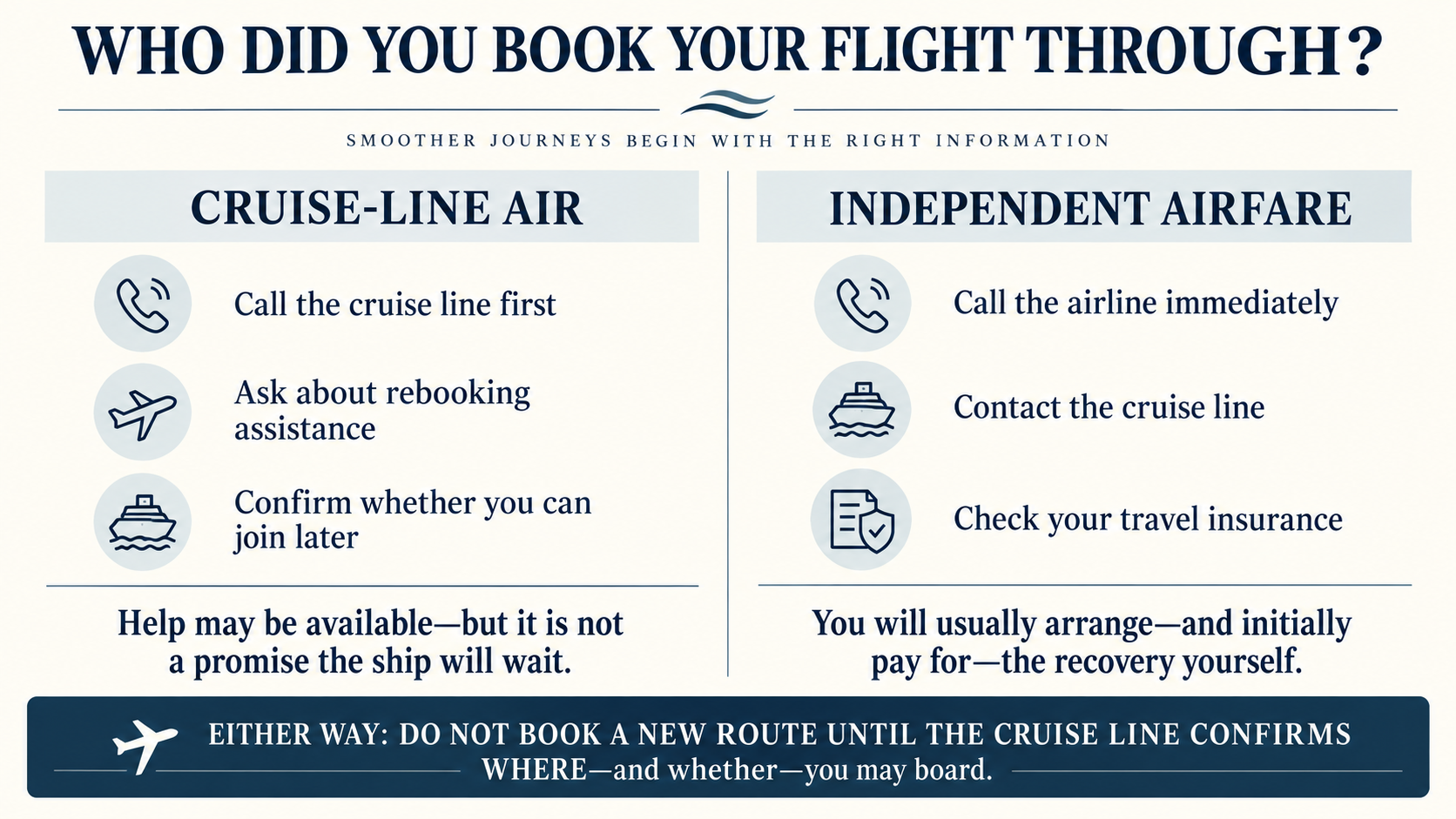
If you booked through the cruise line
Call the cruise line’s designated air-travel or emergency desk first, then follow its instructions.
Some cruise-air programs advertise assistance with alternative flights, hotels or transportation when a qualifying airline disruption prevents a passenger from reaching the ship. The exact benefit depends on the cruise line, program, fare and circumstances.
Royal Caribbean’s Flights by Royal program currently says it will make new arrangements after a delayed or canceled flight and provides additional remedies if it cannot get the passenger to the cruise. Read the current Flights by Royal terms and benefits.
Carnival instructs travelers using its Fly2Fun program to contact its Travel Hotline when a disruption occurs so a representative can work on alternative flight, hotel or transportation arrangements. Review Carnival’s current Fly2Fun information.
Do not treat “cruise-line airfare” as a universal promise that the ship will wait. The assistance and remedies differ among programs, and passenger-caused missed flights may be treated differently from airline cancellations or delays.
If you booked your airfare independently
The airline is responsible for handling the air ticket. The cruise line generally does not become responsible for the independent flight simply because you were traveling to one of its ships.
You will usually need to coordinate among:
The airline
The cruise line
Your travel advisor, if applicable
Your travel-insurance provider
Your credit-card benefits administrator, if applicable
The cruise line still needs to know what happened, but you may have to arrange—and initially pay for—replacement flights, hotels, meals and ground transportation yourself.
Save every receipt. Whether those costs are reimbursable will depend on the airline’s obligations, the cruise-air program, your insurance policy, your credit-card benefits and the documented cause of the disruption.
Why I Build in Extra Time
I have never missed a cruise, but that is partly because I treat the departure time as an immovable deadline.
For my Royal Caribbean cruise from Rome, I arrived in Italy three days early. That provided time for a delayed flight, missed connection or luggage problem without immediately putting the cruise at risk.
My Viking river cruise from Budapest presented a different calculation. We did not have enough time to arrive several days early, so I booked the airfare through Viking because I wanted an additional layer of coordination if the flights went wrong.
That did not make a delay impossible. It changed who I could call and what help might be available.
Arriving early remains the strongest protection. Cruise-line air can be useful when your schedule does not allow much flexibility, but you still need to understand the program’s actual terms.
Can You Join the Ship at the Next Port?
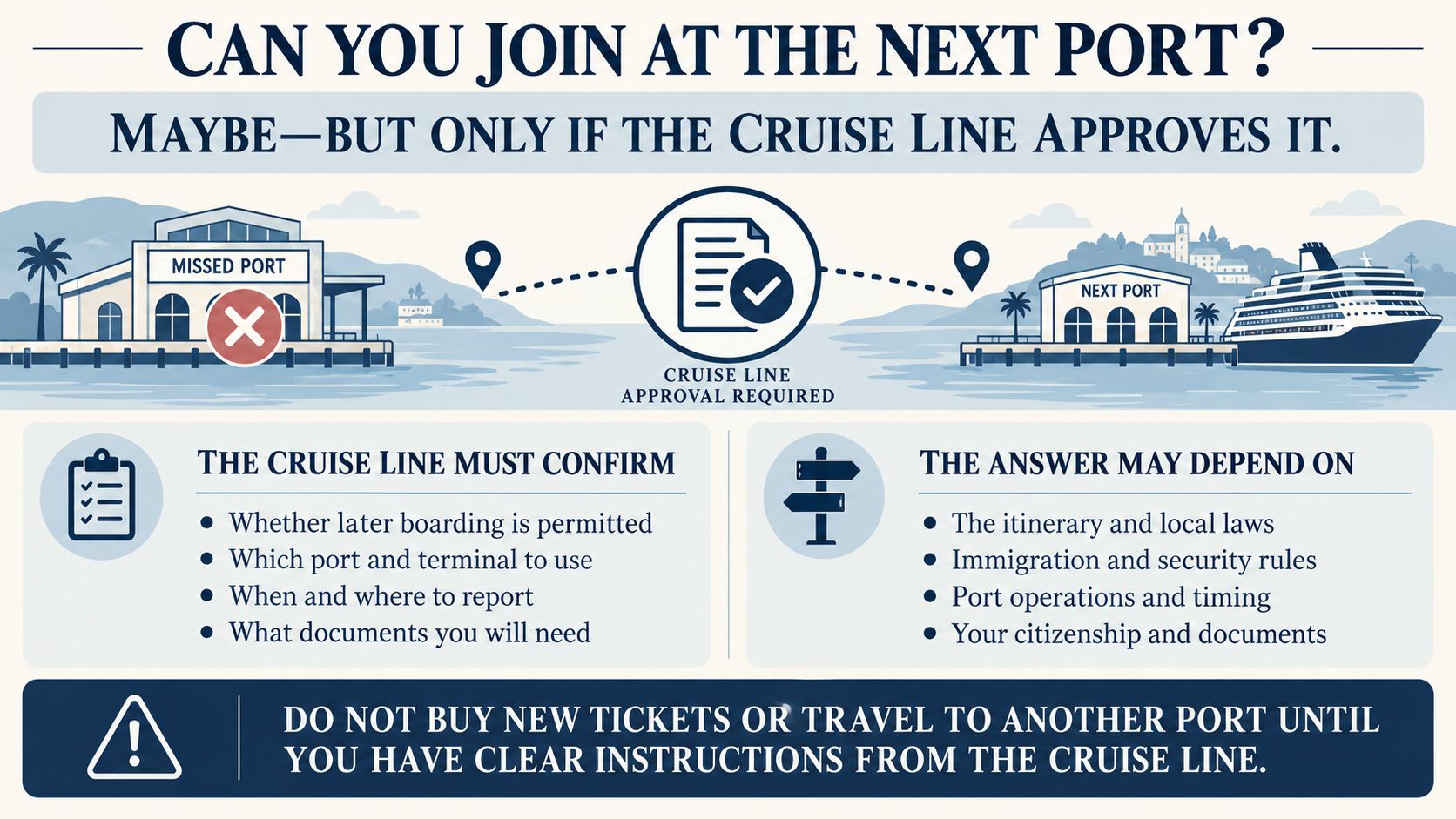
Possibly—but do not assume that you can simply buy another ticket and meet the ship tomorrow.
The cruise line must first confirm:
Whether downstream embarkation is permitted
Which port can accept you
The correct terminal or docking location
The date and reporting time
The documents you must present
Whether immigration or customs clearance can be arranged
Whether the revised plan complies with the itinerary’s applicable laws
The answer can depend on your citizenship, travel documents, ship itinerary, port facilities, immigration procedures and local regulations.
Cruise lines do not all follow the same policy. Royal Caribbean says later boarding may be possible in certain situations if the passenger has the proper documentation and coordinates with its Emergency Travel Team. Norwegian, by contrast, publishes restrictions on joining or leaving a ship outside the designated embarkation and debarkation ports. Review Norwegian’s current boarding guidance.
Even when a later port appears on the published itinerary, the ship may skip it, arrive at a different time or use a location that cannot process a newly embarking passenger.
Do not purchase new transportation until the cruise line gives you clear instructions.
Ask for those instructions in writing whenever possible.
If Traffic, an Accident or a Breakdown Makes You Late
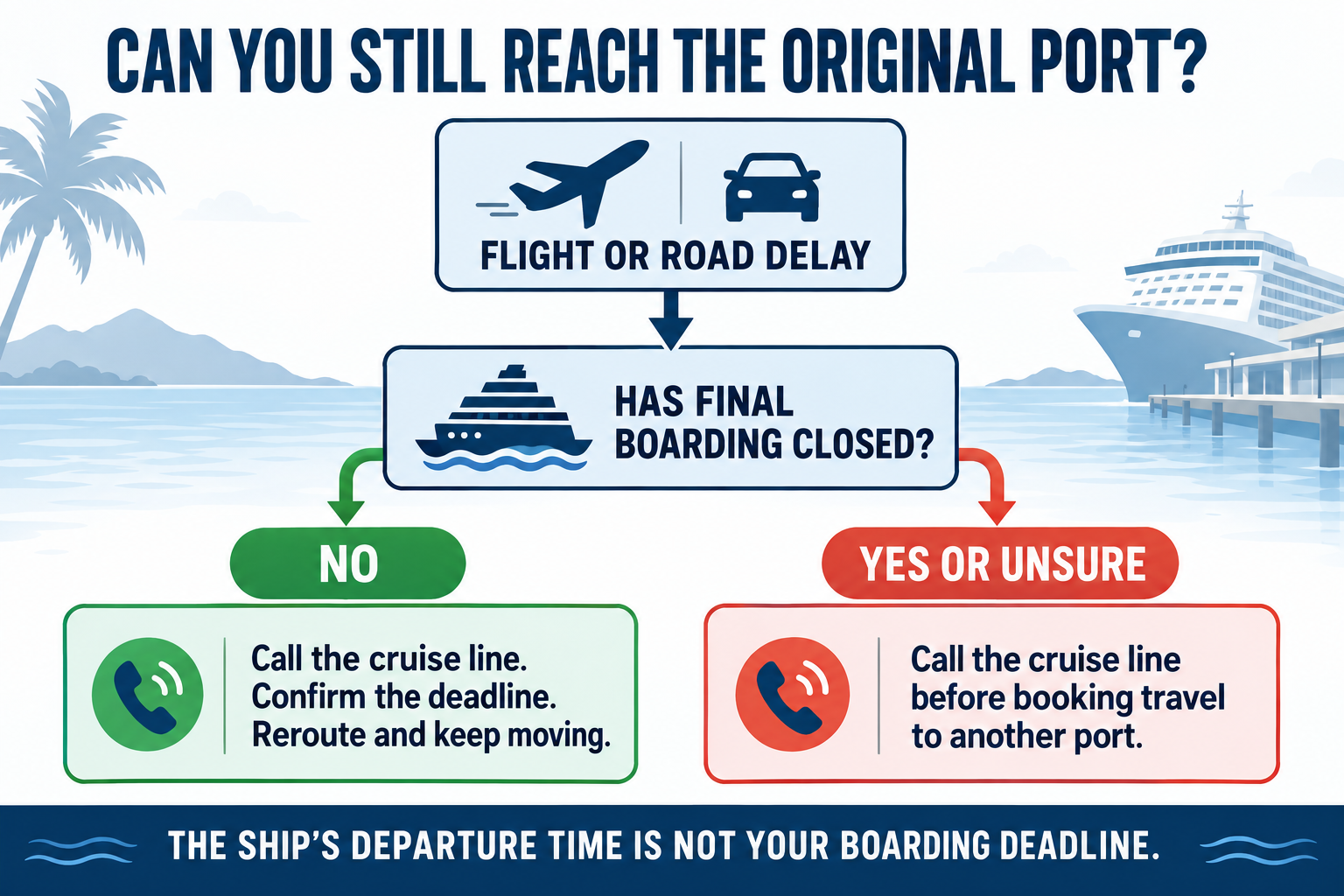
A traffic jam, highway closure, collision, flat tire or parking-shuttle delay generally does not require the cruise line to hold the ship.
Call the cruise line as soon as the delay becomes serious. If you are driving, pull over safely or have a passenger make the call.
Then:
Obtain an estimated arrival time.
Ask whether final boarding is still possible.
Contact roadside assistance or emergency services as appropriate.
Photograph damage or road conditions when it is safe to do so.
Save towing, repair, hotel and transportation receipts.
Contact your travel insurer if the event may be covered.
Do not drive recklessly in an attempt to reach the terminal.
Insurance may distinguish between a documented vehicle accident or mechanical breakdown and simply leaving home too late. Coverage depends on the exact policy language and the cause of the delay.
A vague explanation that “traffic was terrible” may not satisfy an insurance claim. A police report, towing invoice, repair receipt or official highway-closure notice provides stronger documentation.
If a Medical Emergency Prevents You From Boarding
Deal with the medical emergency first. A cruise is replaceable; a life is not.
After obtaining appropriate care, contact the cruise line and your travel-insurance assistance number as soon as reasonably possible.
Request and preserve:
Medical records or a treatment summary
A physician’s statement when appropriate
Itemized bills and payment receipts
Proof of the date and time of treatment
Written advice that you should not travel, if that applies
Records of changed flights and lodging
Every communication with the cruise line and insurer
Trip-cancellation or trip-interruption benefits may apply when an insured traveler cannot travel because of a covered illness or injury, but coverage is governed by the policy. Preexisting-condition provisions, exclusions, documentation requirements and purchase deadlines can all matter.
Do not assume that being ill automatically produces a refund from the cruise line. Start the insurance claim promptly and submit the documentation the insurer requests.
If You Do Not Have the Required Documents
A boarding pass and cruise confirmation cannot substitute for a required passport, visa, birth certificate or government-issued identification.
Cruise lines require passengers to present the documents applicable to their citizenship and itinerary. Completing online check-in does not override that responsibility. Carnival, for example, states that proper documentation is required at embarkation and throughout the cruise. Review Carnival’s travel-document guidance.
If a document is missing:
Contact the cruise line immediately.
Ask exactly which document is required.
Contact the appropriate issuing authority.
Determine whether an urgent replacement is realistically available.
Contact your insurer, recognizing that document problems may not be covered.
Do not rely on social-media advice about what “worked for someone else.”
A passport book is particularly valuable when international air travel may become necessary. The U.S. Department of State recommends that cruise passengers carry one even when the original itinerary may not require it, because an emergency could require the traveler to fly home from another country. Read the State Department’s cruise-travel guidance.
If the Cruise Line Cancels the Sailing
A cruise line canceling the voyage is fundamentally different from an individual passenger failing to reach the ship.
Read the cancellation notice carefully before accepting a credit, replacement sailing or other offer. Determine:
Whether a refund is available
Which portions of the booking are being refunded
Whether taxes, fees, excursions and prepaid packages are included
What happens to cruise-line airfare and transfers
Whether independently booked transportation is covered
Whether accepting a future cruise credit changes your refund options
What deadlines apply
The Cruise Lines International Association’s Passenger Bill of Rights includes a right to a full refund when a voyage is canceled because of a mechanical failure and a partial refund when such a voyage terminates early. Those protections do not necessarily resolve separately purchased airfare, hotels or other consequential expenses. Review CLIA’s Passenger Bill of Rights.
Contact your airline, hotel and insurer separately for anything not included in the cruise line’s resolution.
What Travel Insurance May Cover
Travel insurance may help when a covered event causes you to miss embarkation, but it is not a blanket reimbursement for every reason a traveler arrives late.
Depending on the policy, applicable benefits may include:
Travel delay
Missed connection
Trip cancellation
Trip interruption
Emergency medical treatment
Additional transportation
Hotel and meal expenses
The words covered reason matter.
Weather, a common-carrier delay, a documented accident or an unforeseen medical emergency may qualify under some policies. Oversleeping, misreading the schedule, failing to obtain required documents or leaving insufficient travel time may not.
Some policies can reimburse reasonable transportation costs to reach a cruise after a covered delay, but the certificate of insurance controls what is covered, the required delay period and the maximum benefit. See an example of how missed-cruise travel-delay coverage can work.
Before purchasing expensive replacement travel:
Call the insurer’s assistance line.
Explain the cause of the delay.
Ask which benefit may apply.
Confirm any required waiting period.
Ask what documentation is needed.
Record the claim or case number.
Keep all itemized receipts.
The assistance representative may help coordinate arrangements, but assistance is not the same as guaranteed reimbursement.
What You May Have to Pay Yourself
When you miss embarkation, you may initially be responsible for:
Replacement airfare
Ground transportation
Hotels
Meals
New baggage fees
Visa or document expenses
Transportation to another port
Transportation home
Unused cruise days
Missed excursions or prepaid services
Even when another company may eventually reimburse some expenses, you may need enough available credit or cash to solve the immediate problem.
Ask before spending—but do not expect the airline, cruise line or insurer to pay every provider directly.
Document Everything
Build a simple record while events are happening.
Save:
Screenshots of delay or cancellation notices
Original and revised itineraries
Boarding passes
Cruise documents
Emails, app messages and text alerts
Names of representatives
Dates and times of calls
Case and claim numbers
Police, towing or medical records
Itemized receipts
Written cruise-line instructions
Proof that a promised service was unavailable
Keep the original documents and submit copies unless the company specifically requires otherwise.
Documentation cannot create coverage that your policy does not provide. It can prevent an otherwise valid claim from becoming unnecessarily difficult to prove.
Preventing a Missed Embarkation
The best solution is still avoiding the crisis.
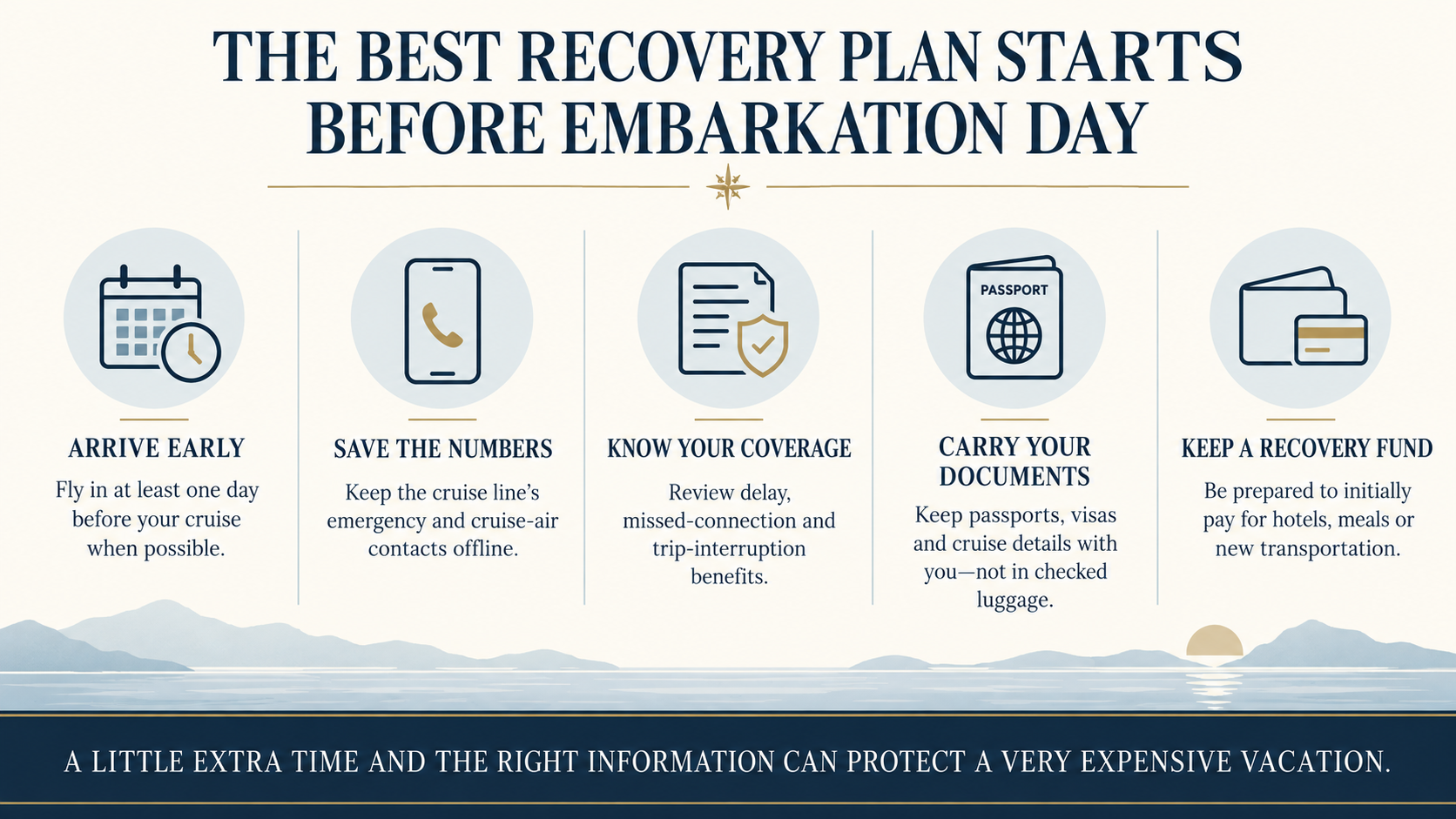
Arrive at least one day early
When flying to the departure city, arrive at least one day before the cruise whenever possible. For an international sailing, two or three days can provide a valuable buffer for flight problems, delayed luggage, jet lag and ground transportation.
Save emergency information offline
Before leaving home, save or print:
The cruise line’s emergency number
Cruise-air contact information
Your travel advisor’s details
Your insurer’s assistance number
Your booking number
The ship’s itinerary
Your hotel and transfer confirmations
Do not assume you will have reliable internet access when something goes wrong.
Carry the required documents with you
Never place passports, visas, birth certificates, boarding passes, medications or essential valuables in checked luggage.
For a complete boarding-day plan, see Cruise Embarkation Day: Start Your Vacation the Smart Way.
Understand insurance before the trip
Read the policy’s definitions, covered reasons, delay thresholds, exclusions and benefit limits before departure. Save the complete policy—not merely the marketing summary.
Keep access to emergency funds
A high available credit limit, emergency savings or another reliable payment method can help you act quickly and preserve options while reimbursement questions are resolved.
The Reason You Missed the Cruise Changes Everything
A passenger whose flight was canceled by severe weather faces a different situation from someone who arrived at the terminal without the required passport.
A traveler delayed by a documented accident has a different insurance claim from someone who simply left home too late.
Cruise-line airfare may provide coordination that independently booked airfare does not. Travel insurance may cover one cause but exclude another. Later boarding may be possible on one itinerary and prohibited on another.
That is why the most important question is not simply:
“Did you miss the ship?”
It is:
“Why did you miss it—and whom did you contact before it left?”
Call immediately. Follow the cruise line’s instructions. Confirm whether later boarding is permitted before spending more money. Save every document and receipt.
Then work the problem one decision at a time.
Important Policy Note
Cruise-line policies, passenger contracts, cruise-air benefits, boarding requirements, immigration rules and travel-insurance coverage vary and can change. Confirm the current terms for your cruise, airfare and insurance policy before traveling.
Information current as of September 2026.
Useful Official Links
Already started your cruise but returned late during a port call? Read Missed the Cruise Ship in Port? What to Do Next for help contacting the port agent, reaching the cruise line and arranging to rejoin the ship.