

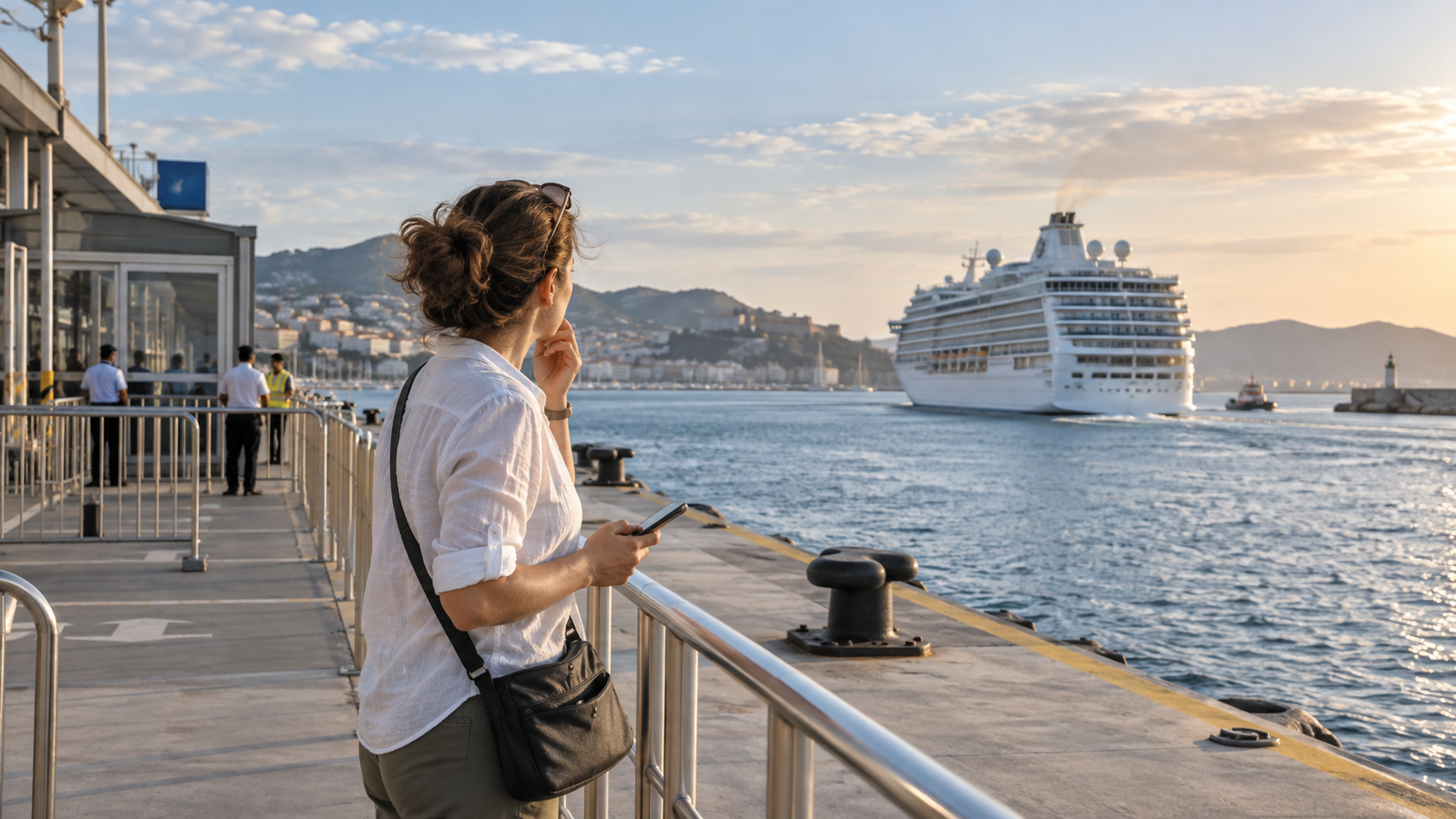
Missed the Cruise Ship in Port? What to Do Next
Whether an excursion runs late, traffic stops moving or you simply lose track of time, what you do next can determine how quickly—and how affordably—you rejoin your cruise.
Watching your cruise ship leave without you is one of those travel problems that sounds almost comical until it happens.
Perhaps a private excursion returned late. A taxi broke down. Traffic came to a standstill. A medical problem required attention. You misunderstood ship time—or one last drink near the pier turned into two.
Whatever the reason, the first rule is the same: do not panic and immediately start booking flights, hotels or transportation to the next port.
First confirm what happened. Then contact the people who can tell you whether, where and how you may rejoin the ship.
I have never missed an all-aboard time, but that is partly because I plan port days with the return trip in mind. I have taken both cruise-line excursions and independently booked tours. When booking privately, I avoid itineraries that travel a great distance from the ship or consume nearly the entire time in port.
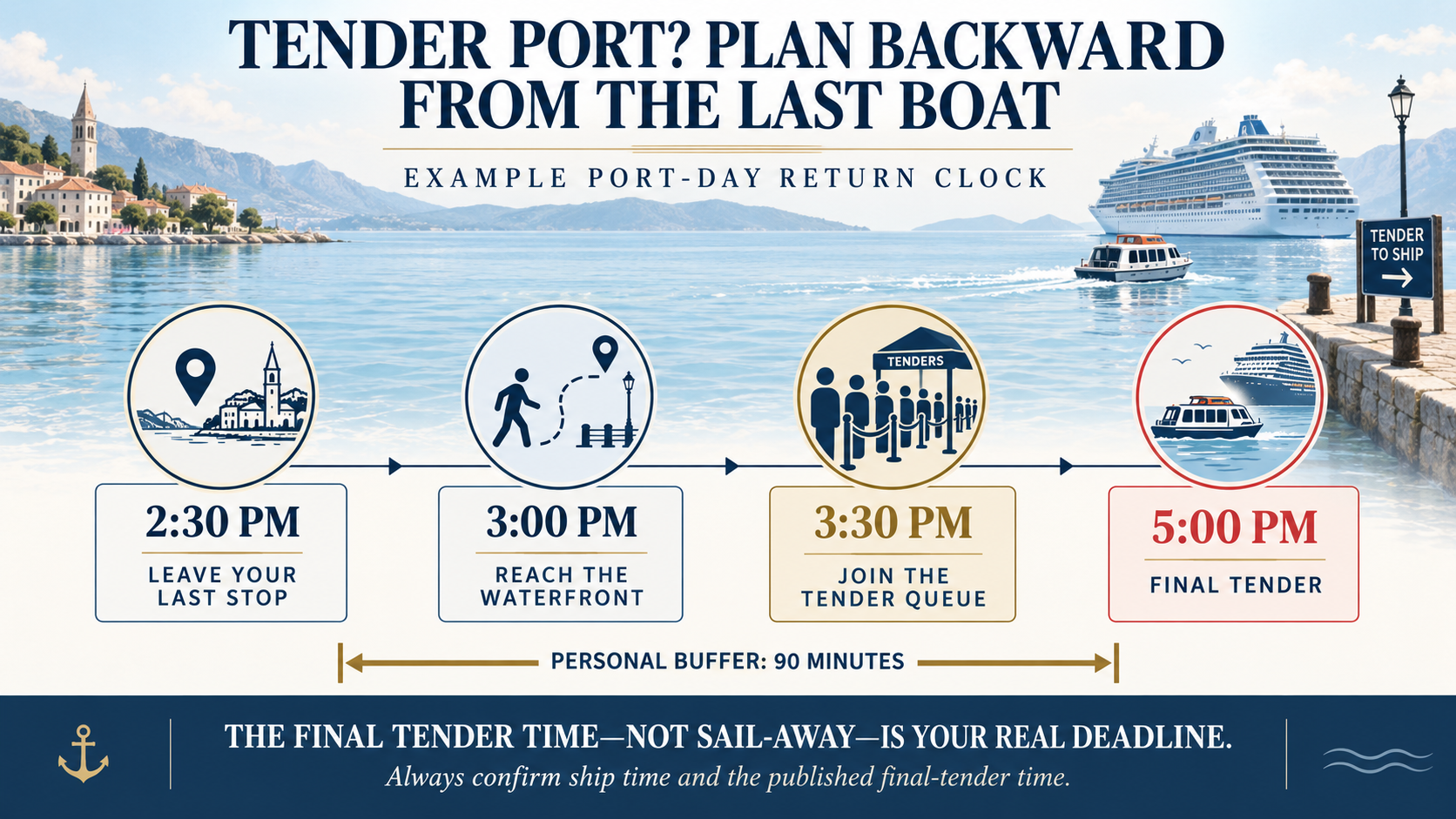
I am even more cautious when tenders are involved. Gina hates standing in long lines, so I generally try to have us back at the tender queue about 90 minutes before the final boat is scheduled to return to the ship.
That is our personal comfort level—not a rule everyone must follow. The important thing is to create a realistic margin based on the port, transportation, excursion and published return deadline.
First, Confirm That the Ship Has Actually Left
A missing ship is not always a departed ship.
The vessel may have shifted to another berth, moved offshore, changed its tender operation or temporarily disappeared from view behind port buildings. Departure times can also change because of weather, port traffic or operational requirements.
Ask a uniformed port employee, terminal representative or security officer to confirm the ship’s status.
If the ship is still present but the normal gangway has closed, do not attempt to enter a restricted area or arrange your own boat. Follow instructions from port personnel and the cruise line.
If the ship has departed, your next objective is to locate the ship’s port agent.
Find the Port Agent
The port agent is the cruise line’s local representative. This person or company can communicate with the ship and may help stranded passengers determine what to do next.
Port-agent contact information is often printed in the daily program or port information delivered to your stateroom. It may also be displayed near the gangway or terminal exit.
Before going ashore, photograph the appropriate page of the daily program. Do not assume you will be able to retrieve the information from the cruise app after the ship leaves.
If you do not have the number, ask port security, terminal personnel, local police or the harbor authority to help locate the cruise line’s agent.
The port agent may be able to tell you:
Whether the ship has definitely departed
Whether your passport or other documents were left ashore
Which cruise-line emergency number to call
Whether you may rejoin at another port
Where you should wait for further instructions
Whether local immigration officials must become involved
The port agent cannot guarantee that you will be permitted to rejoin the cruise. Immigration rules, itinerary restrictions and cruise-line policies may affect the answer.
Contact the Cruise Line Before Booking Anything
Call the cruise line’s emergency or en-route assistance number—not only its regular reservations department.
Explain:
Your full name and booking number
The ship’s name
Your current port and location
The reason you missed the ship
Whether you have your passport
Whether anyone in your party requires medication or medical assistance
Whether your belongings remain aboard
How the cruise line can reach you
Ask the cruise line to confirm the next feasible port and what documentation will be required. A port that appears next on the published itinerary may not be a legal or practical reboarding point.
Port calls can change, some countries restrict mid-cruise embarkation, and the ship may arrive at a terminal that requires advance clearance. Do not race to the next scheduled port until the cruise line confirms the recovery plan.
If you booked through a travel agent, contact the agent as well. The agent may be able to communicate with the cruise line, help coordinate replacement travel and advocate for you while you handle the immediate situation.
However, do not delay contacting the port agent or cruise line’s emergency team while waiting for the travel agent to respond.
Understand Ship Time Before Going Ashore
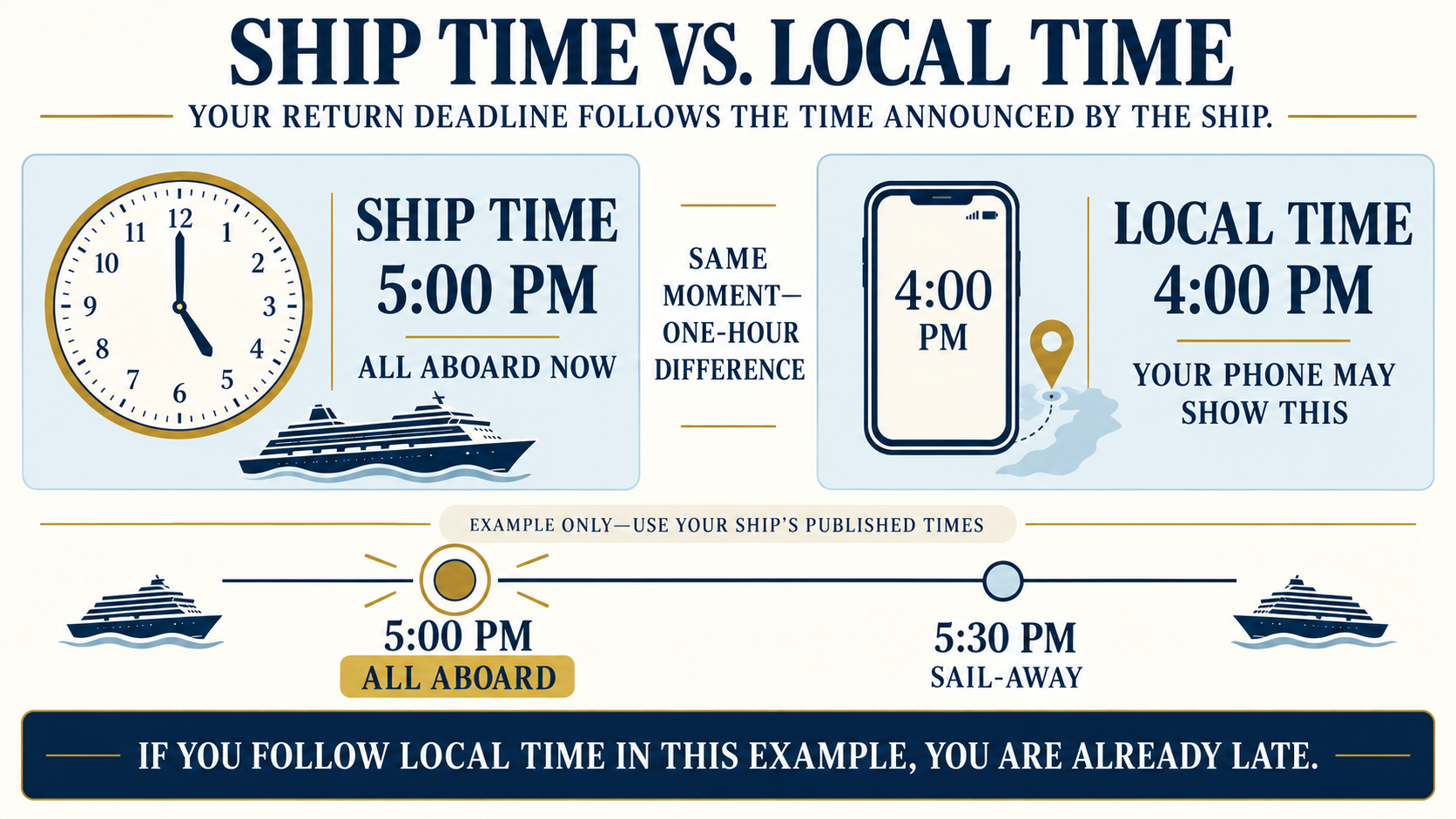
One of the easiest ways to miss a ship is to follow the wrong clock.
Cruise ships may remain on one time zone for several ports, change their clocks during the voyage or adopt local time at each destination. There is no universal rule that applies to every cruise.
The time displayed automatically on your phone may be local time rather than ship time. A phone can update after connecting to a local cellular network even when you do not realize it has changed.
Imagine that all aboard is scheduled for 5:00 p.m. ship time, but the local time displayed on your phone is 4:00 p.m. At that moment, you are not an hour early. You have reached the boarding deadline.
Ship time also determines the meaning of “all aboard.” The ship’s scheduled departure might be 5:30 p.m., but passengers may be required to be back aboard by 5:00. The later departure time is not permission to arrive at the pier at 5:25.
Before leaving the ship:
Confirm whether ship time and local time are the same.
Check the published all-aboard time.
Ask a crew member if anything is unclear.
Set a manual alarm using ship time.
Take a photograph of the daily schedule.
Avoid relying exclusively on an automatically updating phone.
Ship-Sponsored and Independent Excursions Carry Different Risks
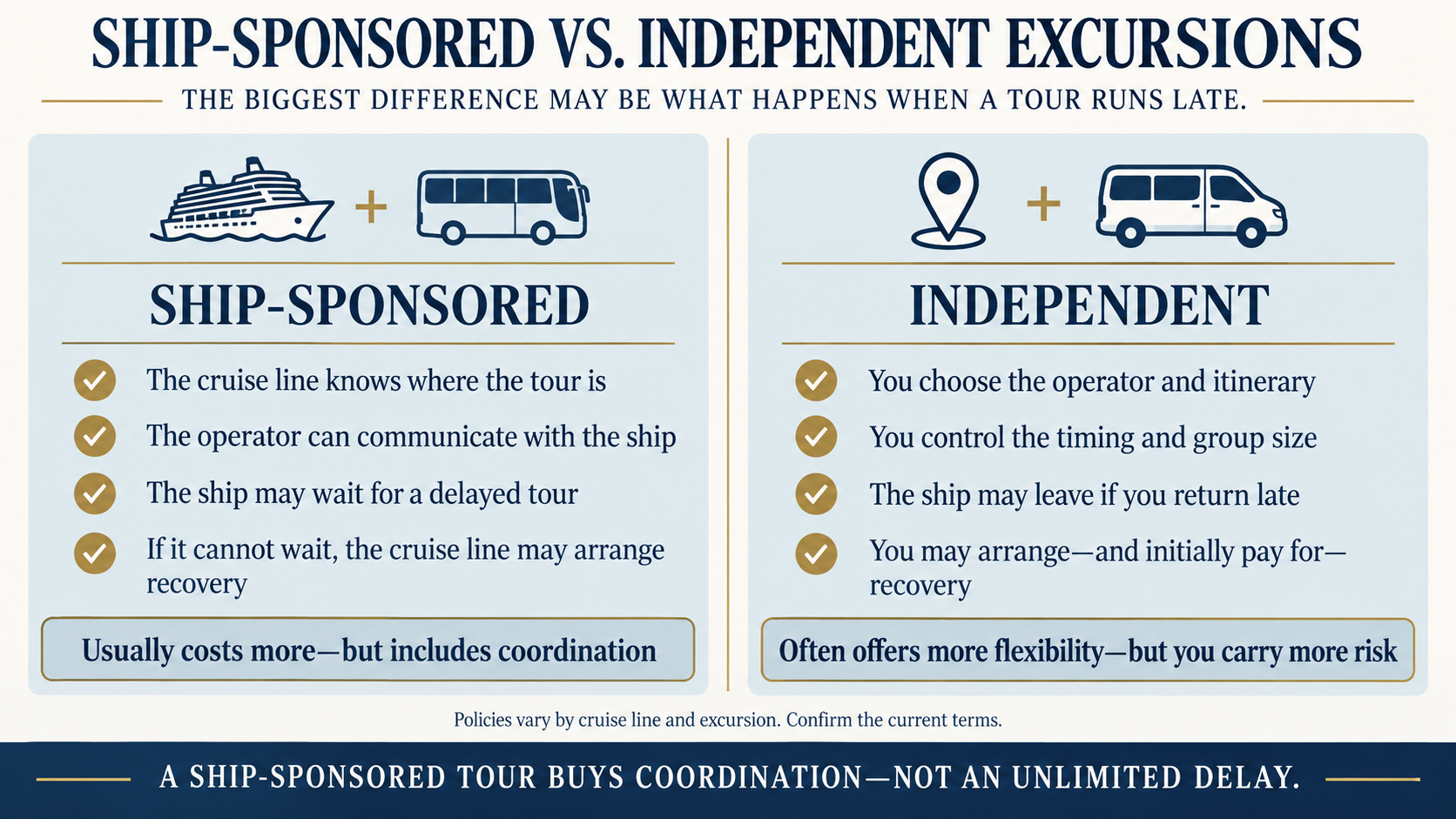
A ship-sponsored excursion usually costs more than a comparable independent tour, but part of that price pays for coordination.
The cruise line knows which passengers are on the excursion and can communicate with the operator. If the excursion is delayed, the ship may wait when operationally possible. If waiting is impossible, the cruise line may help arrange for affected passengers to rejoin later.
That is not the same as an unlimited guarantee. A ship cannot necessarily remain in port indefinitely. Tides, weather, pilot availability, berth schedules and immigration requirements may force it to depart.
Royal Caribbean says that when one of its sponsored excursions is delayed, the ship will wait whenever possible or the line will make arrangements for guests to return to the ship. Review Royal Caribbean’s shore-excursion guidance.
Norwegian similarly identifies guaranteed return to the ship as a benefit of booking an organized shore excursion through the cruise line. Review Norwegian’s reasons for booking cruise-line excursions.
With an independent excursion, you generally choose the operator, itinerary, group size and pace. That flexibility can produce a better or more personal experience—but the cruise line may not know where you are or why you are late.
If an independent excursion returns after all aboard, you may be responsible for arranging and initially paying for transportation, lodging, meals and other recovery expenses.
I am comfortable booking independent excursions when the itinerary leaves a substantial margin. I would be far less comfortable booking one that travels hours from the port or is scheduled to return shortly before all aboard.
Tender Ports Require More Time
At a tender port, the ship anchors offshore and passengers travel between the vessel and shore aboard smaller boats.
The relevant deadline is not simply the ship’s sail-away time. It is the published time of the final tender returning to the ship.
Tender operations introduce variables that do not exist when a ship is secured directly alongside a pier:
Lines can become long near the end of the port call.
Each tender has limited capacity.
Wind and sea conditions can slow boarding.
The ride back to the ship takes time.
Passengers may need to walk or take transportation to the tender landing.
The tender location may not be where you first came ashore.
Cruise lines may operate a numbering or ticket system for passengers going ashore in the morning. The return process may instead involve joining a physical queue.
Our preference is to reach that queue about 90 minutes before the scheduled final tender. That gives us time to handle a line without turning the final hour ashore into a stressful race.
Your buffer may be different, but it should reflect the consequences of missing the last boat. Do not interpret “final tender at 5:00” as “arrive at the waterfront at 5:00.”
If a Medical Emergency Delays You
If someone is seriously ill or injured, get appropriate medical help first. Call the local emergency number or seek assistance from the excursion operator, port authority or nearby medical provider.
Then contact the port agent and cruise line as soon as circumstances allow.
Keep copies of:
Medical reports
Diagnosis and treatment information
Hospital or clinic receipts
Prescription records
Transportation receipts
Names and contact information for medical providers
Written instructions from the cruise line
Evidence of when and why the delay occurred
Contact your travel insurer promptly. Some policies provide assistance services that can help coordinate treatment, transportation or lodging. Coverage depends on the policy, the reason for the delay, exclusions and documentation.
Do not assume that every medical event—or every expense incurred afterward—is automatically covered.
If You Simply Lost Track of Time
Not every missed ship involves an unavoidable emergency.
Sometimes passengers misunderstand the schedule, follow local time instead of ship time, travel too far from the port or remain at a restaurant or bar longer than intended. The cruise line may still help explain how to rejoin, but the cost will often fall to the passenger.
This is where the Señor Frog’s version of the story stops being funny.
If alcohol contributed to the problem, focus first on getting everyone somewhere safe. Do not drive, argue with port security or attempt to hire an unlicensed boat to chase the ship.
Find the port agent, call the cruise line and follow verified instructions.
What Happens to Your Passport and Belongings?
Your luggage will normally remain aboard unless the cruise line makes other arrangements.
In some situations, ship personnel may retrieve passports or other identification from a stateroom and leave them with the port agent. That possibility should never be treated as a guarantee.
Ask the port agent specifically whether documents were removed from the ship and where they can be collected.
This is one reason carrying a passport book ashore—or at least knowing the cruise line’s port-specific instructions—requires careful thought. Carrying it gives you the document needed for unexpected international travel, but it also creates a risk of loss or theft during the day.
The correct choice can vary by port and itinerary. Follow the cruise line’s guidance, carry secure identification and keep a protected digital copy available separately.
The U.S. Department of State recommends that cruise travelers consider a passport book because an emergency may require international air travel. A passport card cannot be used for an international flight to the United States. Review the State Department’s cruise-travel guidance.
The Ship Left: Follow This Order
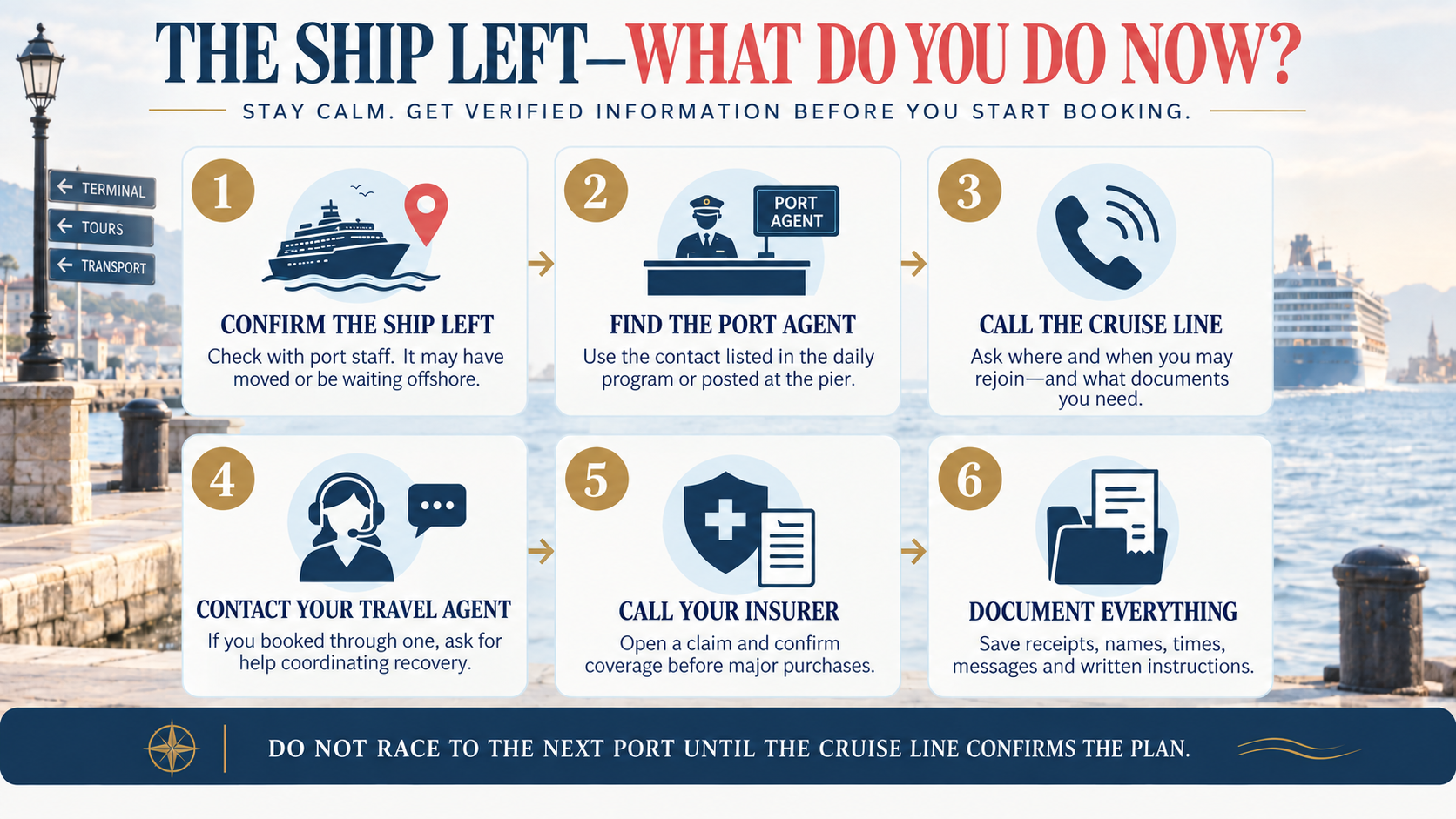
Once departure is confirmed, work through the problem methodically:
Confirm with port staff that the ship has left.
Locate the cruise line’s port agent.
Call the cruise line’s emergency assistance number.
Contact your travel agent, if you used one.
Call your travel insurer.
Obtain written confirmation of the proposed recovery plan.
Confirm passport, visa and immigration requirements.
Book replacement travel only after the destination is verified.
Save every receipt, message and name of whom you spoke with.
Keep the cruise line informed if your travel plans change.
If you do not have your passport, contact your country’s nearest embassy or consulate after speaking with the port agent and cruise line.
Rejoining the Ship Can Be Expensive
Depending on the itinerary, recovering from a missed departure may require:
A hotel near the port
Meals and local transportation
A flight, train, ferry or long-distance car transfer
A passport replacement or emergency travel document
Visa or immigration assistance
Transportation to a different terminal
Several days away from your belongings
Replacement medications or essential supplies
You may also miss one or more days of the cruise.
Travel insurance may reimburse some covered expenses, particularly when the delay results from a documented covered event. It may not cover oversleeping, intoxication, poor planning or returning late from an independent excursion without a covered cause.
Keep receipts even when coverage is uncertain. The insurer—not the taxi driver, hotel clerk or fellow passenger—determines what the policy will reimburse.
Build the Return Trip Into Every Port Day
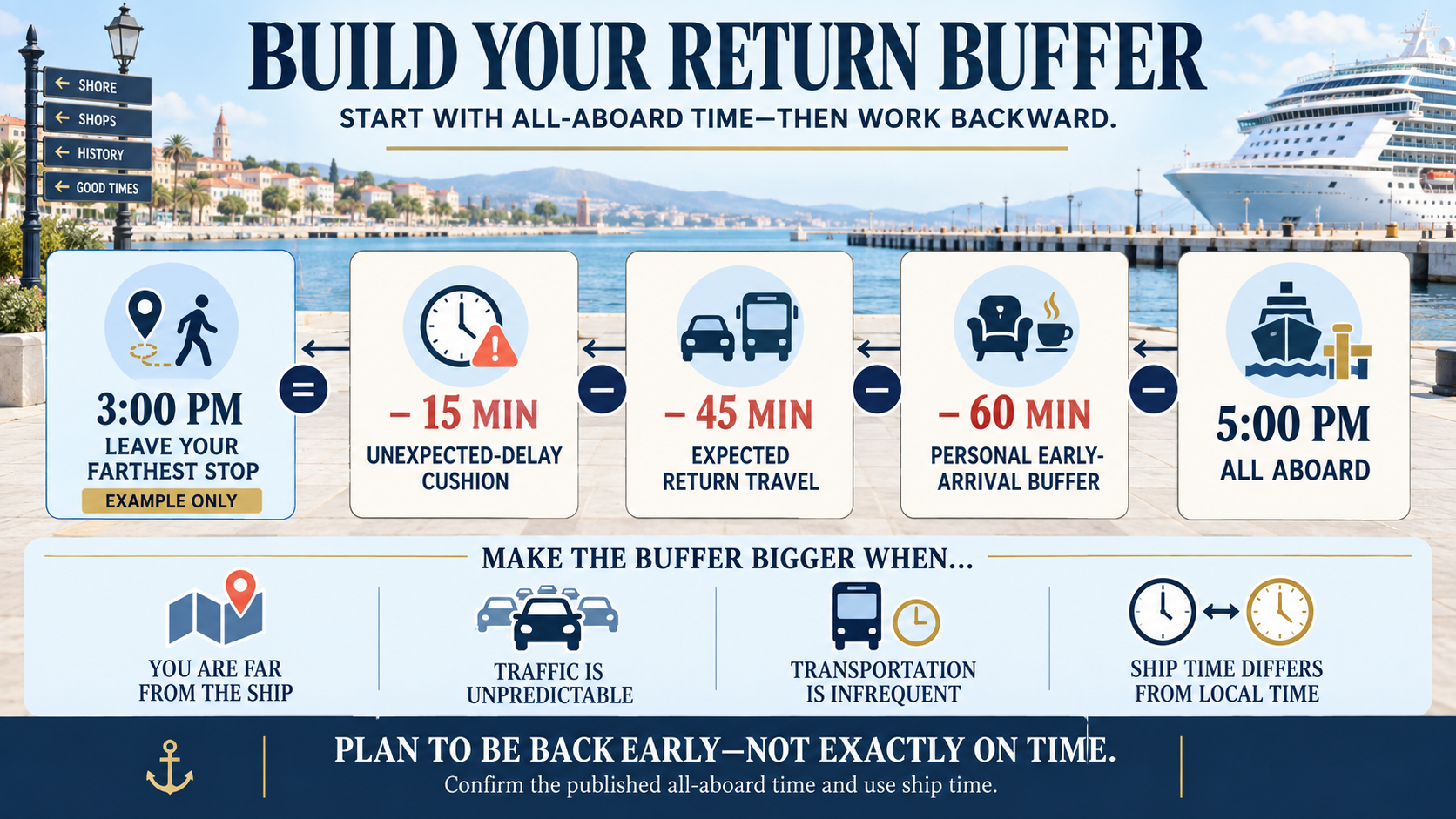
The safest port-day plan begins with the all-aboard time and works backward.
Allow for:
The distance from your final stop to the pier
Normal travel time
Traffic congestion
Delayed or infrequent public transportation
Time to return a rental car
Walking from the terminal entrance to the gangway
Security or immigration screening
Tender queues
Confusion about ship time and local time
An additional cushion for something unexpected
Suppose all aboard is 5:00 p.m. You want to be at the ship an hour early, expect the return trip to take 45 minutes and add another 15 minutes for an unexpected delay.
That means leaving your farthest stop at approximately 3:00 p.m.—not beginning to think about transportation at 4:45.
This is only an example. A distant excursion, unpredictable traffic, complicated border crossing or tender port may require a much larger margin.
Prepare Before You Step Ashore
A few small habits can make a major difference:
Photograph the daily program and port-agent information.
Confirm all aboard in ship time.
Carry the cruise line’s emergency number.
Keep your booking number available offline.
Carry a payment card with sufficient available credit.
Bring essential medication for longer than the expected port visit.
Keep your phone charged and consider carrying a power bank.
Download an offline map.
Know the route back to the ship or tender landing.
Verify how frequently transportation operates.
Share your itinerary with everyone in your party.
Tell an independent operator the ship’s all-aboard time.
Set more than one alarm.
Return early enough that a modest delay remains an inconvenience—not a crisis.
If you separate during the port visit, establish a meeting point and a time after which everyone returns directly to the ship.
The Reason You Were Late Still Matters
The cruise line’s response, your financial responsibility and possible insurance coverage may depend heavily on why you missed the ship.
A delayed cruise-sponsored excursion is different from an independent tour running late. A documented medical emergency is different from losing track of time. A traffic accident may be treated differently from choosing to remain at a bar past your planned departure.
Regardless of the cause, your immediate priorities remain the same:
Confirm the ship’s status. Find the port agent. Contact the cruise line. Verify the recovery plan. Document everything.
Missing the ship does not necessarily mean the entire cruise is over. But the calmest and least expensive recovery usually begins before you go ashore—with the correct time, a realistic return plan and enough margin to absorb the unexpected.
Important Policy Note
Cruise-line policies, port-agent procedures, shore-excursion protections, tender operations, reboarding rules, passport requirements, immigration procedures and travel-insurance coverage can change.
Always verify current information with your cruise line, travel insurer and the appropriate government authorities for your particular itinerary.
Information current as of September 2026.
Useful official links
Couldn’t reach the ship on embarkation day? Read Missed Your Cruise? What to Do If You Can’t Reach the Ship for the steps to take when a flight delay, road problem or emergency threatens the beginning of your cruise.