


Which Card Should You Use for Which Purchase?
You don't need to maximize every swipe. You need a simple system that earns well without turning every purchase into a math problem.
Dinner is over. The check arrives.
You have two rewards cards in your wallet. One earns 3X on dining. The other earns 2X on everything.
Which one do you use?
The answer seems obvious. But once you start looking at groceries, gas, EV charging, travel, online shopping and everything else, the decision can become surprisingly complicated.
As I discussed in You’re Already Spending the Money. Are You Getting the Points?, ordinary household spending can generate meaningful travel rewards without spending a dollar more than you normally would.
But there's another question worth answering.
Which card should get the purchase?
Spend enough time reading about credit-card rewards and you'll find people carrying a dozen cards, tracking rotating categories and calculating the best return on every transaction.
You can do that.
You don't have to.
A good rewards strategy doesn't need to squeeze the maximum possible point from every purchase. It needs to be simple enough that you'll actually use it.
Start With a Good Catch-All Card
The easiest way to simplify your wallet is to decide which card gets everything that doesn't have an obvious better choice.
That's your catch-all card.
Maybe it earns 2 points or miles per dollar on ordinary purchases. Whatever the structure, the important thing is that you don't have to think about it every time you reach the register.
Hardware store? Catch-all.
Vet bill? Catch-all.
New tires? Catch-all.
Random online purchase? You already know the answer.
For me, my Capital One Venture X fills much of that role. It earns 2X miles on everyday purchases, and those miles can later be used with multiple travel partners.
I don't use it because I've calculated the theoretical maximum value of every transaction. I use it because it's a reliable default.
If you're interested in the card I use for everyday spending, you can explore the Capital One Venture X here.
That simple default eliminates most of the decisions before they happen.
Add Categories That Actually Matter to You
Once you have a default, look at where you actually spend money.
Not where a credit-card marketing department wants you to spend money.
If another card earns substantially more on dining and you eat out regularly, that's useful.
If you spend a meaningful amount on gas or EV charging and another card rewards those categories better, that's useful too.
Groceries can be another major household category. So can travel.
The point isn't to collect a card for every possible multiplier.
It's to identify the handful of categories where your normal spending makes the additional rewards worthwhile.
I use a Chase Sapphire Preferred card for categories where it earns more than my everyday card, including dining, gas and EV charging.
That gives me a simple decision tree: if the purchase falls into one of those useful bonus categories, I use the card that rewards it better. Otherwise, I have my catch-all.
If you're looking for a category-focused travel rewards card, you can explore the Chase Sapphire Preferred here.
No laminated wallet chart required.
How Much Is One Extra Point Actually Worth?
This is where points enthusiasts can occasionally lose the plot.
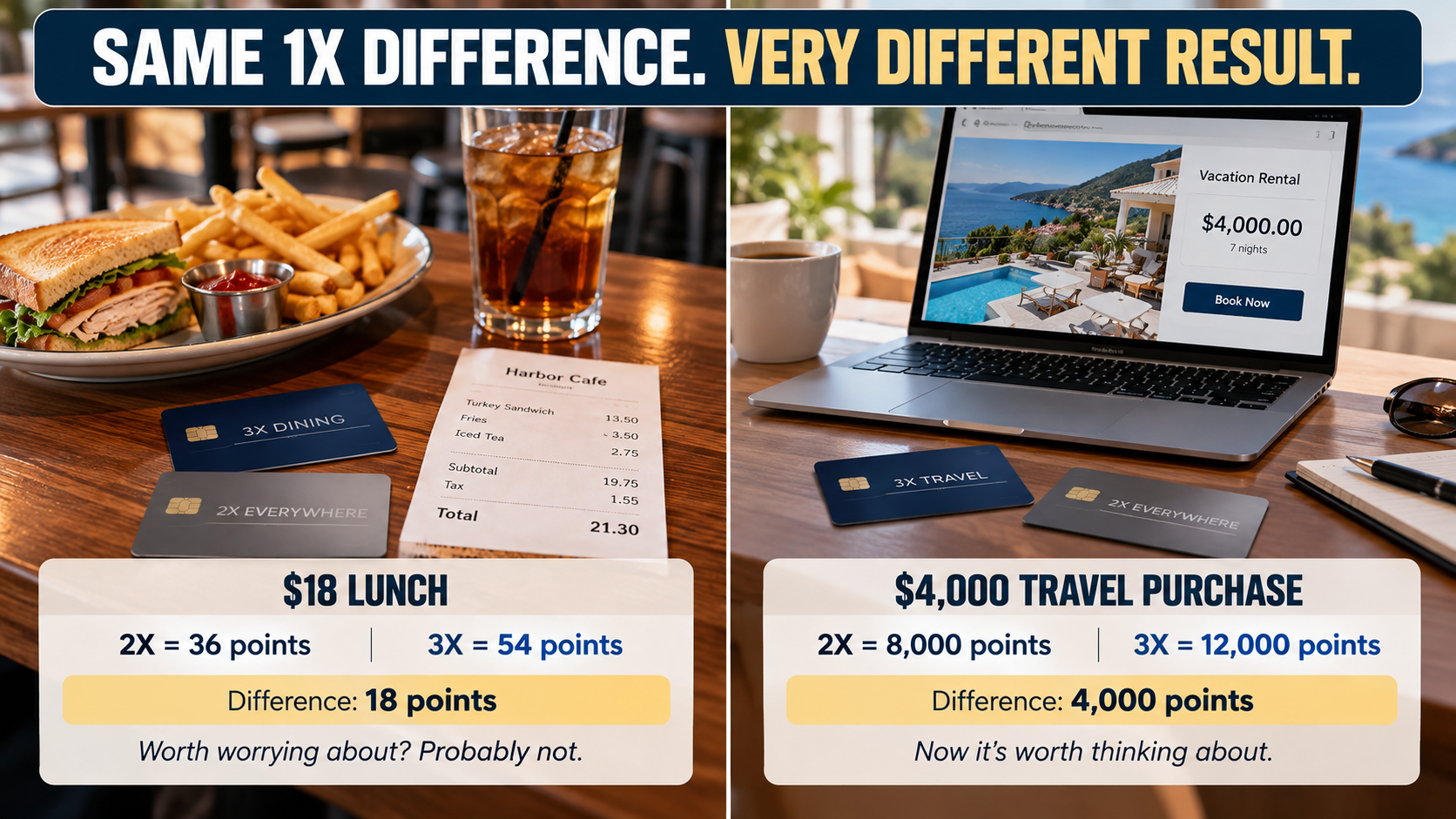
Suppose lunch costs $18.
One card earns 2X.
Another earns 3X.
That's 36 points versus 54 points.
You used the wrong card and missed 18 points.
Civilization will survive.
Now suppose you're making a $4,000 travel purchase.
At 2X, that's 8,000 points.
At 3X, that's 12,000.
Now the difference is 4,000 points.
That's worth thinking about.
The bigger the purchase, the more worthwhile it becomes to stop for a moment and consider which card makes sense.
But even then, the highest multiplier isn't always the answer.
Sometimes the Points Aren't the Most Valuable Benefit
Imagine Card A earns 3X on a travel purchase.
Card B earns 2X.
Card A wins, right?
Maybe.
What protections come with Card B?
Depending on the card and the purchase, benefits might include trip-delay or cancellation coverage, baggage protection, rental-car coverage, purchase protection or extended warranty coverage.
Those benefits vary considerably by card, and the terms can change. That's why I check the actual benefits associated with my cards rather than assuming the card with the biggest number beside "travel" automatically wins.
Suppose you're paying $3,200 for a cruise.
The difference between earning 3X and 2X is 3,200 points.
That's useful.
But if the lower-earning card provides meaningful trip protection that the other doesn't, those extra points might not be worth the trade.
Don't surrender a potentially valuable benefit just to earn a slightly better multiplier.
Points have value.
So does protection when something goes wrong.

Portal Bonus or Book Direct?
Travel portals make this decision particularly interesting.
A card issuer may offer a much higher earning rate when you book a hotel or rental car through its travel portal.
Five points per dollar.
Ten points per dollar.
Those numbers are understandably attractive.
But there's another side to the transaction.
When you book directly with an airline, hotel or rental-car company, you're dealing directly with the company providing the service.
When you book through a portal, you've introduced another party into the reservation.
Most of the time, that may not matter at all.
It can matter considerably when something changes.
A schedule gets disrupted. You need to alter the reservation. The hotel can't find the booking. You want to use elite benefits. Something has gone sideways and now you're figuring out who actually controls the reservation.
Consider a $900 hotel stay.
One booking option earns 10X, giving you 9,000 points.
Another earns 3X, giving you 2,700 points.
That's a difference of 6,300 points.
Would I automatically book through the portal?
No.
I'd compare the actual price, cancellation terms, hotel loyalty benefits and who I'd be dealing with if something went wrong.
Sometimes I'll happily take the additional rewards.
Other times I'd rather book directly.
The highest multiplier doesn't automatically make the best booking.
And if you're trying to decide whether to redeem points through a portal or transfer them to a travel partner, that's a separate decision I cover in Portal vs. Transfer Partner: Which Should You Use?

Airline and Hotel Cards Have a Job
Co-branded cards can be extremely useful.
If you regularly fly a particular airline, its credit card may provide benefits that make keeping the card worthwhile. The same can be true for a hotel card.
Those cards may earn additional miles or points with that particular company and can come with other useful benefits.
But a card can be excellent at its job without needing every job.
An airline card that makes perfect sense when purchasing a ticket from that airline, provide for a free checked bag or priority boarding, but may be a lousy choice for groceries.
A hotel card may be terrific when paying that hotel chain and completely ordinary at Home Depot.
This is another reason I prefer thinking about cards by job rather than trying to rank them from best to worst.
My everyday card has a job.
My category card has a job.
An airline-specific card can have a job.
When there's no compelling reason to reach for the specialist, I go back to the default.
Don't Forget Foreign Transaction Fees
There's another question I ask before traveling internationally:
Does this card charge a foreign transaction fee?
An extra point per dollar isn't particularly exciting if you're simultaneously paying an additional percentage every time you use the card overseas.
Before an international trip, I know which cards in my wallet don't charge foreign transaction fees and which ones are staying home.
And when a payment terminal offers to convert a purchase into U.S. dollars, I generally choose the local currency instead. That avoids the merchant's conversion rate, which may be less favorable.
This isn't sophisticated points optimization.
It's simply avoiding an unnecessary expense.
You Don't Need a Blackjack Dealer's Wallet
There are people who genuinely enjoy optimizing every purchase.
They track rotating categories. They know exactly which card earns the most at every merchant. They manage multiple annual fees, credits and transfer partners.
If they enjoy it and the math works, great.
But that level of complexity isn't a requirement for earning useful travel rewards.
A perfectly reasonable system can be:
One catch-all card for most purchases.
One category card for spending where the difference is meaningful.
A special-purpose card when a particular benefit makes it the better choice.
That's enough to capture a substantial portion of the rewards available from spending you were already doing.
And more importantly, it's easy enough to remember.

Don't Spend More to Earn More
None of this changes the rule from You’re Already Spending the Money. Are You Getting the Points?
Don't buy something because it earns bonus points. Don't spend $100 somewhere you wouldn't normally shop because your card is offering 5X. And don't carry a credit-card balance because you're earning travel rewards.
Paying interest to earn points is still arithmetic wearing a clown nose.
The strategy works when you're putting spending you were already going to do on the card that makes the most sense, then paying the statement balance in full.
Keep It Simple
You can optimize every transaction if you enjoy doing it.
You don't have to.
Have a good default card. Know the few situations where another card clearly makes more sense. Use it when it does.
Then put the wallet away and get on with your day.
You don't need the perfect card for every purchase. You need a good default and a reason to use something else.
Because we're trying to earn the next vacation.
Not turn buying lunch into a math problem.