


Carry-On Only or Check a Bag?
How to choose what works for your trip—not someone else’s
Carry-on only works beautifully for some trips. Checking a bag makes other trips considerably easier.
The mistake is treating either choice as a rule.
We have traveled both ways. A weekend in Las Vegas, a Red Rocks getaway in Denver and a two-night business trip to San Diego were all easy carry-on-only trips.
But when the itinerary involves an early start, a connection, medical equipment or a longer journey, handing over the main suitcase can be one of the simplest ways to reduce stress.
The right answer depends on the trip—and that answer belongs to you.
Carry-on only is a tool. It is not a travel achievement.
I am not here to give you a rigid packing rule. I want to help you understand the advantages, disadvantages and real costs of each option so you can decide what works for your trip, your priorities and your checkbook.
Your answer may be different from mine, and that is perfectly fine.
Your answer for the same trip next year might also change.
That is fine, too.
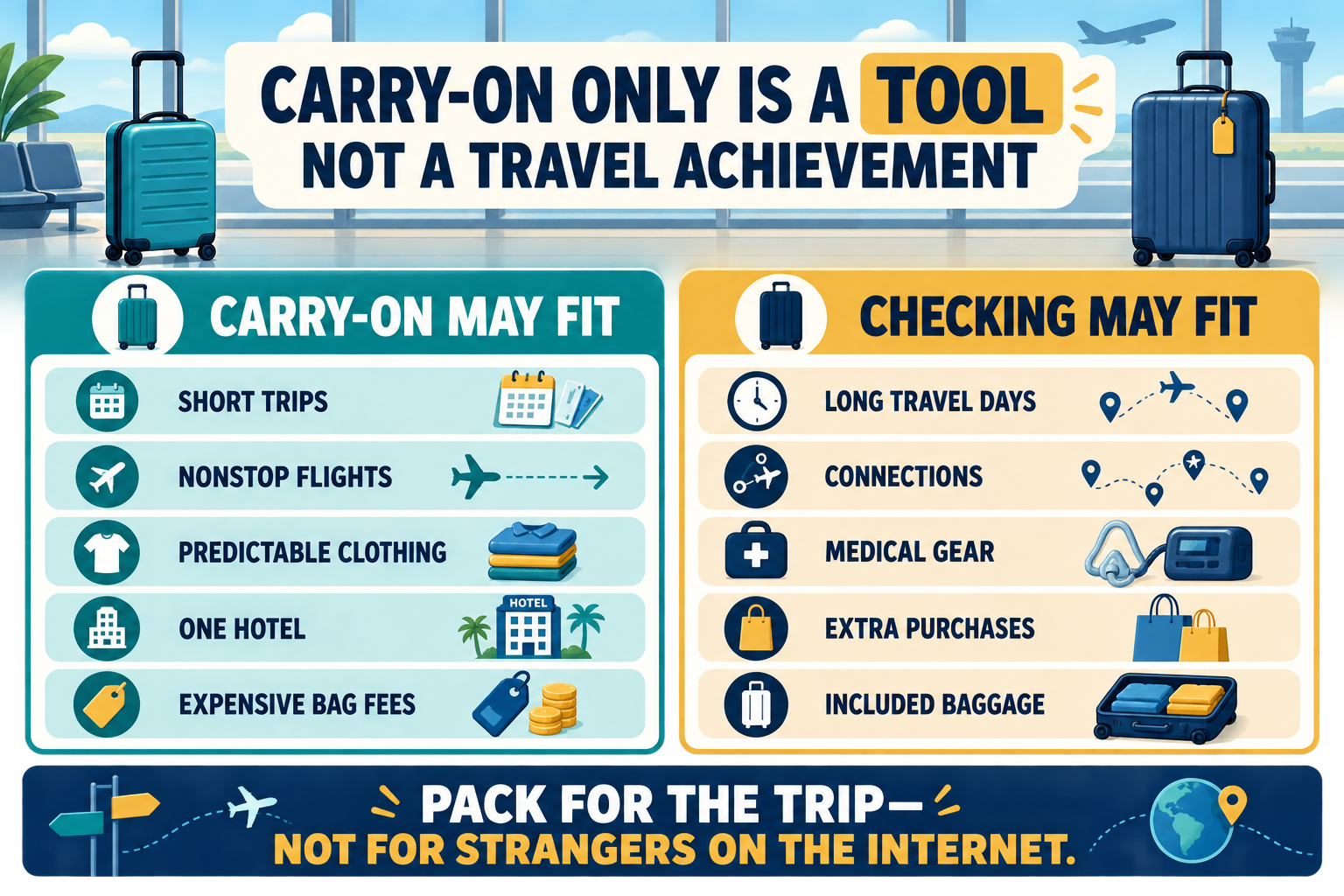
When Carry-On Only Works Well
Carry-on only can be a smart and practical choice.
For a short trip, I may not need enough clothing or supplies to justify checking a suitcase. If I am flying nonstop, staying in one hotel and returning home after a couple of nights, a carry-on can be more than enough.
It becomes even more attractive when the airline charges a significant checked-bag fee.
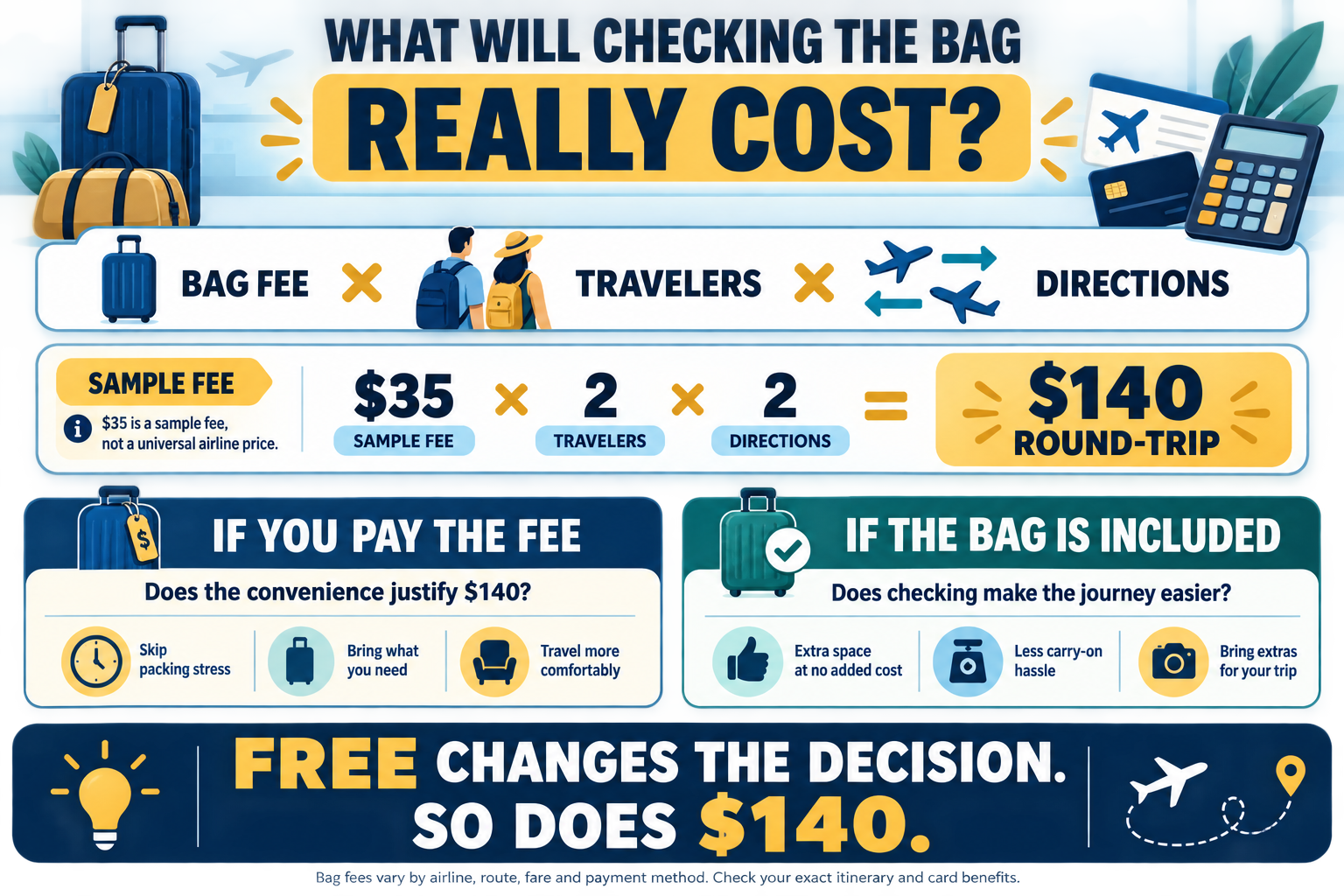
If checking one bag costs $35 each way, that is $70 added to a weekend getaway. Two travelers checking bags could spend $140 round-trip.
At that point, I start asking whether the convenience of checking those bags is worth $140.
Sometimes it is. Sometimes it isn’t.
For a short trip on United in regular economy, for example, I can manage with a carry-on rather than paying to check a bag. I would rather keep that money available for a meal, an activity or another part of the trip.
Carry-on only may fit when:
The trip is short.
The flight is nonstop.
You are staying in one place.
Your clothing needs are predictable.
You will not be bringing home liquids or bulky purchases.
Checked-bag fees are not included.
Avoiding baggage claim is particularly valuable.
Those are practical reasons—not bragging rights.
The Myth of the Effortless Carry-On
Carry-on travelers often point to the freedom of skipping the airline counter, walking directly through security and leaving the destination airport without waiting at baggage claim.
Those are legitimate benefits.
But that version of freedom only tells half the story.
Carry-on travel can also mean pulling a maximum-size roller bag through the parking lot, terminal and security line. It may mean searching for overhead-bin space and wondering whether a later boarding group will force you to gate-check the bag anyway.
Then there is the personal item beneath the seat in front of you, taking away foot space during a flight when you are already trying to get comfortable.
If you travel with medical equipment such as a CPAP machine, you may also be carrying an additional bag through every airport, connection and narrow jet bridge.
Medical equipment may receive special treatment under airline baggage policies, but that does not make it weightless. You still have to transport it.
Carry-on only may eliminate the wait at baggage claim, but it does not automatically eliminate effort.
It simply moves that effort to another part of the journey.
Count the Cost—but Count All of It
Baggage fees matter, particularly when you are trying to keep the overall cost of a trip under control.
The important thing is to calculate the complete cost:
Bag fee × travelers × directions
A $35 fee may not sound too bad when it appears on the booking screen. But for two people on a round-trip itinerary, that becomes $140.
That deserves consideration.
At the same time, do not automatically assume you will have to pay. Some airline credit cards include a checked bag for the cardholder and eligible companions, subject to the card’s current terms.
Our American Airlines credit card gives us that benefit on qualifying trips. That changes my decision because it provides the freedom to check a bag without adding another fee to the trip.
This is where an airline credit card can provide practical value without being part of an elaborate strategy to accumulate a million miles for a business-class flight to Asia.
The everyday benefits may matter more:
An included checked bag
Earlier boarding
Better access to overhead-bin space
Discounts on eligible inflight purchases
Other airline-specific travel benefits
Always check the current terms of your card and itinerary. Benefits may depend on how the ticket was purchased, who is traveling and whether the cardholder’s loyalty number is attached to the reservation.
The card’s annual fee also belongs in the calculation. A bag benefit only saves money if you receive enough value from the card to justify keeping it.
I Emphasize the Air-Travel Portion of My Budget
I am fortunate enough to have some flexibility in my travel budget, but that does not mean the budget is unlimited.
It means I make deliberate choices about where the money goes.
I tend to emphasize the air-travel portion of the overall budget because my comfort and ease of getting from Point A to Point B have real value to me. I may spend more on the flight or baggage and balance that decision somewhere else in the trip.
Someone else may prioritize the lowest possible airfare because the hotel, meals or experiences matter more to them.
Neither approach is wrong.
The traveler looking for a flight that “won’t break the bank” deserves more than an automatic instruction to buy the cheapest ticket and carry everything aboard.
That traveler needs to know what the lower price includes, what it excludes and which additional costs may appear later.
Sometimes saving $70 on baggage meaningfully improves the trip budget.
Sometimes spending $70 makes a long travel day substantially easier.
The right answer depends on which benefit matters more to you.
RELATED ARTICLE: Basic Economy vs. Standard Economy—When the Cheapest Fare Costs More
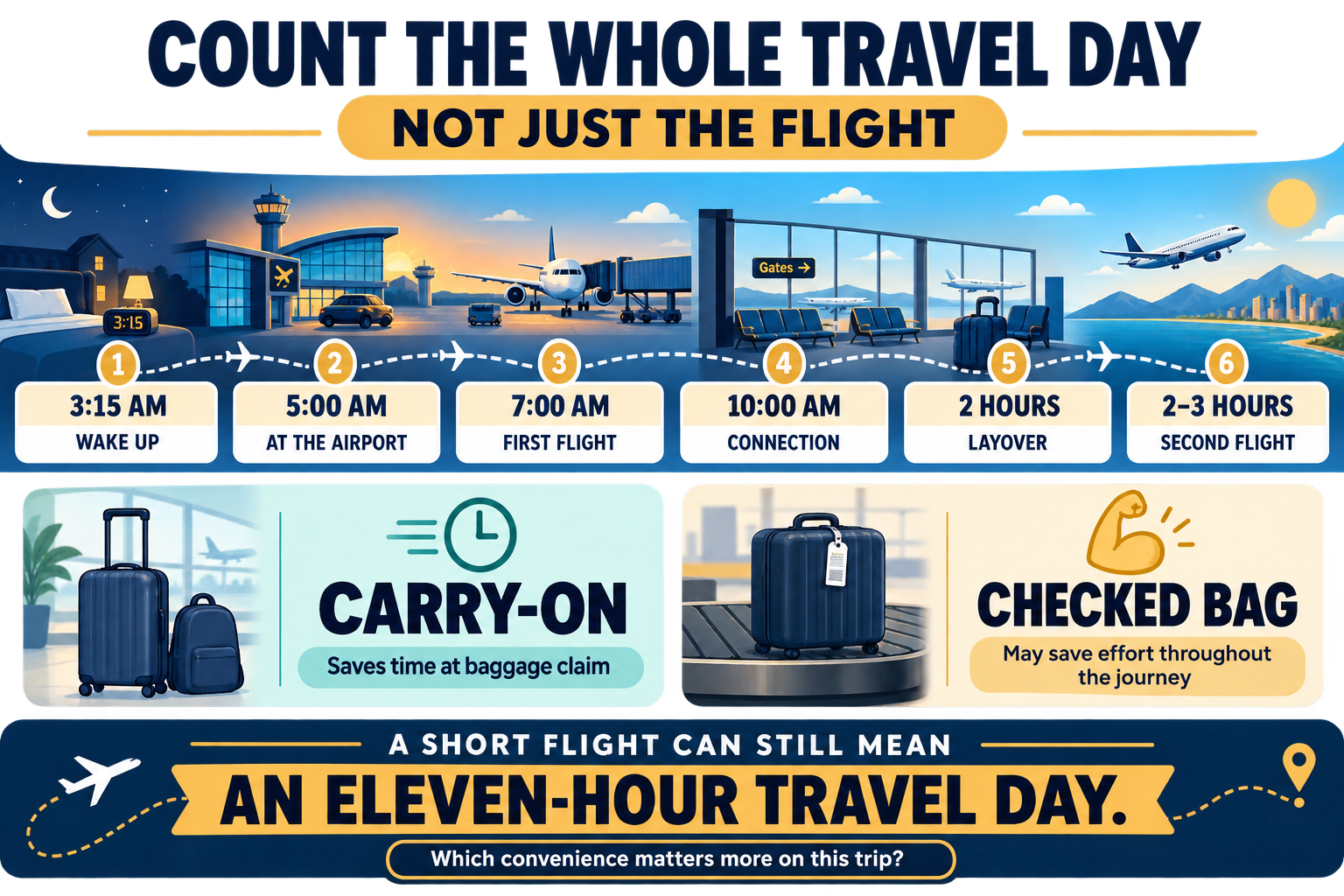
A Three-Hour Flight Can Still Be an Eleven-Hour Day
Flight duration is only one part of the travel day.
Suppose I have a 7:00 a.m. departure.
That means arriving at the airport around 5:00. It means getting up at 4:00—or, because I know myself, probably 3:15.
I take the first flight, arrive at my connecting airport around 10:00 and spend another two hours there. Then I board a second flight lasting another two or three hours.
Neither flight is particularly long, but the complete journey has consumed approximately eleven hours.
That changes how I value a checked bag.
During a long connection, I would rather walk through the terminal, get something to eat or relax in a lounge without hauling a suitcase everywhere I go.
If checking the bag allows me to have a more comfortable, less stressful layover, color me in.
Someone else may reach the opposite conclusion. A traveler with a tight connection may prefer keeping the bag close and avoiding the possibility that it misses the next flight.
Again, the decision depends on the trip.
Consider:
What time will you have to wake up?
How long will you be in the airport?
Do you have a connection?
How far will you have to walk between gates?
Will you have access to a lounge?
Are you also carrying medical equipment?
How much energy do you want to spend managing luggage?
How important is leaving the destination airport immediately?
A short flight does not always mean a short travel day.
Checking a Bag Can Make the Airport Easier
When I check our main luggage, the airport experience changes.
I hand over the heavier suitcase at check-in and continue with only the things that must remain with me.
I can move through the terminal more easily, sit down without surrounding myself with bags and enjoy a connection without constantly keeping track of a roller bag.
Once aboard, I am not fighting for overhead-bin space. I am not waiting for the passengers ahead of me to rearrange their luggage so mine will fit. I am also not trying to lift a heavy suitcase above my head in a crowded aisle.
My personal item can remain small enough that it does not eliminate all the space around my feet.
That convenience matters more to me on a long travel day than it does on a two-night nonstop trip.
Checking a Bag Creates Room for the Trip
Carry-on-only travel limits more than what you can bring with you. It may also limit what you can bring home.
A tightly packed carry-on does not leave much room for:
Local artwork
Pottery
Gifts
Clothing
Food products permitted through customs
Bottles that cannot pass through airport security
Unexpected purchases
On some international trips, we have packed a second, nearly empty bag inside our primary suitcase. We can then use it for purchases on the return journey.
That does not mean every trip should become a shopping expedition. It simply gives us room to bring home something meaningful without worrying about whether it will fit beside clothing that was already compressed to its limit.
Travel can affect what you want to bring home.
Leaving a little physical space for that is not poor planning.
Checked Bags Come With Risk
Checking luggage introduces another variable.
A bag can be delayed, misrouted or damaged. You may have to wait at baggage claim. A long line at the check-in counter can consume some of the time you thought you were saving.
On an itinerary involving several connections, your suitcase has more opportunities to take a different route than you do.
We experienced the downside firsthand when our luggage was delayed for seven days during a trip to Ireland.
That experience did not convince me never to check another bag.
It taught me to check luggage more intelligently.
The answer is not necessarily to carry the entire trip aboard. The answer is to keep the true essentials with you.
RELATED ARTICLE: What to Do When an Airline Loses or Delays Your Luggage
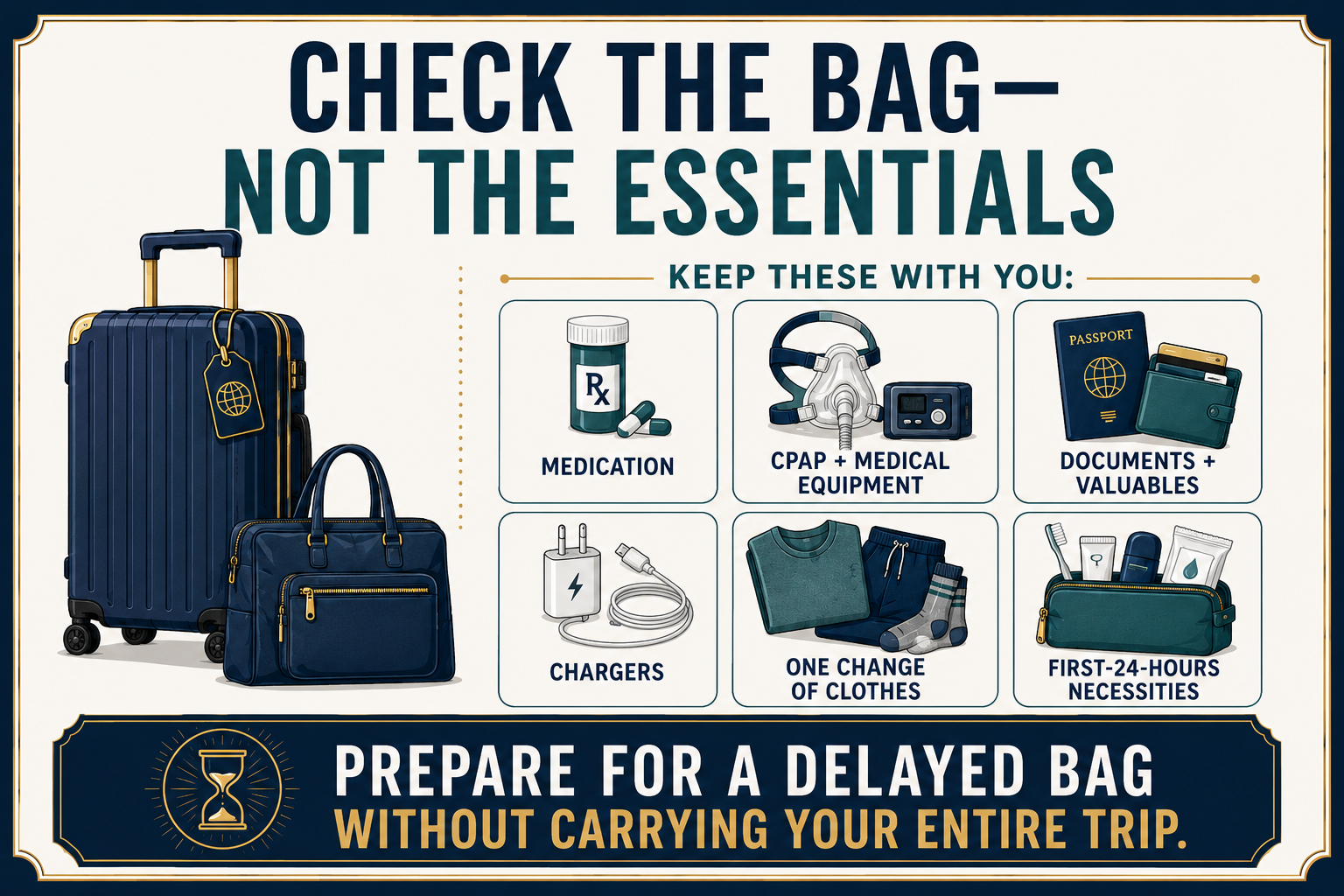
Check the Bag—not the Essentials
Even when I check our main luggage, certain things never leave my control.
Your carry-on or personal item should contain anything that would be difficult, dangerous or expensive to replace during the first day of the trip.
That includes:
Prescription medication
CPAP machines and other medical equipment
Passports and travel documents
Wallets, electronics and valuables
Chargers and essential cables
One change of clothes
Basic toiletries that comply with security rules
Anything else you will need during the first 24 hours
If the checked bag arrives late, you should still be able to take your medication, use necessary medical equipment, change clothes and begin the trip.
That is different from hauling every outfit and optional item through the airport because a suitcase might be delayed.
Prepare for the realistic inconvenience without making the entire journey more difficult.
RELATED ARTICLE: Traveling With Prescription Medication—What to Pack and Keep With You
My Carry-On vs. Checked-Bag Decision
I do not begin with a rule.
I begin with the trip.
Carry-On May Fit When:
The trip is only a few days.
The flight is nonstop.
I am staying in one place.
The baggage fee would be significant.
I do not expect to bring home bulky purchases or liquids.
I want to leave the destination airport immediately.
Managing the carry-on will not make the journey harder.
Checking May Fit When:
The travel day begins extremely early.
The itinerary includes a long connection.
I am already carrying medical equipment.
The checked bag is included with the ticket or credit card.
The trip requires more clothing or different types of clothing.
I expect to bring home purchases.
Moving through the airport unburdened has meaningful value.
The convenience is worth the cost.
For me, a two-night business trip to San Diego might be carry-on only.
A long international trip involving connections, medical equipment and room for purchases will probably involve checked luggage.
Different trip. Different priorities. Different answer.
The Curated Upgrades Verdict
Go Carry-On Only
Choose carry-on only when the trip is short, straightforward and easy to pack for—particularly when checking a bag would add a meaningful fee.
Calculate the Complete Cost
Calculate baggage charges for every traveler and both directions. Then check whether your fare, elite status or airline credit card changes the price.
Do not forget to count the physical cost of carrying the bag throughout the journey.
Check the Bag When It Makes the Journey Better
If handing over the suitcase will make a long travel day, connection or international trip noticeably easier, checking it can be a worthwhile upgrade.
Keep the essentials with you and let the airline carry the rest.
Final Thoughts
Travel should not be a test of how much discomfort you can tolerate to prove a point to strangers on the internet.
Carry-on only can be efficient, inexpensive and liberating.
Checking a bag can also be comfortable, practical and liberating.
The correct choice is the one that works for you on this particular trip.
Your priorities matter. Your physical comfort matters. Your schedule matters. Your budget matters.
And your answer is allowed to change.
Pack for the trip—not for the internet.